
Save Time: Get 5 Simple Writing Tips
you can put to use in 10 minutes
Always Be Writing: 20 Tips for Staying Busy Writing (Productively)
Award-winning writer Kathy Widenhouse has written 9 books and garnered 800K+ views for her writing tutorials.
Updated 8.26.26
“What are you working on right now?”
“I need some tips for staying busy writing.”
I hear this a lot from newbies, part-timers, and freelance writers who may not have a lot of assignments or deadlines.
I’ve been there. And early on I adopted this mantra:
ABW: Always Be Writing.
If you’re always writing, then you’re always producing content. The more content you produce, the more clips you have, whether you’re a newbie copywriter or a seasoned pro. And the more content you produce, the more people find out that you write and ask you to write for them.

Why staying busy writing builds your writing reach
One of the hardest things about being a writer isn’t always finding something to write about. Sometimes it’s getting yourself to sit down and write when you don’t have a deadline breathing down your neck.
That’s when it helps to remember a simple rule: Writers need to stay busy writing.
- It doesn’t mean you need to produce a 2,000-word article every day.
- It doesn’t mean every writing session needs to result in a finished piece.
- And it certainly doesn’t mean you should fill your day with meaningless busywork.
It means keeping yourself in motion.
A writer who spends a little time every day developing ideas, researching topics, polishing old work, writing pitches, or even jotting down a few paragraphs is continually building momentum. Those small efforts add up.
In fact, some of the most productive things you can do as a writer take only a few minutes.
Here are some quick tasks that can help.
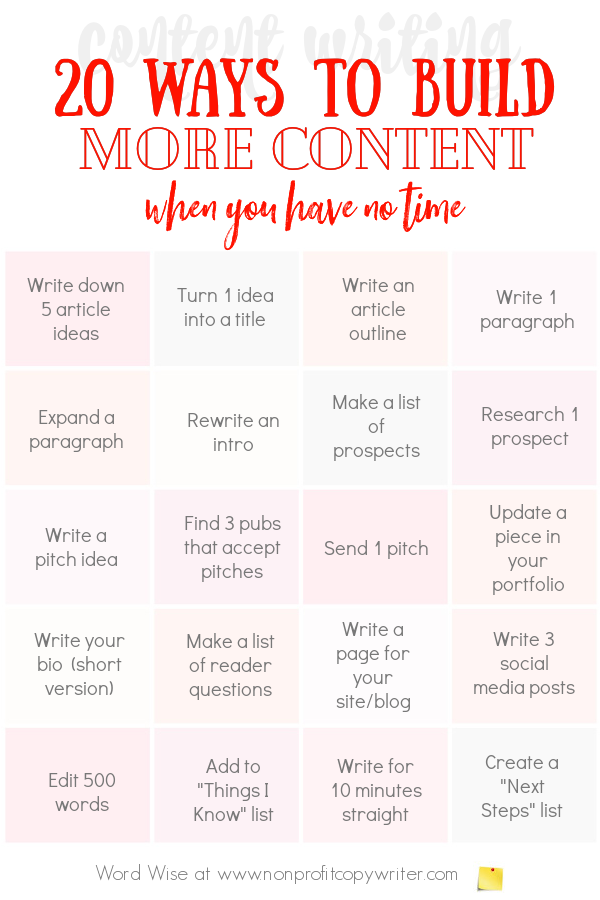
20 tips for staying busy writing (productively)
1. Write down 5 article ideas
Time required: 5–10 minutes
Open a notebook or document and write down five possible article topics. Don’t worry about whether they’re brilliant. Just get the ideas out of your head.
How it moves you forward: You’re building an idea bank that you can return to when you’re looking for assignments, blog topics, pitches, or content for your own website.
2. Turn one idea into a working title
Time required: 5 minutes
Take one idea and turn it into a specific headline. Instead of “gardening,” for example, try “What to Plant in Your Garden After Tomatoes.”
How it moves you forward: A vague idea becomes a potential article. A good working title also makes it easier to create an outline and begin writing.

3. Write an article outline
Time required: 10–15 minutes
Choose one topic and jot down the main points you want to cover. Don’t worry about writing complete sentences. A handful of subheads and bullet points is enough.
How it moves you forward: The hardest part of writing is often getting started. An outline gives you a roadmap, so the next time you sit down, you can start drafting instead of staring at a blank screen.
4. Write one paragraph
Time required: 5–10 minutes
If you don’t have the energy to write an entire article, write one paragraph.
That’s it. Write the introduction. Explain one point. Tell a short story. Answer one question.
How it moves you forward: One paragraph is more than zero paragraphs. If you repeat the process tomorrow, you may have the beginnings of a finished article before you realize it.
5. Expand an old paragraph
Time required: 10 minutes
Go back to something you’ve already written — even yesterday — and find a paragraph that could use more detail. Add an example, explanation, statistic, personal observation, or helpful tip.
How it moves you forward: You’re improving existing work while practicing the ability to develop ideas more thoroughly.
6. Rewrite an old introduction
Time required: 10–15 minutes
Find an older article and look at the introduction. Does it get to the point quickly? Does it give readers a reason to keep reading?
Try writing a stronger version.
How it moves you forward: You’re improving your editing skills and learning to recognize what makes an introduction effective.
7. Make a list of potential clients
Time required: 10 minutes
Research companies, publications, websites, organizations, or businesses that hire freelance writers. Don’t forget nonprofits and small businesses — they always need content, and many look for freelancers because they can’t afford staff writers. Seek out causes or groups that share your passion and offer to write their newsletter, identity content, website pages, social media posts, grant applications, and content.
Write down five names. You don’t have to contact them today. (Put that on your To-Do list for tomorrow. See #20).
How it moves you forward: You’re creating a prospecting list instead of waiting for clients to find you.
8. Research one potential client
Time required: 10–15 minutes
Choose one potential client and spend a few minutes learning what they publish, who their audience is, and what kinds of content they use. Look for gaps you might be able to fill.
How it moves you forward: Research turns a generic potential client into a potential pitch.
9. Write a pitch idea
Time required: 10 minutes
Come up with one article idea that would fit a particular publication or website. Write the proposed headline and a few sentences explaining why readers would care.
How it moves you forward: You’re creating an actual freelance opportunity rather than simply thinking about finding work.
10. Find 3 publications that accept pitches
Time required: 10 minutes
Make a short list of publications that accept freelance submissions. Keep the list somewhere you’ll be able to find it later.
How it moves you forward: Over time, you build a prospect database that makes pitching faster and easier.

11. Send one pitch
Time required: 15 minutes
If you’re a freelancer, you need clients. If you’re a fiction writer, you need a publisher, or you need podcasters to interview you. And if you’ve written down a few pitch ideas (#9) and have found publications (#10) and potential clients (#8) — well, you’re all teed up. Keep a record of who you send your pitch to, what you pitched, and when you sent it. Then, give yourself an assignment to follow up in a couple of weeks (#20).
How it moves you forward: You cannot get published if you don’t ask to be.
12. Update one piece of your portfolio
Time required: 10–15 minutes
Add a recent article, remove an outdated sample, or rewrite the description of one portfolio piece.
Or maybe you’re a new freelancer. Don’t panic! If you have very little in your clip files, create a brochure for an imaginary service or product, just as you would for a client … write an article … put together a blog post. If you want extra samples of appeal letters or white papers or case studies or any other kind of project, write them. You don’t need someone to ask you to do so. Your samples simply demonstrate that you can write.
How it moves you forward: A stronger portfolio makes it easier to demonstrate your abilities when you approach potential clients.
13. Write a short version of your professional bio
Time required: 10 minutes
Write or update a two- or three-sentence description of who you are and what you write about. Draw from the full bio you have on your website.
Alternative: Create a new resume or update your old one. If your resume is current, then write a bio blurb in three versions: long (for your website), medium (for introductions to paste into emails), and short (for your byline in guest posts).
How it moves you forward: You’ll have a ready-to-use bio for pitches, guest posts, professional profiles, and your website. Or a resume to send prospects.
14. Make a list of questions readers ask
Time required: 10 minutes
Choose a subject you know well and write down 10 questions people commonly ask about it. Don’t answer them yet. (Save that for your next writing session. See #20).
How it moves you forward: Each question could become an article, subheading, social media post, newsletter topic, or pitch.
15. Write a new page for your website or blog
Time required: 10–20 minutes
You have a website or blog, right? (If not, then creating your own website is one of the most important tips for staying busy writing.) The more pages or posts you create on your site, the larger your reach. That’s because each page’s keywords will be entered into the search engine swirl.
How it moves you forward: You’ll get practice writing content and optimizing it. Plus, you’ll have a piece that you can link to when you …
16. Write 3 social media posts
Time required: 10 minutes
Compose a series of posts for your social media sites. Link each one back to an appropriate page on your website or blog. Schedule them. Tip: Save these posts in a file and re-schedule the successful ones over and over.
How it moves you forward: You create visibility on your platforms and generate comments from readers. The links drive readers to your site. I’ve had dozens of readers subscribe to my newsletter because they saw one of my social media posts, clicked to my page, and downloaded one of my opt-ins.
17. Edit 500 words
Time required: 10–15 minutes
Pull up something you’ve written and edit just 500 words. Look for repetition, unnecessary words, awkward sentences, weak transitions, and places where you can be more specific.
How it moves you forward: Editing teaches you something that simply producing more words can’t: how to make your writing better.
18. Keep a “Things I Know” list
Time required: 5 minutes
Start a running list of subjects you know something about. Add experiences, hobbies, professional knowledge, personal interests, and subjects you’ve researched.
How it moves you forward: When you’re searching for article ideas or pitching opportunities, you have an instant reminder of the expertise and experience you can draw upon.
19. Write for 10 minutes without stopping
Time required: 10 minutes
- Set a timer and write continuously.
- Don’t edit. Don’t delete. Don’t worry about whether it’s good.
- Just keep your fingers moving.
How it moves you forward: You’re practicing the most important freelance-writing skill of all: getting words onto the page.
20. Create a “Next Steps” list
Time required: 5 minutes
Give yourself an assignment or a list of writing tasks for the next day like, “Outline a query and article for Furry Pets and Feathered Friends magazine.” Or write down the next three things you need to do. By having a self-prescribed To-Do list ready, I jump-start writing each day because I don’t have to think about what to write. Your list could be things like …
- Finish the introduction to “Ways to Clean the Gerbil Cage.”
- Find two supporting sources.
- Write the section about common mistakes owners make with gerbil cages.
How it moves you forward: Tomorrow’s writing session starts with a clear assignment instead of another blank page.
Why staying busy matters for writers
Writing is a skill, and skills get stronger with practice. The more often you write, the easier it becomes to find your words, organize your thoughts, and get past the dreaded blank page.
But there’s another benefit to staying busy: small tasks create forward progress. Big writing projects — or even simply building a writing habit — become manageable when you focus on the next small item you need to do.
Maybe you don’t have time to write an entire article right now. So you walk past the computer today. And tomorrow. And the next day.
And soon a week or two has passed by, and you haven’t written a thing.
Now, writer’s block feels like writer’s mountain.
Yet writing success can be built in a series of bursts, rather than piles of binges.
Anne Lamott’s New York Times bestseller Bird by Bird is built around this principle. “Thirty years ago my older brother was trying to get a report on birds written and was in tears,” she says. “Then my father sat down beside him, put his arm around my brother’s shoulder, and said, ‘Bird by bird, buddy. Just take it bird by bird.’”
Small tasks accumulate big results
The important thing to understand is that productivity doesn’t always look like writing 2,000 words.
- Sometimes productivity looks like writing 100 words.
- Sometimes it looks like finding a great article idea.
- Sometimes it’s sending one pitch or researching one potential client.
- Sometimes it’s opening an old article and making it 10 percent better.
Those small actions matter because your body of writing is built through accumulated effort. One idea becomes an outline. The outline becomes a draft. The draft becomes an article. The article becomes a portfolio sample. The portfolio sample helps you land a client. The client leads to another assignment.
The individual steps may seem small. But they’re connected.
Staying busy writing also helps prevent one of the biggest traps freelancers face: waiting for inspiration, a client, or the “perfect” project before getting to work.
Instead, you develop the habit of asking: What can I do right now that will make me a little further ahead by the end of the day?
So the next time you find yourself saying, “I don’t have enough time to write today,” don’t assume that means you have to do nothing.
Give yourself 10 minutes and …
- Write one paragraph.
- Develop one idea.
- Send one pitch.
- Edit one page.
- Research one client.
Always be writing. And you’ll soon find you’ve accumulated more content than you thought possible … especially for someone who “has no time.”
More Tips for The Writing Life
Maker Time vs. Manager Time For Freelance Writers ...
My Favorite Writing Productivity Hack: It’s Not about Writing At All ...
Beat Writer’s Block When You Eat the Frog First ...
Do Writers Get Imposter Syndrome? Here’s What You Can Do About It ...
Find Time to Write by Busting These 3 Myths ...
Manage These 3 Big Distractions When You’re Writing At Home ...
The Writing Life: You Can Make a Living With Your Words ...
Manage These 3 Big Distractions When You’re Writing At Home ...
How to Create a Content Calendar ...
5 Fun Gifts for Writers: Useful Gadgets for Capturing Ideas on the Go ...
21 Ways To Beat Writer’s Block and Jumpstart Your Project ...
Start Your Writing Day With a Quick Win and Get Momentum ...
5 Valuable Tips for Writing at Home ...
Kinds of freelance writing projects you can be paid to write ...
5 Non-Writing Skills Every Writer Needs ...
3 Tips in Getting Freelance Writing Assignments ...
How to Set and Achieve a Writing Goal ...
What kinds of writing projects do copywriters do?
How to find Christian freelance writing jobs ...
Prospecting: How To Write a Sales Letter That Sells Your Services ...
3 tips for starting your writing project ...
More tips about copywriting on our Pinterest board ...
Return from Tips for Staying Busy Writing to Nonprofit Copywriter home
As an Amazon Associate I earn from qualifying purchases.
Share This Page

Named to 2022 Writer's Digest list
BEST GENRE/NICHE WRITING WEBSITE



Stop Wasting Time!
Grab your exclusive FREE guide, "5 Simple Writing Tips You Can Put to Use in 10 Minutes or Less"
 Subscribe To This Site