Save Time: Get 5 Simple Writing Tips
you can put to use in 10 minutes
New Writers: Start Here – and Take Just One Step At A
Time
Award-winning writer Kathy Widenhouse has written 9 books and garnered 800K+ views for her writing tutorials.
Posted 9.21.26
Want to become a better writer — or break into freelance content writing?
I’ve been where you are. While looking for a second career after the military, I stumbled upon freelance writing when I received a letter from a writing school in my mailbox.
In that letter, I learned that myriads of underground writers make a living with their words.
Until then, I had no idea that the world of freelance content writing existed. I thought writers were sprinkled with fairy dust at birth and thus deemed fit to write impactful novels. Or they became pit bulls (AKA investigative journalists).
My reaction to this discovery?
- Delight — “This is something I can pursue!” And …
- Overwhelm — “I have no idea how to get started.” Accompanied by a touch of …
- Fear — “There’s no way I can make money at this.”
New writers: Yes, it's easy to get overwhelmed
If you’re new to writing, freelance writing, copywriting, or the whole business of getting paid to put words on a page, you may have discovered something a little unsettling.
There’s a lot to figure out. And it’s confusing. Where should you begin?
You’re not sure you even qualify to label yourself as a freelance writer. You may think you need more time to know how to write a good lead … how to write a headline … how to organize an article … how to go about learning SEO basics.
Or perhaps you’ve got writing fundamentals mastered, but you need to understand how to find clients … create writing samples … who to pitch and how … and figure out whether or not you need to have a niche right out of the gate.
What should you do first?
The answer is simple: Just do one task at a time.
You don’t have to do it all today or even learn part of it before Friday. Yes, breaking into freelance writing is a long game. But it’s simply a series of steps. Most people give up too soon. Don’t be like them. Just hammer away at the steps and don’t give up — and you can succeed.
And here's a simple road map.
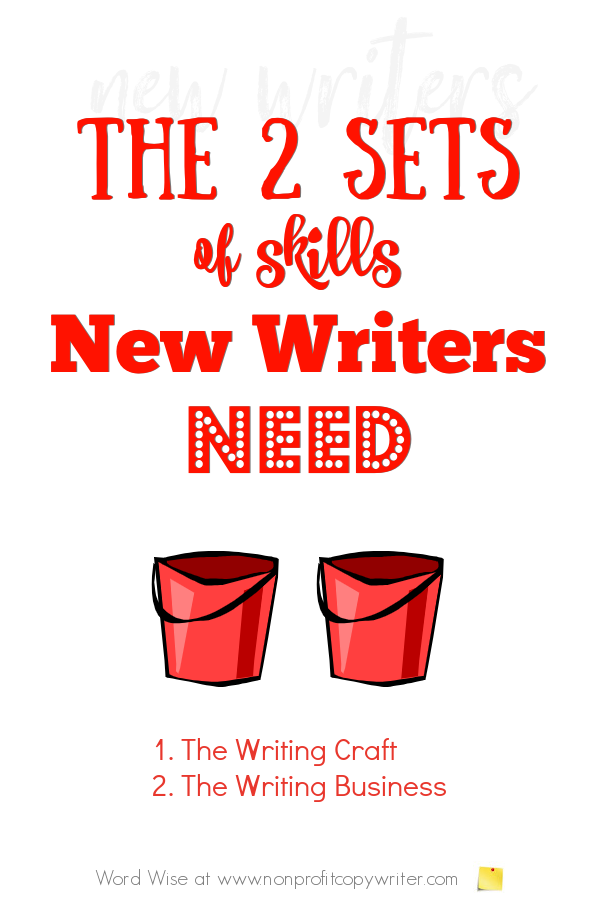
New writers need to acquire just two skill sets
It’s been years since my early days of confusion about freelance writing. Since then, I’ve watched plenty of veteran freelancers provide helpful guidance to newcomers.
And yes, as most of them say, there are 47+ steps you can take right now to get started.
Yet in reality, all those steps boil down to two buckets of skills.
- Bucket #1: The writing craft
You need to learn the basics for writing useful, clear, interesting, persuasive content. - Bucket #2: The writing business
You need to learn how to get paid for your words.
Both matter.
- You can be a terrific writer who can’t find a client.
- You can become excellent at marketing yourself but be a writer who doesn’t understand the difference between an email series and a blog post.
Be both. Be a provider who writes well and a writer who runs a thoughtful, helpful business.
New Writers Bucket #1: The writing craft
Naturally, to become a freelance writer, you need to acquire basic writing skills.
But I’m going to be radical here and tell you that if you can read and if you passed your high school language arts class, you’ve got the foundation you need. To become a freelance writer, you don’t need to spend hours conjugating verbs. You need to write. So please, take this as permission to dive right in.
Instead of starting with, “How do I become a writer?” start with, “What am I going to write?”
As in a writing project. Choose one. And then write it.
1. Choose a first writing project
I’d write an article or blog post.
Later you can try your hand at website content, copywriting, email marketing, grant writing, direct mail, appeal letters, case studies …
But when you’re just getting started, you need practice with narrowing down to one idea, making your point, and leaving your reader with a takeaway. Writing articles and blog posts — good ones — force you to complete those tasks.
By writing an article or a blog post, you’ll also acquire additional writing skills you need to master to become a decent freelance writer, like …
- Gathering research
- Organizing your ideas
- Writing headlines
- Creating a strong opening hook
- Using headings and subheads
- Varying your sentence length
- Transitioning from one idea to the next
- Using active voice
- Eliminating unnecessary words
- Writing to a target reader
- Revising and editing
Attack an article or blog post project, and you’ll get experience at all of that. Yes, your first draft will be ugly. Congratulations! That’s what revision is for.
Use this worksheet to write your blog post step-by-step.
2. Experience the writing process
When you tackle a first project — rather than a series of prompts or exercises — you’ll experience the writing process wholesale, rather than piecemeal.
Good writing usually doesn’t happen like this:
Sit down → magically produce perfect prose → publish.
It’s more like:
Research → think → organize → draft → rewrite → edit → proofread → publish.
Keep writing one project after another, and you’ll discover which parts of the process are most fun for you and which ones challenge you the most. You’ll get faster.
Added bonus: When you finish your first writing project, you’ll walk away with much more than a computer file full of writing exercises. You’ll have a completed article or blog post in hand. And you’ll be ready to tackle Project #2 while you find a home for Project #1.
My first “official” article was published 6 months after I wrote it. In the interim, I steadily built a stable of other articles and pitches.
3. Write another project … and another
So while you’re taking your first steps getting Project #1 into the hands of a publisher or posting it on your own site, start on Project #2. Yes, it can be another article or blog post — in fact, that’s probably a good idea, especially if you don’t have much writing experience. You can build upon what you learned with Project #1.
Then it’s on to Project #3 and Project #4. And so on.
Along the way — and as you gain confidence — experiment. Learn how different kinds of writing work.
- A blog post isn’t a fundraising appeal.
- A website home page isn’t a newsletter.
- A grant proposal isn’t a sales page.
- A social media post isn’t an annual report.
While the fundamentals of different writing projects remain the same, the purpose, audience, structure, and techniques change. One of the smartest things you can do as a new writer is to learn about different types of writing, like …
- Copywriting
- Website writing
- Email writing
- Newsletter writing
- Social media writing
- Fundraising writing
- Grant writing
- Case studies
- Reports
- SEO content
Try different things … one at a time. Take a writing course that’s specific to a particular type of content. You don’t have to master everything. Notice what you enjoy. Notice what you’re good at.
And notice what organizations actually need. You’re looking for the types of writing that interest you — and that people will pay you to produce. That’s the intersection where a writing career can grow.
Don’t do it all at once. Just one writing project at a time.
Speaking of noticing what organizations and businesses need …
The New Writers Bucket #2: The writing business
You will spend years learning the craft of writing … in fact, the rest of your writing life. Don’t “wait” until you’re “there” to start finding buyers for your words.
If you’re going to freelance, ask: “How will anyone find me?”
That’s marketing. It’s a scary word if you don’t have a business background — at least it was for me.
But here’s some great news. You don’t have to become a slick salesperson to get paid to write. There’s a better way to think about marketing your skills, and it’s this:
Don’t sell your writing. Help people.
When you think about marketing as helping people solve problems, it becomes a whole lot less creepy.
- A nonprofit needs a fundraising appeal.
- A small business needs website content.
- A publisher needs an article.
- A consultant needs a newsletter.
- A business owner needs someone to explain a complicated subject.
Most of these leaders don’t have time to produce all that content, even if they’re good writers. They need someone to make their life easier. Think about it … most business owners have the ability to empty the trash, dust their office, and vacuum the floor. But they hire a cleaning service because they don’t have time for all that tidying. And a good cleaning service will do a much better job than the business owner.
You have a basic skill. Business owners and nonprofit leaders need someone to provide that skill. Your job is to make that connection.
Here are tasks you can undertake, one at a time, to do so.
1. Develop your core message
One of the hardest questions new writers need to answer is, “So … what do you write?”
If your answer is a rambling explanation of everything you’ve ever written, you need a core message. A useful core message tells people: Who you help + what you do + why it matters.
For example: I write website content and fundraising communications for small nonprofits so they can connect with supporters and raise more money.
With that, you give people something to remember. Plus, your core message becomes the foundation for your website, bio, portfolio, social profiles, pitches, and conversations.
If you’re starting out, you may not have a core message. Use a basic one: I write content for small business owners to save them time and get their message out.
Write your core message quickly using this easy worksheet.
2. Build your online home
Yes, you need a website. No, it doesn’t have to win a design award. Rather, it needs to answer a few questions quickly:
- Who are you?
- What do you write?
- Who do you write for?
- How can someone hire you?
Your website becomes your online hub — your own piece of real estate on the internet where you can post your portfolio, content, and lead magnet.
You’ll be adding to your website for the rest of your freelance life. It’s a long-term project. But right now, it doesn’t need to be perfect. Use it to get going. Then over time, add useful content that answers questions and demonstrates your expertise.
Fun fact: If you’ve got a core message — even a simple one — you’re all set to write your website’s homepage!
3. Find people who need writers
Marketing isn’t just “post on social media and hope.” You need to identify potential readers, clients, customers, or publishers. Start building a list of people and organizations you’d genuinely like to work with, such as …
- Companies or nonprofits
- Editors online and offline
- Professional groups
Then learn about them.
- What do they do?
- Who is their audience?
- What kinds of content do they publish?
- What problems might they have?
- Where could your writing help?
Build a list of prospects. That’s much more productive than randomly shouting, “Hire me! I’m a writer!”
4. Write pitches
You’ve got some samples of your writing. And you’ve got a list of businesses or publications that you’d like to write for. Now, reach out with a pitch.
A pitch is simply an invitation to consider working with you. It could be an email to a prospective client … a query to an editor … a proposal … a response to a job posting … a follow-up to someone you met … a suggestion for a new project for a current client.
A good pitch isn’t about bragging. It’s about making a connection between your prospect’s need and your ability to help.
2 pitching tips
- One “no” doesn’t mean you’re a bad writer. It means that particular opportunity wasn’t a yes. Keep following up by being helpful. Remember — don’t sell your writing. Be useful.
- Getting gigs is a numbers game. The more you pitch, the more chances you have to land a gig. The average pitch response used to be 2–4%, but now with email it’s down to less than 1%. In other words, if you pitch to 100 prospective clients, expect 1 inquiry.
Extra tip: Start by offering your writing services for free to a fledgling business or a small nonprofit. You’ll get experience and a wonderful set of clips. They’ll get the content they need — and you can use them as a referral. You can leverage your samples when you pitch to other prospects in that niche.

Use these email templates to start pitching for gigs.
5. Build relationships (not a client list)
Here’s an important marketing principle: People hire people they know, like, and trust.
That’s why relationships matter.
You don’t have to become a networking machine. Instead, build relationships by being useful. Answer questions about the prospect’s niche. Provide helpful information. Send a prospect a useful tip sheet or checklist after a conversation. Stay in touch — send a weekly newsletter with helpful information geared to your prospects.
This “be useful” step is the one that most would-be freelancers miss. In our eagerness to get hired, it’s easy to forget that the business owner is busy and has needs. If you focus on helping that prospect — truly caring that their business succeeds — they find they can trust you.
Over time, those relationships lead to opportunities. A prospect may not need content right now. But 3 months from now, when they need a blog post series, they’ll remember the time and support you gave them.

Make a successful marketing plan on just 1 easy-to-follow page.
New writers should avoid this one big mistake
You may be looking at this page thinking, “Good grief. I have to do ALL THAT?”
No, you don’t. Not at once. Think in stages.
If you’re brand new to writing, start with …If you’re already a decent writer, spend time on …If you’ve got a client or two, focus on …
- Creating Project #1
- Creating Projects #2, #3, and beyond to build a sample writing portfolio
- Trying a different type of writing
- Writing for free to build credibility
- Pitching your first paying prospect
- Building samples in your niche
- Creating a core message
- Identifying prospects
- Sending pitches
- Getting repeat business
- Asking for referrals
- Specializing
You don’t need to climb the entire mountain today. You just need to know which trail you’re on and then take the next step.
One more thing new writers need to know
Here’s something I wish someone had told me when I started: Begin before you feel ready.
- You can learn while you work.
- You can improve a writing sample.
- You can change your niche.
- You can rewrite your website.
- You can find more prospects.
- You can get better at pitching.
- You can make mistakes.
- And then you can try again.
That’s how freelance writing works.
You don’t become a freelance writer because you suddenly know everything a freelance writer needs to know. You become one by doing the work and learning the next thing you need to learn. And then doing it. Day after day.
Don’t worry about mastering the entire process.
- Pick one bucket … one skill. Start there.
- Then come back for the next step.
- And the next.
And repeat. Soon, you’ll get one gig. And another. And before you know it, you’ll be helping other new writers learn about the writing life, too.
More Tips for New Writers
5 Steps in the Writing Process: Jumpstart Your Writing Quickly ...
Content Writing Basics: What Is Content Writing?
Basic Copywriting: What Is It and Why Do You Need It?
How To Create a 1-Page Marketing Plan for Writers ...
Branding Basics for Writers (Especially Non-Marketers) ...
The Writing Life: You Can Make A Living With Your Words ...
Return from New Writers: Start Here to Nonprofit Copywriter home
As an Amazon Associate I earn from qualifying purchases.
Share This Page

Named to 2022 Writer's Digest list
BEST GENRE/NICHE WRITING WEBSITE

Stop Wasting Time!
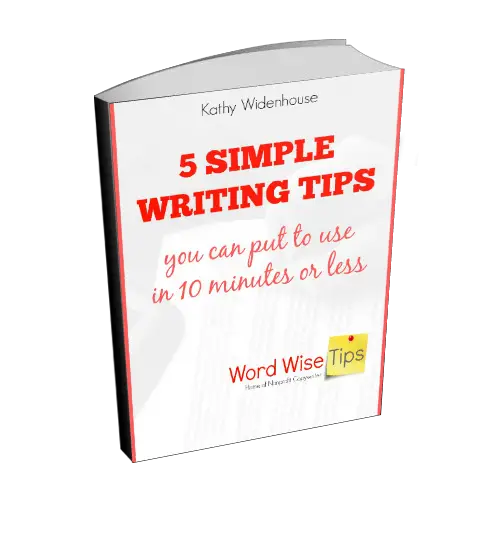
Grab your exclusive FREE guide, "5 Simple Writing Tips You Can Put to Use in 10 Minutes or Less"
 Subscribe To This Site