Save Time: Get 5 Simple Writing Tips
you can put to use in 10 minutes
Wanted: Nonprofit Writer
Award-winning writer Kathy Widenhouse has written 9 books and garnered 800K+ views for her writing tutorials.
Posted 5.12.26
- “A nonprofit writer? I didn’t know there was such a thing.”
- “Is there really writing work available with nonprofits?”
- “Writing for nonprofits sounds fulfilling, but can you make any money?”
I had the same questions when I started my writing journey. Most of my fellow writing students sought high-paying writing jobs with large corporations. I hesitated to go in that direction.
To be honest, I was intimidated. I had no marketing or business background.
But as I sought to get writing work, I discovered I possessed another — though different — commodity.
I had a desire to help those who help others.
That’s when I learned about the immense opportunity with the 1.5 and 1.8 million nonprofit organizations registered in the U.S. alone. Public charities, private foundations, chambers of commerce, fraternal organizations, and civic leagues — they all needed something I could offer.
They need writers. Like you.
What is a nonprofit writer?
A nonprofit writer is a writer who creates content for nonprofit organizations to help them raise money, share their mission, attract supporters, and empower people to care about a cause.
Instead of helping a business sell products, a nonprofit writer helps “sell” a cause. You connect organizations with donors, volunteers, grant funders, and the community — through clear, meaningful communication.
Nonprofit writing is a blend of psychology, copywriting, content writing, and passion. As a nonprofit writer, you turn facts and programs into stories. Your content becomes the vehicle that inspires people to take action, donate, volunteer, or get involved.
Why do nonprofits need writers?
Every operation needs content. Nonprofits need websites, social media, email marketing messages, newsletters, and appeal letters just as much as for-profit businesses do.
Maybe more. Because a nonprofit’s product is not physical merchandise or useful services they sell to consumers.
It’s a cause. A bit tricky, that.
Nonprofit leaders are focused on delivering services and a million other crises vying for their attention. A majority don’t have time to write campaigns or update a website or create blog posts or manage a social media strategy — or even write grant proposals.
A writer fills the gap by creating fundraising appeals, grant proposals, emails, and stories that keep support coming in.
Why do nonprofits hire freelance writers?
- Because they don’t have the budget to hire a full-time content creator … but they can afford a contract worker.
- Because you reach out to them and offer your services. They never considered how hiring a freelance nonprofit writer could save them time and be cost-effective. Or they had no idea how to find one.
- Because you catch them at a time when they have a big writing project, and they don’t have time to do it themselves.
- Because you offer them a freebie that helps them solve a problem. Through that valuable piece of content, they come to see that you understand their challenges.
- Because you offer help. And they embrace those who want to support their cause.
What makes nonprofit writing different?
Nonprofit writing overlaps with business writing, copywriting, and content writing, but its purpose is unique.
- Business writing focuses on company goals such as increasing sales, improving operations, building brand awareness, or communicating with customers and employees. It is practical, professional, and results-driven. Nonprofit writing, on the other hand, is mission-driven. The goal is to raise donations, recruit volunteers, attract grant funding, advocate for change, or show community impact, all in support of the nonprofit’s cause.
- Copywriting and nonprofit writing overlap because both aim to persuade people to take action. In my nonprofit work, I repeatedly draw upon my copywriting skills to persuade readers to give … to click … to share. However, traditional copywriting focuses on convincing someone to buy a product or service. Nonprofit writing motivates people to care enough to act — to support a cause, donate, volunteer, or attend an event.
- Content writing educates, informs, entertains, or improves search engine visibility. Think blog posts, articles, guides, and website content that promote a business’s product or service. Nonprofit writers, too, create these types of content — always with an eye to expand the organization’s reach. For example, a nonprofit blog post about an uptick in homelessness among District of Columbia youth is not just informational — it may also help readers understand why there’s a capital campaign for a new transitional home.
Another major difference between nonprofit writing and other writing is the audience mindset.
- Business audiences often ask, “What’s in it for me?”
- Nonprofit audiences ask, “How can I help?” or “Can I trust this organization to make a difference?”
Because of this, nonprofit writing sits at the intersection of storytelling, persuasion, and transparency.
What does a nonprofit writer actually do?
A nonprofit writer creates content that helps a nonprofit organization communicate its mission, raise money, attract supporters, and keep people informed.
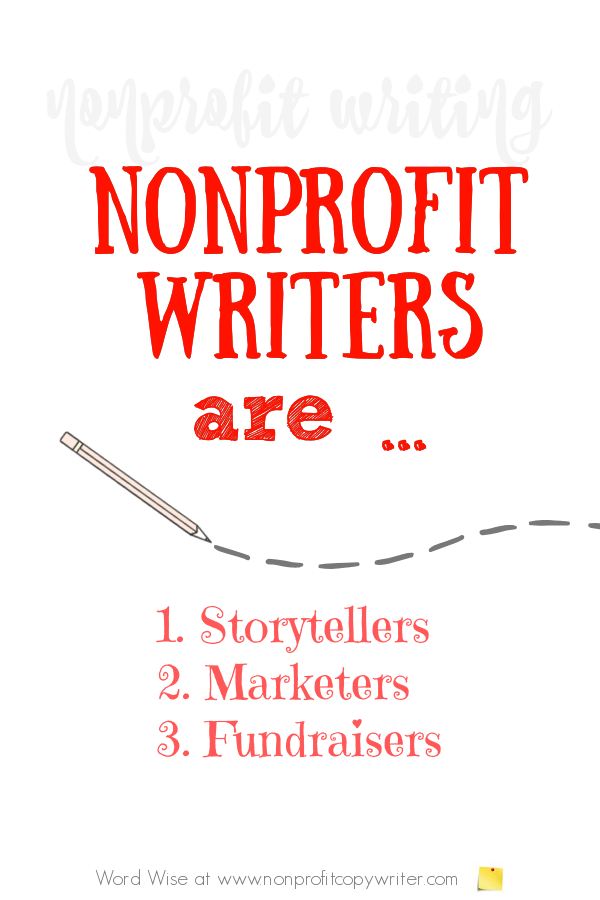
Their job is part storytelling, part marketing, and part fundraising.
- Nonprofit writers tell stories. One of the biggest nonprofit writing skills is turning real-life impact into stories people care about. For example, instead of simply saying a food bank served 5,000 meals, a nonprofit writer might tell the story of a family who avoided going hungry because of community support. The goal is to help readers emotionally connect with the mission.
- Nonprofit writers are marketers. You use your words to show your nonprofit’s value. You combine facts and emotion.
- Nonprofit writers are fundraisers. Nonprofit writers explain what gifts are needed, where donations go, and what results ensue. They’re big on building trust through being transparent. You show why your cause is not just a worthy investment, but a cost-effective one.
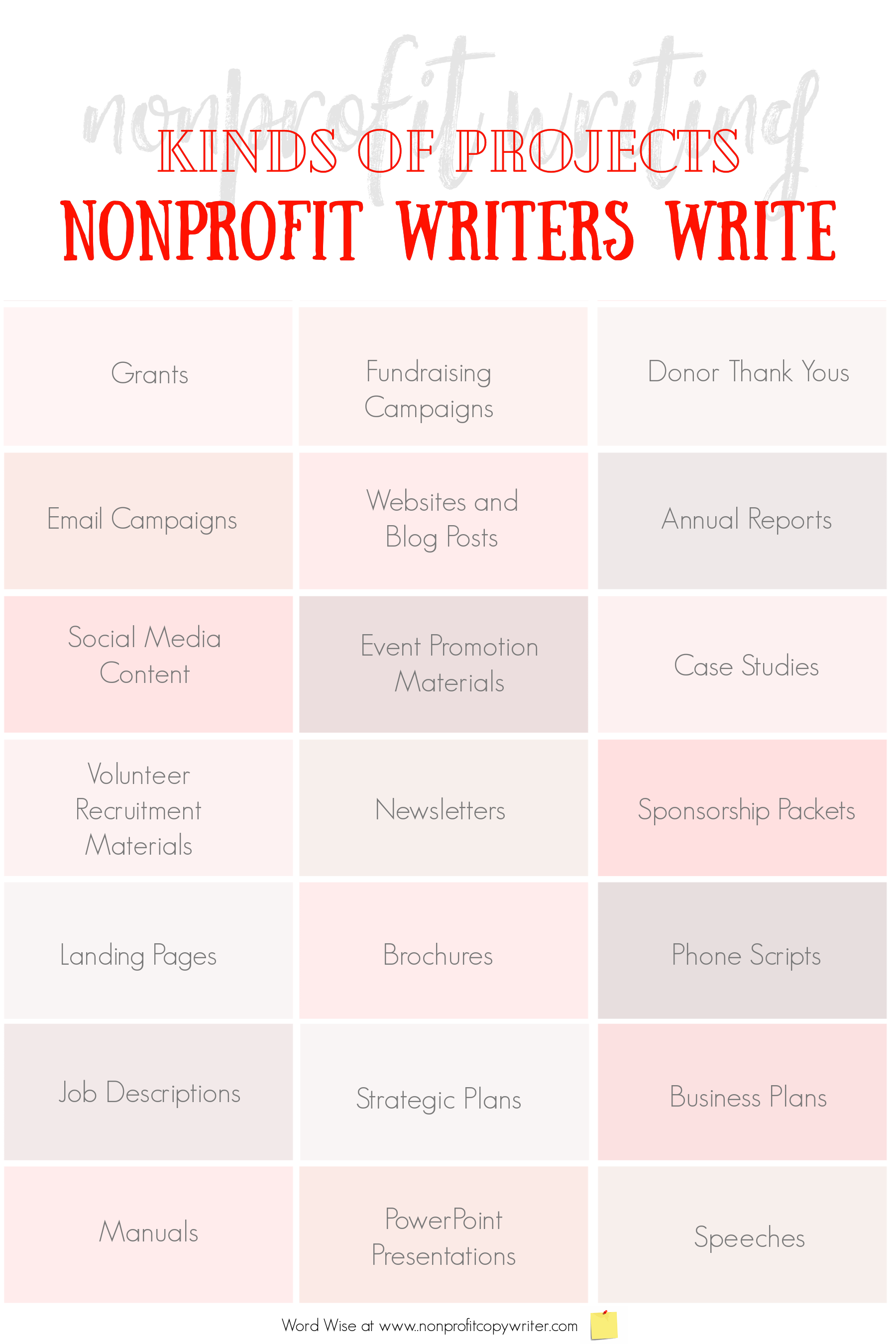
What a nonprofit writer writes
Nonprofit writers work on a wide variety of projects, but most of your writing will focus on fundraising, storytelling, donor communication, and community outreach.
One day, you find yourself writing a donor appeal letter asking for support.
The next day, you are creating website content, a grant proposal, or a social media campaign for an upcoming fundraiser.
Over the decades, I’ve written these kinds of projects for nonprofit clients:
- Grant proposals and grant applications
- Fundraising letters and donation appeals
- Donor thank-you letters and stewardship emails
- Email campaigns
- Website copy and blog posts
- Annual reports and impact reports
- Social media content
- Event promotion materials
- Case studies and beneficiary stories
- Volunteer recruitment materials
- Newsletters
- Sponsorship packets
- Campaign landing pages
- Brochures and informational handouts
- Phone scripts
- Job descriptions
- Strategic plans
- Business plans
- Procedure manuals
- PowerPoint presentations
- Speeches
If you work for a large organization, you may specialize in one of the most-needed types of nonprofit writing:
- Grant writing
- Fundraising copywriting — print appeals, direct mail, and email campaigns
- Content writing and blogging, to build awareness about the cause and show successes
- Technical or report writing, including annual reports
Many nonprofit writers freelance, while others work in-house for charities, foundations, schools, hospitals, religious organizations, or advocacy groups.
What writing skills does a nonprofit writer need?
Nonprofits have important stories to tell, but those stories don’t move people on their own unless they’re communicated clearly and compellingly.
A good nonprofit writer helps turn programs, data, and everyday work into messages that connect with real people — donors, volunteers, grant funders, and the public. They explain impact in a way that builds trust and encourages action using these key skills.
1. Storytelling
- Why it matters: Nonprofit work revolves around people and causes. When readers want to hear compelling stories about people, they’re inspired. Then they’re ready to act.
- Key tip: Practice writing narratives with a clear beginning (the problem), middle (what happened because of the nonprofit), and end (the outcome), showcasing the transformation.
2. Persuasive writing
- Why it matters: Persuasive, actionable writing encourages readers to donate, volunteer, and advocate.
- Key tip: Use techniques like the AIDA formula (Attention, Interest, Desire, Action) to craft messages that inspire response.
3. Audience awareness
- Why it matters: Nonprofits serve diverse groups: Donors, grantors, beneficiaries, and policymakers. Each requires a tailored communication style. You’ll be successful when you identify a specific audience for each project you write.
- Key tip: Research your audience’s motivations and preferences to create content that resonates with that target reader.
4. Research and fact-checking
- Why it matters: Nonprofits that present accurate data maintain credibility and build trust.
- Key tip: Use reputable sources for statistics, quotes, and facts. Verify every claim before publishing. Maintain financial transparency.
5. Fundraising know-how
- Why it matters: Nonprofit writers help generate income through grant proposals, direct mail, and online campaigns.
- Key tip: Learn the basics of nonprofit fundraising strategies, such as donor psychology and crafting calls to action.
6. SEO and digital marketing skills
- Why it matters: Nonprofits, like for-profit businesses, rely on online platforms to attract new supporters. A writer who understands SEO can help the organization reach a broader audience.
- Key tip: Optimize content with targeted keywords, meta descriptions, and engaging headings to boost visibility in search engines.
7. Editing and proofreading
- Why it matters: Clear, error-free communication reflects professionalism and respect for the audience’s time.
- Key tip: Develop a systematic editing process. Write, edit, and rewrite. Use tools like Grammarly to refine your work.
What non-writing skills does a nonprofit writer need?
1. Collaboration
- Why it matters: You’ve got to play well in the sandbox with others. Nonprofit writers often work with diverse teams, including program directors, graphic designers, and external partners. Throw together lots of different and enthusiastic personalities, and you've got a recipe for Need-To-Get-Along.
- Key tip: Act as Mom taught you. Be polite and respectful.
2. Adaptability
- Why it matters: Nonprofits operate on tight budgets — every dollar matters. Help them find innovative (and cheap) ways to convey their message.
- Key tip: Experiment with different content formats, such as blog posts, social media updates, and infographics. Learn basic graphic skills so you can provide add-on services and save a nonprofit money (while boosting your own paychecks).
3. Passion
- Why it matters: Genuine passion for the nonprofit’s cause fuels authentic, persuasive writing.
- Key tip: Identify organizations that align with your values. Spend time learning about the organization’s work, attending events, or speaking to beneficiaries to deepen your empathy and understanding.
4. Organization
- Why it matters: Nonprofit leaders wear many hats. A valuable nonprofit writer is not just crafty with words but can also manage the nonprofit's content calendar and send timely reminders to keep those responsibilities off the director’s plate.
- Key tip: Manage back-off dates to give yourself (and the nonprofit) plenty of time for edits and mailings … and so you don’t miss funding opportunities like grant deadlines.
How do I become a nonprofit writer?
- Learn to write well. Acquire good writing skills, just as you would for any other writing career. Take a class to learn to write a good article. Understand basic copywriting and persuasive writing. Know how to write strong headlines and a clear call to action. Cultivate your storytelling skills.
- Acquire clips. Get experience and build a portfolio, even if you start small. Many nonprofit writers begin by volunteering for a local charity or community organization to create samples and learn how nonprofits operate. (My first pieces of content were for my church.) Better yet — get samples in the niche you want to target.
- Learn fundraising basics. Nope, you don’t need an MBA … you simply need to think like a potential donor. How would you respond to an appeal … a newsletter … an Ask?
- Develop skills in different formats. Learn to write specific types of pieces that nonprofits need, including fundraising appeals, grant proposals, newsletters, donor emails, website content, annual reports, and social media posts. Small and mid-size organizations that find a versatile writer will reward you with plenty of work.
- Identify your passion. Choose causes that align with your own values. Then target nonprofits in that niche and offer your services. I was able to make headway into the faith-based market not only because there was a need for writers in those small to mid-size organizations, but also because I am passionate about faith causes and I can “talk the talk.”

Use this FREE letter template to offer your writing services to prospective clients.
Where do you find nonprofit writing jobs?
You can scour the usual places: Job boards like Idealist, The Chronicle of Philanthropy, Work For Good, AFP Career Center, and NTEN Job Board. Follow LinkedIn. Freelance platforms. Agencies and consulting firms.
Search for terms like grant writer, development writer, fundraising copywriter, communications coordinator, donor communications writer, nonprofit content writer, annual report writer, major gifts writer, stewardship writer — even marketing and communications specialist.
But I have had the most success finding freelance nonprofit writing jobs by approaching organizations directly.
You can, too. Create a prospecting letter and reach out to nonprofits in your niche. Offer a useful freebie. Start a dialogue. Once you get a few clients and deliver quality writing, they will refer you to others. And some will become anchor clients, delivering you assignments each month.
How much do nonprofit writers get paid?
Nonprofit writers can earn anywhere from about $45,000 to $100,000+ a year. Yes, it’s a wide range. But your income depends on your specialty, experience, and whether you work freelance or in-house.
- Grant writers and fundraising writers usually earn the most because their work directly helps nonprofits raise money.
- Freelance nonprofit writers often charge hourly or per project. (I do). Experienced grant writers commonly charge $60–$100+ per hour, especially if they also help with fundraising strategy.
- Remote and senior nonprofit communication roles can also pay quite well, particularly for writers who specialize in donor communications, major gifts, or high-level fundraising campaigns.
- Some experienced nonprofit grant writers report salaries above $100K in larger organizations or high-cost niches.
Is nonprofit writing a good career?
- Do you want your writing to make a difference?
- Do you want to advance a particular cause?
- Do you want to provide support for those making the world a better place?
- Are you willing to work hard and get paid well?
Answer yes to those questions, and nonprofit writing can be a very rewarding niche for you.
More Nonprofit Writing Tips
Getting Started with Freelance Writing for Nonprofits …
How to Find Beginner Freelance Writing Jobs with Nonprofits ...
Nonprofits Need You to Write These 5 Types of Content ...
Grant Writing for Beginners: Getting Started ...
Where to Find Freelance Writing Jobs With Nonprofits ...
More writing tips for nonprofits on our Pinterest board ...
Return from Wanted: Nonprofit Writer to Nonprofit Copywriter home
As an Amazon Associate I earn from qualifying purchases.
Share This Page

Named to 2022 Writer's Digest list
BEST GENRE/NICHE WRITING WEBSITE
Stop Wasting Time!
Grab your exclusive FREE guide, "5 Simple Writing Tips You Can Put to Use in 10 Minutes or Less"
 Subscribe To This Site