
Save Time: Get 5 Simple Writing Tips
you can put to use in 10 minutes
What Is SEO Content Writing? A Quick
Tutorial
Updated 9.3.26
“What is SEO content writing?”
It’s a question I hear a lot – and not just from writing newcomers.
SEO content writing can feel like a mysterious mix of marketing, tech, and writing skills. Your fears may be especially acute if you’re not technically-minded. Search engines are driven by a mass of algorithms that continually shift, right? It’s easy to be intimidated by those incessant changes. The complexities make even the most avid tech geek’s mind swim.
But there’s good news behind all those bytes, and it’s this: You can create online content that appeals to search engines without understanding all the technical gobbledygook.
You simply need to understand and apply a few key writing principles.
Then, once you strip away the jargon and understand how online traffic works today – well, SEO content writing is actually pretty simple and fun to write.
Because you get to help readers.
What
is SEO content writing?
SEO content writing is online writing that gets found – easily.
It’s written to ‘…
- Show up in search results.
- Answer what people are searching for.
- Bring traffic to your website (or a client’s website).
- Keep readers engaged once they land there.
Let’s break it down a bit more.
What is the “SEO” in "SEO content writing"?
SEO is the acronym for “search engine optimization.”
- A search engine is a computer program that looks for words or terms across the web. When a reader types a term or question into the search engine’s bar, the engine returns the results in a list. Bing, Dogpile, DuckDuckGo, Google, and Yahoo! are examples of popular search engines.
- Optimization is the process you use to enhance your web content so it appears as high as possible on search engine results pages. Optimization involves your writing and other factors (see the next section). When your page appears higher on the results – ideally on the first page or two – then more users see your link, click on your page, and land on your site. You get more traffic.
To sum it up …
Search Engine + Optimization (SEO) is the practice of making your content easier for both search engines and people to find and trust.
Good
SEO is not just about writing
Like I said, SEO involves more than writing. Success with search engines depends on several non-writing factors that happen behind the scenes. Your content takes center stage, but it’s supported by …
- Solid infrastructure. Page speed (slow sites lose rankings and visitors), mobile-friendliness (most searches take place on phones), a secure site (HTTPS), a clean URL structure, and no broken links or errors – these components combine to make a strong SEO foundation.
- Authority (links). Backlinks are links from other websites pointing to your content. They act like votes of confidence. A link from a trusted site is far more valuable than dozens of low-quality ones and gives your site authority. Good backlinks are one of the strongest ranking factors outside of content.
- User experience (UX). Is your site navigation clear and easy to use? Do readers spend time on your page or bounce off quickly?
- Organization. When your site is arranged in clear categories and offers internal links to other pages on your site, then search engines and people can navigate easily. They can find the content they’re looking for.
If you want more organic traffic (visitors to your site that land there for free, simply because they found you via search engine results), then you want to write and optimize your pages in a way that appeals to search engines and to readers.
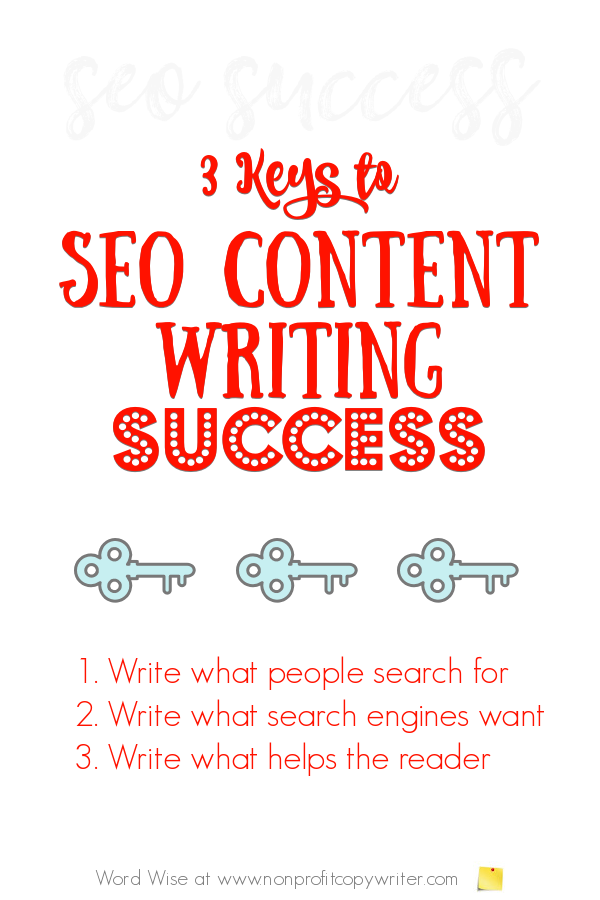
How
SEO content writing works (the simple version)
At its core, SEO content writing aligns 3 elements. When those three line up—you win.
- What people search for (search intent)
- What search engines want
- What actually helps the reader
1. What people search for (search intent)
What are you thinking when you type a query into Google? For example, if you search “how to grow cantaloupes,” you’re probably looking for simple, step-by-step help—not a long history of cantaloupes. If you search “best cantaloupes to grow in Texas,” you want a list of recommended varieties.
When you write content, think like a reader. What’s their goal as they search? Match your content to your reader’s “why,“ and they are more likely to stay, read, and trust what you’ve written.
2. What search engines want
Search engines like Google want to show content that is clear, helpful, and easy to understand. That means your writing should be well-organized, use relevant keywords naturally, and answer the topic thoroughly. You’ll score even more algorithm points when you include headings, short paragraphs, and accurate information.
When your content checks these boxes, search engines are more likely to see it as valuable. And they’ll show your content to more people.
3. What actually helps the reader
The best content makes the reader’s life easier. Clear answers, practical tips, and helpful examples solve the reader’s problem or answer their question in a simple, useful way.
When readers feel helped, they’re more likely to stay on your page, come back for more, and even share your content.
How SEO content writing works (a deeper dive)
Let me explain each of these elements a bit further. But first, the “why.”
SEO has changed a lot since its early days. Creators started figuring out how to optimize their content in the late 1990s and early 2000s, when early search engines like Yahoo and AltaVista were popular. Website owners realized they could get free traffic by showing up in search results. When Google launched in 1998 and became the dominant search engine, SEO took off.
Back then, ranking was often about stuffing pages with keywords and getting as many backlinks as possible. Quality didn’t matter much. Bloggers, businesses, and content writers began to see SEO as an essential way to grow visibility online. By the mid-2000s, SEO had become a standard part of digital marketing.
Today, SEO content writing is a fundamental skill for anyone creating content on the web.
And today, SEO is less about “gaming the system” and more about understanding what people need, creating high-quality content, and providing a good user experience (like fast-loading pages and mobile-friendly design). In short, SEO has evolved from a technical shortcut into a strategy centered on genuinely helping the reader.
The same 3 elements matter, of course. But here I’ve teased them out a bit more so you can understand how to structure your content for SEO.
1. What
people search for (search intent)
There are 4 types of queries that readers ask when they search online. In fact, a good test of this is to track your own search queries for a day and see how they line up to these 4 kinds of questions.
- Informational queries (“How to grow cantaloupes”)
- Navigational queries (“Facebook login”)
- Transactional queries (“Buy cantaloupe seeds”)
- Commercial queries (“Best cantaloupe seeds for Texas gardens”)
In light of this, you can see why search intent = what the user actually wants.
So if your content does match what your reader wants, the search engines reward that page with a higher ranking.
But if your content doesn’t match your reader’s search – what he wants – it won’t rank. No matter how well you write it.
2. What
search engines want
Search engines have gotten greedy over the years! Here’s what algorithms look for these days.
A. Search
engines want E-E-A-T content (Experience, Expertise, Authority, Trust)
They’re
a lot like us in that they favor content created by people who:
- Know what they’re talking about
- Show real experience
- Provide trustworthy information
What does this mean for you? Add real examples. Use credible sources. Show depth, not fluff.
B. Search
engines want humanized content
It’s
ironic that machines want to read humanized content, isn’t it? They see AI as
one of them and want better for their human consumers. To search engines, AI is a tool for humans, but not a replacement. Use AI to help as you research and
outline. But then heavily edit your content using your own voice.
C. Search
engines want topical depth
Short,
superficial pages? No. Unrelated topics scattered across a site with no
connections? Uh-uh.
Thin content is out. Search engines prefer to rank pages that cover a topic thoroughly, answer related questions (or connect the reader to pages that so), and connect ideas together.
The principle is called topical authority (TA). Your site garners higher TA when you offer not just one article, but a cluster of helpful content around a topic.
D. Search
engines want “Answer First” content
I
get so excited when I read a headline that promises to answer a question. So I
click. And I have to scroll F-O-R-E-V-E-R to get my question answered. Oh, the
frustration!
Search engines feel the same. They pull answers directly from pages. So if you want to make them happy (and rank your pages), your content should answer the question quickly – at the top of the page or beginning of a section on the page. And then go deeper. (This principle is known as Answer Engine Optimization or AEO) .
3. What
actually helps the reader
A. Simple structure helps the reader
People don’t read online—they scan. Search engines follow that behavior. So your content should include:
- Clear headings (H2, H3)
- Short paragraphs
- Lists and bullet points
- Your page focuses on one or two keywords (terms or phrases associated with a particular topic)
- Your page tags the keyword phrase(s)
- Your page’s keyword phrase is positioned in six crucial places on the page
- Your page content contains quality, helpful, well-organized information
- Your page content is conversational
- Your page content doesn’t overstuff or overuse the keyword
B. High-quality content helps the reader
This is the biggest shift in SEO since its beginnings. Back then, getting your content to rank was about building as many pages as you could, even if each one had thin content and just a handful of paragraphs, all stuffed with keywords and plastered with ads.
But now, search engines are prioritizing helpful, original, user-focused content. Not tricks. Not hacks. Just value.

Use this FREE glossary to help you talk SEO like a pro.
Why
SEO content writing matters
Good SEO content writing is not just about writing well. And it’s not just about keywords.
It’s a balance between helpfulness and strategy that …
- Solves a problem
- Matches what people are searching for
- Signals to search engines that your content is worth ranking
If you’re a freelance writer, this skill is gold. Why? Because businesses don’t just want content—they want traffic. Don’t you?
High-quality SEO content helps a biz or nonprofit to get free (organic) traffic instead of paying for ads. Over time, content builds authority in a niche and ultimately generates leads and sales.
And
here’s the kicker – a powerful reason to invest your time in knowing how to
write good SEO content.
It keeps working long after it’s published.
That’s why business owners and leaders are willing to pay more for writers who understand SEO. It makes sense for you to learn this skill, whether you’re a freelancer, small biz owner, or leader.

Use this step-by-step guide to ID seed keywords for your blog or website.
How
to write SEO content (step-by-step)
Here’s the simple process I use to write every page of content on my 3 websites and hundreds of pages for paying clients. Follow these steps to create your own high-quality SEO content writing.
Step
1: Start with a keyword
- Pick a topic people are searching for in your niche. (I keep a running list of keywords I want to use on my sites.)
- Then ask, “When it comes to this topic, what problem are my readers trying to solve?” In other words, you’re looking for your reader’s intent. When readers type in this keyword, what are they looking for? Look at Google results … “People Also Ask” questions … competitor content. I check out related UberSuggest keywords and Keywords Everywhere keywords, too. And often, I run a quick ChatGPT query for high-demand, low-supply long-tail keywords centered on that topic.
- Use all that information to figure out what users expect when they ask a question or type a keyword term in the search bar.
- Make a note of secondary keywords that relate to that topic. You can weave them into your content, too (see Step 4).
Step
2: Create a simple outline
Plan
your content to answer the reader’s question or solve the problem you
uncovered.
Organize your content with main sections (H2s) and supporting points (H3s). Where possible, include your primary keyword and secondary keywords in those headers.
Step
3: Write your content for humans
Write your content draft. And beware … it’s tempting to include your primary and secondary keywords in every sentence.
Don’t.
Follow the most important SEO mantra: Write to be helpful to your reader.
- Be clear. Write like you’re speaking to your neighbor across the picket fence or at the break table at work. Avoid fluff and edit ruthlessly. Readers take notice when a writer is clear and concise.
- Add examples. Include sources and real insights to build trust signals into your content. Cite your own experiences. People feel safe when you quote experts. They believe you more deeply when they see voices of authority and statistics.
- Most important: Solve the problem or answer the question that you set out to address.
Step
4: Optimize naturally
As you go back to edit your work, include …
- Your main keyword – naturally.
- Secondary keywords that you uncovered in your early research – but only where you can do so without going off topic or sounding artificial.
- Internal links to related pages on your site.
Step
5: Edit your content for web readers
Ask …
- Is this easy to scan? See where you can break paragraphs or insert bullets to add white space.
- Does it answer the question fast? Look at your title. Then see if you’ve given a simple answer above the fold of the page.
- Is anything unnecessary? .
- Do I see an author bio? At the top is best. Bottom is ok. Either way, you want to provide authority.
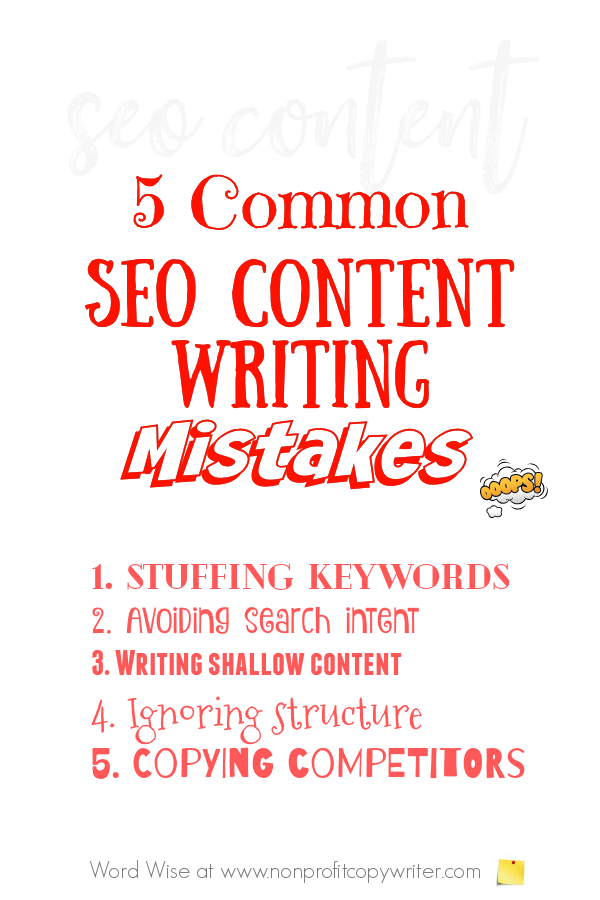
Avoid
these common SEO writing mistakes
It’s easy to fall into these common writer traps. Resist doing so! Otherwise, you’ll hurt your rankings, even if you write well.
- Keyword stuffing: Loading web content with excessive, repetitive, or irrelevant keywords to unfairly manipulate search rankings.
- Writing without understanding what the reader is searching for. In other words, you avoid your reader’s intent and write what you think they should think.
- Thin or shallow content. There’s plenty of that online already. Give depth or originality or special insight, instead.
- Ignoring structure and readability. Keep your paragraphs short. Use plenty of white space, lists, and bullet points.
- Copying competitors. You don’t win Google points by simply writing what everyone else is writing – or by dumping AI-generated content onto the web. You win points by offering a fresh look at a topic … a unique viewpoint … your life experience.
What
makes SEO content actually work
By now, you’re armed with the basics about …
- What is SEO content writing
- How SEO content writing works
- Why SEO content writing matters
- How to write SEO content
- Even the most common SEO content writing mistakes
But maybe your head is still spinning.
No worries. Let me make things even easier. Here’s the simplest way to think about SEO content writing today:
Answer the question better than anyone else.
That’s it.
Don’t worry about adding more keywords … more tricks … more fluff. Just use your content to give better answers, a clear structure, and real value.
If you focus on that, you’ll already be ahead of most beginner writers when it comes to SEO content writing.
And honestly, a lot of experienced ones, too.
More Web Content Writing Tips
Web Content Writing: A Quick Tutorial ...
50 SEO Terms Every Content Writer Should Know (and Why) ...
What Are Keywords in SEO, Anyway? A Simple Tutorial ...
Use 3 Types of Web Traffic to Build Your Blog or Website ...
The Best Word Count for SEO ...
How Keywords Work: an overview ...
Build Backlinks and Build Your Traffic: A Beginner’s Guide ...
How to Search for Keywords the Easy Way ...
Searching for Keywords? Use These SEO Writing Terms ...
The Skinny on Thin Content: Don’t Put Rankings Over Readers ...
Contextual Links and Why You Need Them on Your Website ...
The 3 Types of Links Your Website Needs and How to Build Them ...
6 places to use keywords in web pages and blog posts ...
Keyword Glossary: Quick SEO Jargon at Your Fingertips ...
Long Tail Keywords: A Quick Guide to Using Unpopular Search Terms ...
3 Ways to Help People Find Your Website and Build Traffic ...
Terms You Need to Know for Writing Website Content: A Glossary ...
More Online Writing Tips on our Pinterest board ...
Return from What Is SEO Content Writing? to Nonprofit Copywriter home
As an Amazon Associate I earn from qualifying purchases.
Share This Page

Named to 2022 Writer's Digest list
BEST GENRE/NICHE WRITING WEBSITE



Stop Wasting Time!
Grab your exclusive FREE guide, "5 Simple Writing Tips You Can Put to Use in 10 Minutes or Less"
 Subscribe To This Site