Save Time: Get 5 Simple Writing Tips
you can put to use in 10 minutes
50 Copywriting Terms Every Writer Should Know
Award-winning writer Kathy Widenhouse has written 9 books and garnered 800K+ views for her writing tutorials.
Updated 3.5.26
If you’re new to copywriting, the terminology may feel overwhelming fast. Headlines, hooks, CTAs, AIDA, PAS — copywriting terms can sound like a foreign language.
But learning these basic copywriting terms isn’t about memorization. It’s about thinking like a copywriter.
Once you understand the language, you’ll write faster, communicate more clearly with clients or teams, and make intentional choices instead of guessing what “sounds right.” In short, copywriting terms help you turn words into tools that drive action.
Even if you don’t include copywriting in your portfolio of skills as a writer, you still want to know these terms. At least half of them apply to all forms of content writing. And when you promote your books, writing services, and content – well, you need to understand the lingo to do so.
Below is a beginner glossary that groups 50 key copywriting terms into practical categories, so you can see how they work together. (You can also download your own free copy with examples here).
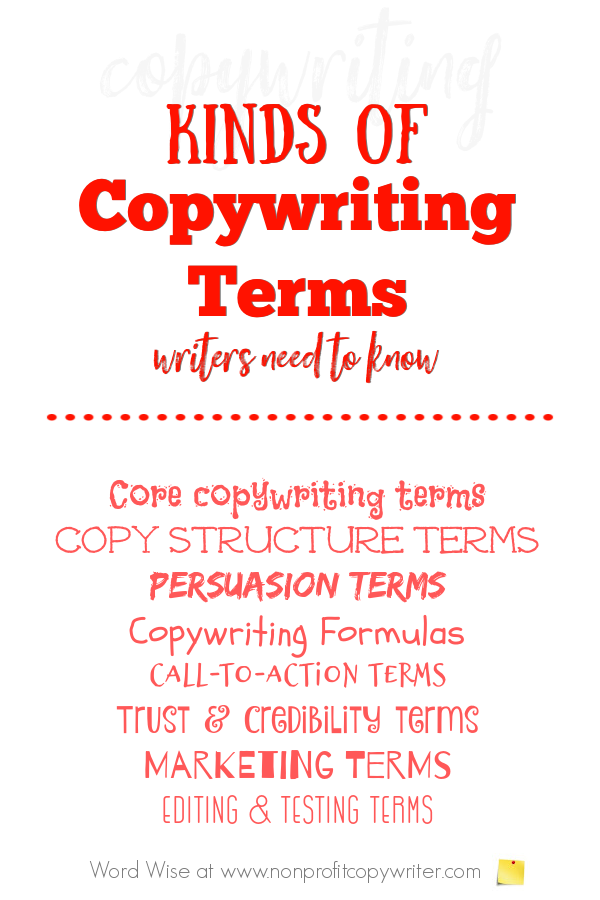
50 copywriting terms you should know
Core copywriting terms
- Copy: Written text used to promote, persuade, or move the reader to act
- Copywriting: The skill of writing text that encourages action
- Audience: The people the copy is written for
- Target Market: A specific segment of the audience
- Tone: The attitude or emotional feel of the writing
- Voice: The consistent personality of a brand or writer
- Clarity: How easy the message is to understand
- Plain Language: Simple, straightforward wording
- Readability: How easily a reader can read and process the copy
Copy structure terms
- Headline: The main title that grabs attention
- Subhead: A supporting headline that adds detail or clarity
- Hook: The opening idea that pulls the reader in
- Lead (Opening): The first paragraph that sets direction for the copy
- Above the Fold: Content visible before scrolling
- Skimmable Copy: Text designed to be scanned quickly
- Bullet Points: Short, scannable lists of information
- White Space: Empty space that improves readability
- Callout: Highlighted text that draws attention to key ideas
Persuasion and psychology terms
- Pain Point: A problem or frustration the audience has
- Feature: A factual detail about a product or service
- Benefit: How the feature helps the reader
- Benefits vs. Features: The difference between what something does and why it matters
- Value Proposition: The main promise or benefit offered
- USP (Unique Selling Proposition): What makes the offer different
- Emotional Trigger: A feeling that motivates action
- Objection: A reason someone might hesitate
- Scarcity: Limited availability to increase desire
- Urgency: Time pressure that encourages action
Copywriting formulas and frameworks
- 4 Ps: Promise, Picture, Proof, Push
- AIDA: Attention, Interest, Desire, Action
- PAS: Problem, Agitate, Solution
Call to Action terms
- Call to Action (CTA): A prompt telling the reader what to do next
- Offer: What the reader is being asked to accept or buy
Trust and credibility builders
- Social Proof: Evidence that others trust or use the product
- Testimonial: A customer’s positive statement
- Credibility: How trustworthy the message feels
- Trust Signals: Elements that build confidence (reviews, guarantees, logos)
Marketing and conversion terms
- Conversion: When a reader takes the desired action
- Conversion Rate: The percentage of readers who convert
- Landing Page: A web page focused on one specific action
- Sales Page: Long-form copy designed to sell
- Email Copy: Copy written for email marketing
- Direct Response: Copy meant to get immediate action
- Brand Copy: Copy focused on identity and positioning
- SEO Copywriting: Writing optimized for search and humans
- Keyword: A search term people use online
- Engagement: How readers interact with content
- Bounce Rate: Percentage of visitors who leave quickly
Editing, testing, and improvement terms
- Optimization: Improving copy for better performance
- Split Testing (A/B Testing): Comparing two versions of copy
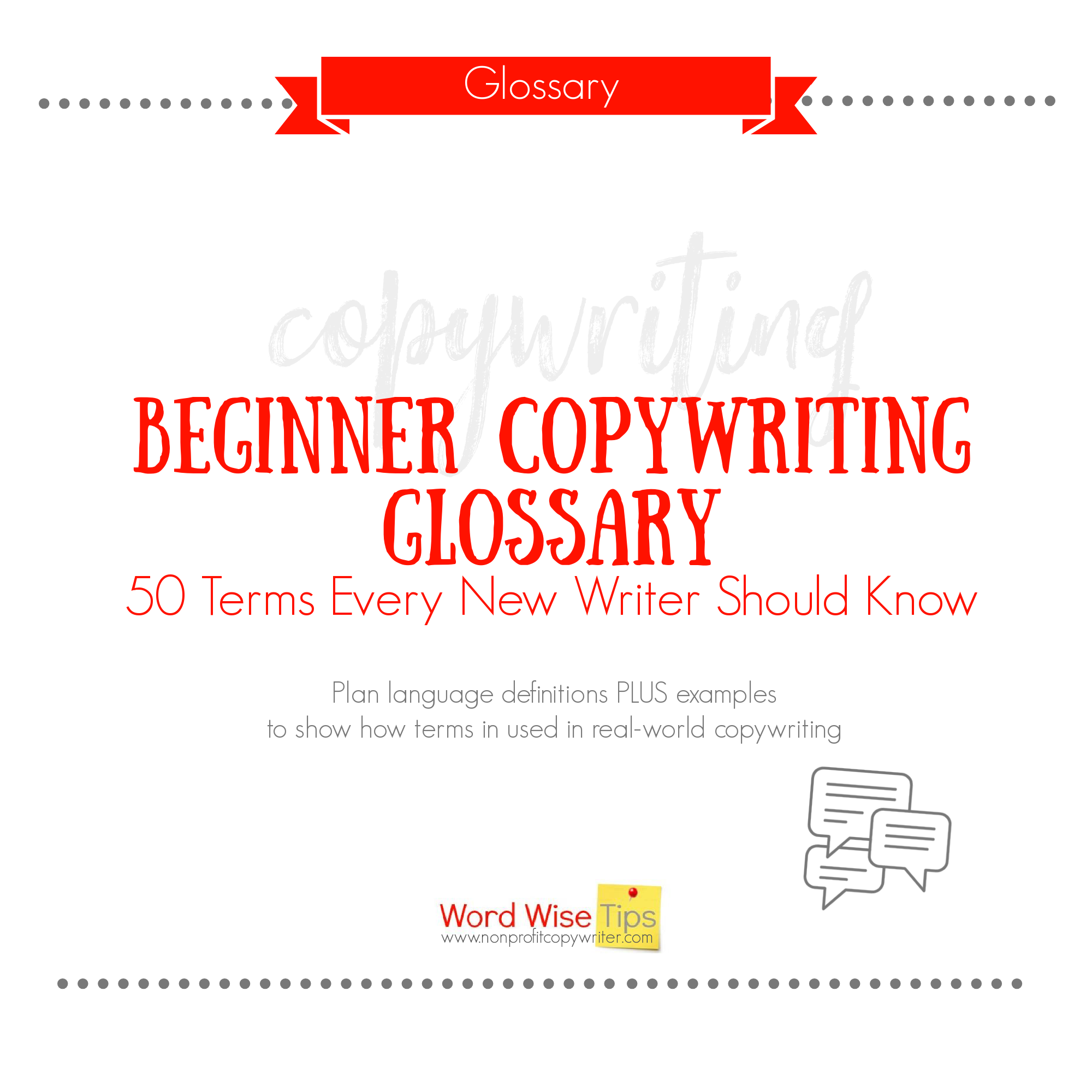
Download your free copy here. Includes examples.
How this glossary can help you
You don’t need to master all of these terms at once. But if you’re venturing into the copywriting realm but you do need to recognize them, for at least two reasons.
- Yes, you want to sound professional, particularly as you interact with prospects and clients.
- But better than sounding professional? Being one.
Without terminology, you’ll rely on instinct. Let’s say you review a draft and you sense that “something feels off.” When you recognize copywriting terms, you pinpoint the problem, such as …
- “The headline isn’t strong enough.”
- “The hook doesn’t create curiosity.”
- “The CTA is unclear.”
That shift—from vague feeling to precise diagnosis—is one mark of a pro. When you can name what you’re doing, your copy is intentional instead of accidental.
Ways to use these copywriting terms
You can use this copywriting glossary in different ways:
- Pick three terms from this list and apply them to your next piece of writing.
- Read a piece of copy and label three items from the glossary, such as the headline, a benefit, and a CTA.
- Bookmark this page and refer back to it as you write your next copywriting project.
- Download a free copy of this list (with examples) to keep so you can refer to it over and over.
New writers don’t need to memorize copywriting terms to sound smart. You need to recognize them to write with purpose. When you can name the parts of effective copy, you gain clarity. You get more confident because you understand each element.
Result? Your skills improve faster – and so does your copy.
More Copywriting Tips
Copywriting - what is copywriting?
Copywriting vs Content Writing: What's the Difference?
8 Copywriting Principles Every Writer Should Steal ...
Basic Copywriting Terms for Direct Mail ...
Basic copywriting: know your audience before you write ...
Basic copywriting rule: how to make the "You Rule" work for you ...
Newbie copywriting FAQs (Frequently Asked Questions) ...
Kinds of writing projects copywriters do ...
Copywriting website glossary, part 1: Internet Acronyms ...
Copywriting website glossary, part 2: Ten Basic Terms ...
More Basic Copywriting Tips on our Pinterest board ...
Return from 50 Copywriting Terms to Nonprofit Copywriter home
As an Amazon Associate I earn from qualifying purchases.
Share This Page

Named to 2022 Writer's Digest list
BEST GENRE/NICHE WRITING WEBSITE

Stop Wasting Time!
Grab your exclusive FREE guide, "5 Simple Writing Tips You Can Put to Use in 10 Minutes or Less"
 Subscribe To This Site