
Save Time: Get 5 Simple Writing Tips
you can put to use in 10 minutes
8 Copywriting Principles Every Writer Should Steal
Award-winning writer Kathy Widenhouse has written 9 books and garnered 800K+ views for her writing tutorials.
Posted 3.4.26
If you write, you’re in the sales business. (Bold statement, I know.)
Bloggers, authors, freelancers, nonprofit communicators, content marketers: I’m talking to you.
“But I’m not selling a product,” you say. You are, however, selling something else. When you write that article or blog post or book or web page or newsletter, you’re selling your reader on taking an action, such as …
- Embracing an idea
- Changing their mind
- Making a decision
- Remembering a truth
- Identifying with a cause
- Starting a conversation
- Considering a different perspective
- Making a commitment
- Taking a course of action
- Following steps
Or maybe you’re simply convincing your reader to keep reading.
The big misconception about copywriting
If what I said is true — that you’re in the sales business — then you need to write to sell. Commonly known as copywriting.
But you may mistakenly fear that if you adopt copywriting techniques, you’ll become a pushy car salesman on paper. Horrors — you don’t want to be manipulative. You get squeamish with the idea of being salesy in your content.
Me, too.
And that’s where writers make a big mistake. Equating a slimy salesman with copywriting is a common misconception.
The truth is quite different. Good copy leads the reader through a thought process — a process that empowers him to act or think differently or make a decision. When a reader works his way through a piece of well-written copy, his thoughts look like this:
- This got my attention. It’s relevant to me.
- I feel like I want this.
- I trust this.
- I’m ready to act.
Copywriting is simply text that guides readers through that line of thinking.
This mindset shift changed everything for me. I want my content to bring about change for my readers. Don’t you?
That’s why all writers — not just copywriters — should weave copywriting principles into their writing.
How copywriting principles drive good content
I stumbled upon this truth by the back door. One of the first writing classes I took was a copywriting course. Those persuasive techniques were ground into my writing, especially early on in my writing career when I did a good deal of copywriting for clients.
Over time, I became more of a content provider. Yet I continued to focus on the reader … write a strong opening … use clarity and a conversational tone. Core copywriting principles had become part of my writing DNA.
And why not? As you’ll see from my list below, these principles drive good content. If you want to persuade with words, you can easily adopt them, too. And you needn’t become an oily salesman in the process.
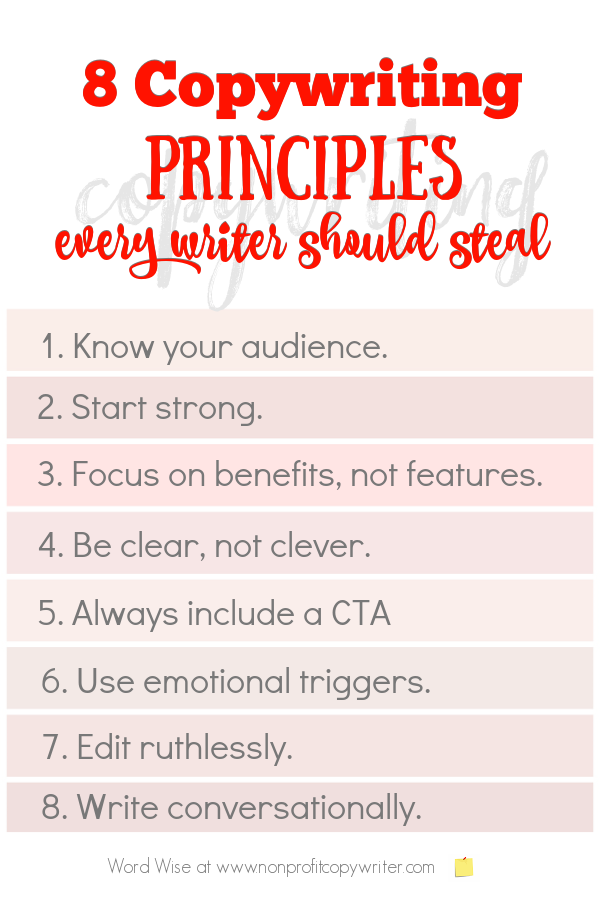
8 copywriting principles you should steal
Principle 1: Know your audience.
Understand who you’re writing for, what they care about, what problem they want solved, and what kind of language or tone they respond to. If you don’t write to your reader, he will click off your content because it doesn’t interest him.
Tip: Content that tries to reach everyone usually reaches no one.

Principle 2: Start strong.
A powerful headline and enticing first line earn your reader’s interest. “If you write, you’re in the sales business.” That caught your eye, right?
If you don’t grab attention in seconds, readers bounce. Your goal? Make them want to read the next line.
Tip: The headline is your hook — don’t bury it.
Principle 3: Focus on benefits, not features.
People don’t embrace features (facts) — they embrace solutions. For example, compare these two statements:
Feature: This chair has adjustable lumbar support.
Benefit: Sit comfortably for hours without back pain.
Tip: Ask, “What does this feature do for the reader?” Focus on the answer in your content.
Principle 4: Be clear, not clever.
Clever writing might win awards. Clear writing makes sales and wins over readers. Choose clarity by using simple words, short sentences, and direct structure.
Tip: If you confuse them, you lose them.
Principle 5: Always use a Call to Action (CTA).
Tell the reader exactly what to do next. Don’t assume they’ll figure it out — guide them, like this:
- Sign up today so you don’t miss an issue.
- Get your free guide and get that project done.
- Learn to use copywriting principles and you’ll be more strategic in your writing.
Tip: Without a CTA, your writing has no destination.
Principle 6: Use emotional triggers.
People buy based on emotion, then justify with logic. Good writing taps into emotions like fear, curiosity, desire, belonging, and urgency.
Is that manipulative? I think not. Feelings are part of the human experience. Facts support the good decisions you present to your reader. Use both.
Tip: People act based on emotion, then justify with logic.
Principle 7: Edit ruthlessly.
While web content may favor long form so that plenty of keywords attract search engines, great writing thrives on revision. Cut fluff. Trim passive voice. Make every word earn its spot.
Tip: Good content isn’t written — it’s rewritten.
Principle 8: Write conversationally.
Write like you talk, not how you might deliver a lecture or construct a term paper. Use contractions. Ask questions. Vary sentence length.
Tip: Good writing should sound like a one-on-one chat.
Every good writer is a copywriter in disguise
Every good writer writes to persuade. A novelist persuades readers to care about characters. A grant writer persuades funders to believe in a mission. A blogger persuades readers to accept an idea.
To that point, the question is not Should I write to sell or Should I write to persuade? — because you should always be writing to convince your reader of something. Rather, ask yourself Do I persuade well or poorly?
Copywriting principles are the foundation of good written persuasion. Use those principles, and you’ll strengthen your writing in any genre.
The irony? Many writers already use copywriting principles instinctively. Learning them intentionally makes you more effective and more strategic with the words you choose.
Steal them. Use them purposefully. And I promise, you won’t become a Don Draper Mad Men lookalike. You’ll be a better — more persuasive — writer.
More about Writing Persuasively
Copywriting vs Content Writing: What's the Difference?
Basic Copywriting: What Is It and Why Do You Need It?
50 Copywriting Terms Every Writer Should Know ...
The One Question You MUST Answer To Persuade…
Use the "You Test" for More Persuasive Writing ...
The 7 Most Powerful Words in Persuasive Content...
Use These 5 Persuasive Techniques in ANY Piece of Writing ...
Pillars that Persuade: Understand the 3 Persuasive Writing Basics ...
More persuasive writing tips on our Pinterest board ...
Return from 8 Copywriting Principles to Nonprofit Copywriter home
As an Amazon Associate I earn from qualifying purchases.
Share This Page

Named to 2022 Writer's Digest list
BEST GENRE/NICHE WRITING WEBSITE


Stop Wasting Time!
Grab your exclusive FREE guide, "5 Simple Writing Tips You Can Put to Use in 10 Minutes or Less"
 Subscribe To This Site