
Save Time: Get 5 Simple Writing Tips
you can put to use in 10 minutes
Why You Need A Core Message – and How To Write Yours
Award-winning writer Kathy Widenhouse has written 9 books and garnered 800K+ views for her writing tutorials.
Posted 1.7.26
“So … what do you write?” If you’re like me, you’ve bumbled and mumbled more than a dozen answers to that question.
Which means you need a core message. Unless …
- You want to sound like every other writer
- You want writing to be harder than it needs to be.
- You want your writing to be vague.
- You want readers and prospects to be confused.
- You want to lose confidence.
- You want to maintain the status quo.
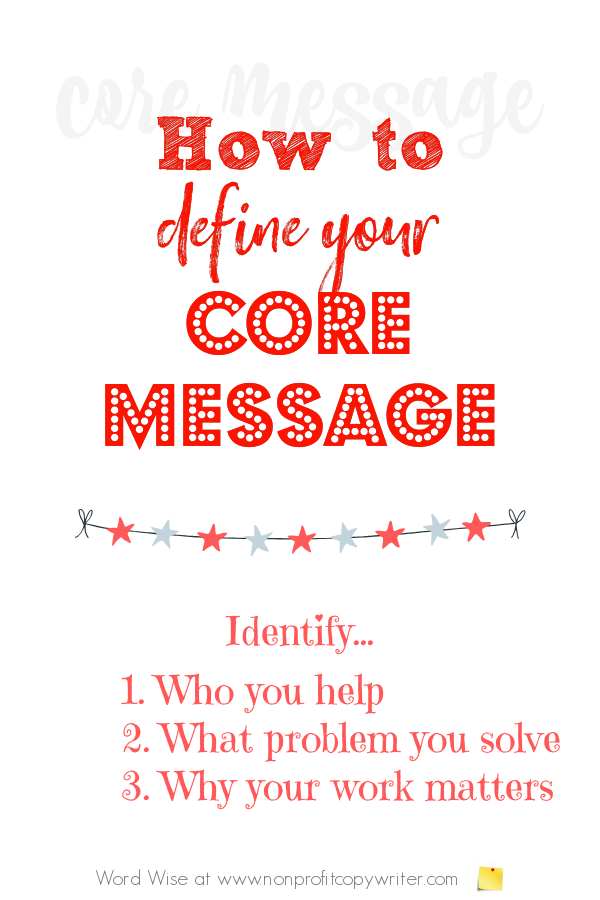
What is a core message?
Your core message is a short, clear statement that explains who you help, what problem you solve, and why your work matters.
Why do writers need a core message?
- It tells readers exactly what you can do for them. Your core message cuts through confusion and gives clarity.
- It keeps you focused on the writing you enjoy and do best. This way, you don’t drift off course. Instead, you accumulate clips and credits in your niche and build credibility.
On a fun note, your core message doesn’t limit you. It spreads a wider net than you may think. This surprised me. I was initially afraid to create a core message because I mistakenly believed I’d stifle my reach.
The opposite happened. My core message is, “I help busy people with simple writing tips to shorten their learning curve.” That content attracts my target reader — nonprofit leaders and writers who are pressed for time (I want to do their writing for them). But hundreds of others jump on my content, too: small business owners and wannabe writers and new writers who want clear writing tips to write better and faster.
How do I write my core message?
It’s not as hard as you may think. Ask yourself these three questions … and answer them honestly.
1. Who do you help?
Sketch out your ideal reader — his age, income, level of education, interests, needs, pain points. This is who you help.
2. What do you create?
Jot down the type of content you write for your ideal reader: how-tos, tips … case studies … articles … eBooks … This is what you create.
3. What is the result you deliver?
Record what happens to Mr. Reader after he consumes your content. Does he learn a skill, get funded, build traffic, or access products and services? This is the result you deliver.
Put the three together, and you’ve got your core message. Write a single sentence that answers those questions. Try this formula:
“I help [audience] with [type of writing] so they can [benefit/result].”
Write your core message in 3 easy steps.
How to use your core message
You don’t need a lofty slogan that’s lonely, living on your website but forgotten. Freelance writers, small biz owners, and solopreneurs use a core message as a practical, everyday tool. When your core message is clear, it quietly guides almost every business decision you make.
Here’s how to use your core message in real life.
1. Your core message demonstrates your value
Use your core message to explain what you do (without rambling) quickly. It gives you a simple way to answer, “So… what do you do?”
Lead with the outcome your content creates and who you help. That makes your work easier to understand — and easier to remember.
When prospects understand your value in one sentence, they can quickly say, “Yes, that’s what I need,” or, “I know someone who needs that.” It eliminates guesswork. You don’t have to keep reinventing your answer every time you’re asked … because you’ve got clarity.
2. Your core message builds your authority
A strong core message helps you avoid sounding like a generalist: “I can write anything for anyone.”
By defining your strengths, you highlight what makes you different — your niche, your approach, your results, or your personality. That filter makes it easier for clients to hire you and easier for people to refer projects your way because you’ve identified your specialty — that is, what problem you help solve and why your perspective or approach is different.
You can use your specialty to filter clients, too. When an opportunity comes along, test it alongside your core message. If it doesn’t line up, then it’s easier to say no — even if the project sounds tempting.
3. Your core message makes selling yourself easier
Instead of reinventing the wheel over and over, your core message becomes the backbone of your marketing, making it easier to sell your services. You’ll be more consistent (and less exhausted) when you repeat the same central idea in different formats, like:
- Your website copy
- Your social profiles and posts
- Your email newsletters
- Your pitches and bios
- Your email signature
This repetition builds recognition and trust over time.
4. Your core message drives your content creation
With a clear core message, you don’t need to start from scratch every time you sit down to create content. Your core message makes it easier to choose …
- Topics that reinforce your expertise
- Stories that support your point of view
- Calls to action that feel natural
This is why writers with a clear message rarely run out of ideas.
5. Your core message builds your confidence
In proposals, discovery calls, and follow-ups, a core message keeps the focus on value. You’ll be able to talk about …
- Results instead of tasks
- Transformation instead of word count
When you can clearly articulate what you do, it’s easier to be grounded and self-assured. That confidence comes through in your marketing, conversations, and proposals. Readers and clients can feel it.
Core message examples for writers
Nonprofit Writer
I help nonprofits tell clear, donor-centered stories that increase giving — without losing their mission’s heart.
Why it works: Focuses on audience (nonprofits), outcome (increase giving), and values (mission-first).
Health & Wellness Writer
I help health brands publish credible, accessible content that educates readers without overwhelming them.
Why it works: Emphasizes trust and readability in a crowded niche.
SEO Blog Writer
I write search-optimized blog content that brings in the right traffic — and keeps readers reading.
Why it works: Balances SEO with human engagement.
Ghostwriter
I help founders and executives turn their ideas into thought leadership that builds authority and opens doors.
Why it works: Outcome-driven and client-centric.
Website Copywriter
I write website content that helps visitors quickly understand what you do — and why it matters to them.
Why it works: Centers on user clarity and relevance.
Grant Writer
I help nonprofits secure funding by translating their impact into compelling, funder-ready grant proposals.
Why it works: Connects storytelling to a concrete result.
Email Marketing Writer
I help online wellness businesses write emails that sound like a real person — and actually get read.
Why it works: Conversational, relatable, and benefit-focused.
Write your core message in 3 easy steps.
Where do I use my core message?
- On your website or blog homepage, so readers know immediately what they can expect and what you do for them.
- As a pitch opener, so you can show your expertise to prospects right out the gate.
- In your short bio on your socials and in your email signatures.
- As a decision filter for new projects, to help you stay in your lane.
What your core message may cost you
You may find that writing your core message takes more time than you thought … forces you to make choices … can feel limiting.
Those are costs of clarity. And they’re well worth paying.
By whittling down your core message, you demonstrate value and expertise to readers, which in turn builds your authority. Plus, in the long run, you’ll save marketing time and avoid “what-do-I-write-next” confusion because you’ll know who you’re writing for and what they need.
You can change your core message anytime. But for now, use it as a decision-making tool, a confidence booster, and a way to show up consistently — without getting lost on the internet or burning out.
More Tips for Selling Your Writing and Your Writing Skills
Selling Your Services: 6 Writing Tips for Starting Out as a Freelancer ...
7 Streams of Income for Writers ...
Don’t Market Your Writing. Do This Instead...
Branding Basics for Writers (Especially Non-Marketers) ...
What’s Your Unique Selling Proposition?
The 4 Ps of Marketing for Writers ...
Write a Problem Statement Using This Handy Template ...
A Simple Guide to Writing a Mission Statement ...
3 Types of Freelance Writers: Which Are You?
The 2 Main Ways to Build Your Freelance Writing Business ...
More tips for freelance writers on our Pinterest board ...
Return from Why You Need a Core Message to Nonprofit Copywriter home
As an Amazon Associate I earn from qualifying purchases.
Share This Page

Named to 2022 Writer's Digest list
BEST GENRE/NICHE WRITING WEBSITE

Stop Wasting Time!
Grab your exclusive FREE guide, "5 Simple Writing Tips You Can Put to Use in 10 Minutes or Less"
 Subscribe To This Site