Save Time: Get 5 Simple Writing Tips
you can put to use in 10 minutes
Conversational Writing vs Formal Writing: What Every
Content Writer Should Know (With Examples)
Award-winning writer Kathy Widenhouse has written 9 books and garnered 800K+ views for her writing tutorials.
Posted 8.12.26
Which of the following is easier for you to read and understand?
Example 1: When analyzing the effectiveness of various communication techniques, it is important to understand the distinctions between conversational writing vs formal writing.
Example 2: What’s the difference between conversational writing vs formal writing? Here’s a simple way to think about it.
I chose #2, too.
This is a good example of conversational writing vs formal writing.
- Conversational writing sounds like you’re talking to a friend.
- Formal writing sounds serious and professional.
Yes, there’s a place for both. But why does this matter to you and me, dear writing friend?
Conversational writing vs formal writing: Given a choice, which do readers prefer?
Your first consideration is your reader’s preference. Your words are not for you. They’re for your reader, to help him understand your point easily.
So, which style do readers prefer?
Conversational writing. Hands down. Data proves it.
When marketing expert Montana Thomas posted the same content in both conversational and formal tones, 247% more readers read the conversational version — and spent 3 ½ times more time reading it than the formal one.
The choice makes sense. When I read formally written content, I have to think too hard. I’ll do it if I must. But I’d rather not.
However, as a writer, I cannot simply ditch all my formal tones and go completely casual on the written page.
And you can’t either. Certain situations are laid-back and relaxed. Others require more decorum. Which is which?
What is conversational writing — and what is formal writing?
Both styles communicate information … but they do so in very different ways.
Conversational writing is a style that sounds natural, relaxed, and similar to the way people speak in everyday conversation. It’s standard in blogs, online articles, marketing content, newsletters, and social media.
The goal of conversational writing is to make readers feel comfortable and engaged. Instead of sounding distant or technical, conversational writing feels approachable and human and typically includes:
- Simple, everyday language
- Short sentences and paragraphs
- Direct address to the reader (“you”)
- Questions that engage the reader
- A friendly, informal tone
- Personal examples or stories
Formal writing follows a structured, professional style that avoids casual language and personal expressions. It is designed to present information clearly, logically, and objectively.
You write formally in academic papers, research reports, official documents, and professional correspondence — and 90%+ of the time, you use third person. Rather than sounding like everyday speech, formal writing focuses on precision and credibility. It’s typified by …
- More complex vocabulary
- Plenty of niche lingo
- Longer, structured sentences
- A neutral, objective tone
- Few or no contractions (“do not” rather than “don’t”)
- Limited use of personal pronouns
- Carefully organized arguments or explanations
Conversational writing vs formal writing: Which style is better online?
Hands down, conversational writing.
People read differently on the internet than they do in books or academic papers — they scan and prefer clear, approachable language.
Plus, research on web user behavior finds that users typically read only about 20–28% of the words on a page. Online writing that uses simple, direct language — characteristic of a conversational style — helps retain more readers and conveys ideas faster.
Conversational writing vs formal writing: How your readers engage with each one
Conversational writing captures attention quickly because it feels approachable and relatable. By using a friendly tone, short sentences, and direct language, you draw readers in and encourage them to keep reading.
Then, you ask questions, using “you,” which invites readers to respond (even if only in their minds). Plus, personal examples make readers feel like they know you and are involved in your life. That increases the time readers spend on your page and interact with you.
Formal writing, on the other hand, can feel distant or rigid. Readers skim or lose interest — especially online.
True, formal writing is the M.O. for academic or professional contexts. They read every nitty-gritty detail when they must.
But conversational writing keeps readers more engaged by creating a sense of dialogue. And the information is worded more simply, so it’s easier to absorb.
When should you use each in your own content?
If you’re writing your own content, you need to decide which approach to take. Here are a few general rules of thumb.
When to use conversational writing
Conversational writing works best when your goal is to connect with readers and make information easy to understand. It’s a favorite in online and website writing because it keeps readers engaged and scrolling … and it’s easy to consume on screen, as in …
When to use formal writing
Formal writing helps maintain a professional standard. It is more appropriate when you want to present information professionally or academically — in situations where credibility and accuracy are more important than making the reader your BFF. Use formal writing in …
- Academic papers
- Research reports
- Business proposals
- Legal documents
- Government publications
- Professional reports
Conversational writing vs formal writing: When to use each in other publications?
This is a crucial question for freelance writers. Your pitch to an editor can be rejected out of hand if you choose a style that’s contrary to the publication’s approach.
Before you write anything, study the publication you’re writing for and ask these questions about its style. The answers will help you choose the best style for your writing project.
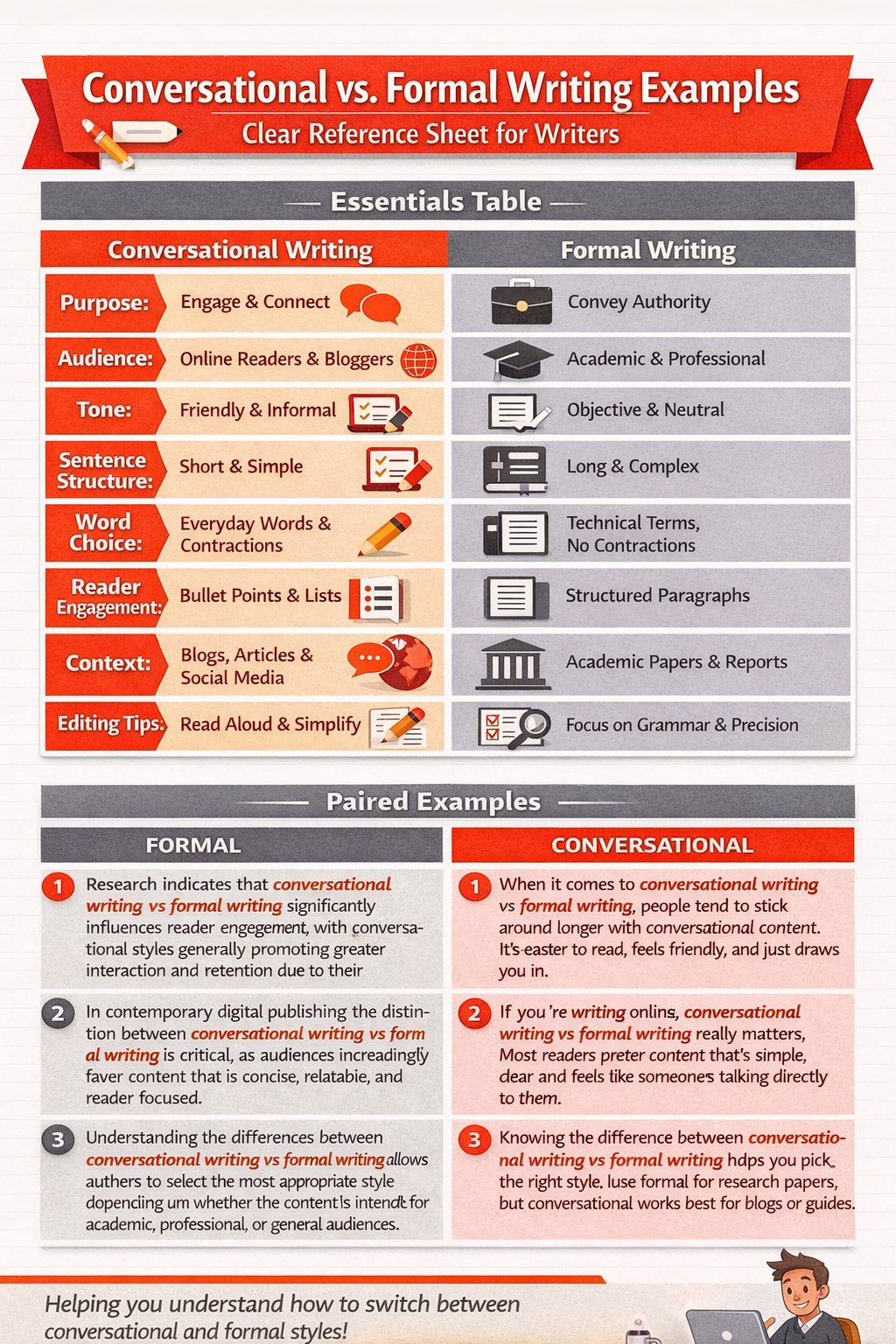
1. What’s the purpose of the publication’s content?
- Want readers to interact with you? Use conversational writing. You’ll be approachable. This way, readers will feel more comfortable highlighting or commenting or responding to you.
- Want to present academic credibility? Use formal writing. You’ll project authority like a college professor or a doctor or a judge in a courtroom.
Special note: In one of writing’s great ironies, you can convey authority using a conversational style. You do so by writing high-quality information that communicates complex ideas in an easy way.
2. Who are the readers?
Tailor your style based on who will read your content.
- Writing for online readers? They prefer conversational writing.
- Writing for academic, legal, or technical audiences? The genre requires formal writing.
Identify the ideal reader for your content so you know what style to write in.
3. What tone does the publication use?
Study the publication and its recent content.
- Conversational writing uses a relaxed, friendly tone that feels like a discussion, such as, “Let’s take a closer look at how this works.”
- Formal writing uses a professional, objective tone that’s neutral and avoids sounding casual. For example, “This section examines the process in greater detail.”
4. What kind of sentence structure is typical in this publication?
- Ideas broken into small thoughts … short sentences … simple grammar … white space: These indicate conversational writing. Write for online readers who prefer to scan your content.
- Multiple ideas in one sentence. Few opinions, lots of facts and citations. Longer paragraphs — more than 6 lines. These indicate a formal approach.
5. What kinds of word choice does the publication favor?
- Conversational writing publications use everyday language and contractions like “don’t” and “you’re.” You’ll see more 10-cent words (1 or 2 syllables) rather than $20 words (3 or more syllables). If you check the content’s readability index, it will be 8th grade or less.
- Formal writing publications avoid contractions like the plague. You’ll find plenty of 3- and 4-syllable words. And all that technical and specialized lingo? Yep, that too.
6. How do writers address readers?
- Publications that use a conversational style directly to readers using “you” and questions to create interaction, even if it’s just in the reader’s mind. You’ll see plenty of first- and second-person point of view.
- Publications that are formal don’t address the reader directly, but stick to third-person POV. The focus is on presenting information objectively — like both you and the reader are invisible.
7. How is the content formatted?
- Conversational writing uses subheadings, bullet points, white space, and lists to make scanning easier.
- Formal writing contains long, structured paragraphs and oodles of citations — often with footnotes.
8. Where are you publishing?
- Conversational writing is most common in online blogs, marketing content, and newsletters.
- Formal writing is the favorite approach in research papers, official reports, and professional correspondence.
9. How should you edit and revise for this publication?
- Conversational writing: Read your content aloud. Make sure it sounds like you’re bantering with your little brother.
- Formal writing: Imagine you’re called to the dean’s office to explain yourself. Follow the rules. Use a respectful tone. Make sure your procedures are intact.
Can writers combine both conversational and formal styles successfully?
Yes. For example, you could …
- Use conversational language to explain ideas clearly.
- Maintain a professional tone when presenting facts.
This blended approach is common in high-quality online content. It allows you to remain engaging while still sounding credible and trustworthy.
Conversational writing vs formal writing: Why many writers are switching styles
All of this to say that conversational writing is not a trend or a “style preference.” It’s a response to human behavior — matching how people read, think, and decide … and how trust is built in a noisy, skeptical world.
That’s why the conversational style has become the norm — especially online.
In short, conversational writing is more than just casual. It’s efficient.
Efficiency is a valuable skill. Learn to write conversationally, and you help people solve their problems in less time.
Every reader wants that. Which means they’ll want your content … and become your fans.
More Conversational Writing Tips
7 Conversational Writing Techniques Pros Use Without Thinking ...
Why You MUST Master a Conversational Writing Style ...
3 Ways to Write Conversationally ...
The Top Online Writing Tip: Write Conversationally ...
19 Practical Conversational Writing Tips ...
Run-On Sentences Can Be Your Friend. Fragments, Too...
More Quick Writing Tips on our Pinterest board ...
Return from Conversational Writing vs Formal Writing to Nonprofit Copywriter home
As an Amazon Associate I earn from qualifying purchases.
Share This Page

Named to 2022 Writer's Digest list
BEST GENRE/NICHE WRITING WEBSITE


Stop Wasting Time!
Grab your exclusive FREE guide, "5 Simple Writing Tips You Can Put to Use in 10 Minutes or Less"
 Subscribe To This Site