Save Time: Get 5 Simple Writing Tips
you can put to use in 10 minutes
7 Conversational Writing Techniques Pros Use Without
Thinking
Award-winning writer Kathy Widenhouse has written 9 books and garnered 800K+ views for her writing tutorials.
Posted 3.12.26
“Write the way you talk.” It’s the conversational writing mantra drilled into you from the moment you decided to write content.
But why do so many of us struggle to acquire a laidback chitchat style? And no, you can’t blame AI. Something visceral is missing.
I’d love to be sitting across the table with you, fellow writer, with a cup of tea at my elbow. You’d have your beverage of choice. And I’d spend most of my time listening to you talk about …
- What you’re working on right now
- What confuses you about writing
- What you need to do next with your writing
I’d listen to your questions and try to give some simple feedback (since I’m all about making content writing simple). When we broach tough topics, I’d try to break down your struggles into smaller pieces … and then egg you on for your next idea.
It would be a conversation. But I’d try to listen to you more than talk … because I’d be working hard to figure out what you need.
Listening. That’s what we’re missing when it comes to conversational writing.
Why we need conversational writing techniques
Readers want an easygoing conversational writing style. We content writers should listen to the 79% of our users who scan online content instead of reading it word-for-word.
But the subtle truth about conversational writing is this: readers don’t want you to talk to them. They want you to listen to them and answer their questions. They don’t want you to be consumed by following formal rules for writing. Instead, they want you to have a relationship with them on the page.
It’s an easy-to-miss shift … but it can be learned.
The best writing pros put themselves in their reader’s shoes and anticipate what the readers ask or say. They “listen” and then use their content to answer … comment … and point the conversation to the next topic.
Here are a few ways you can do that, too.
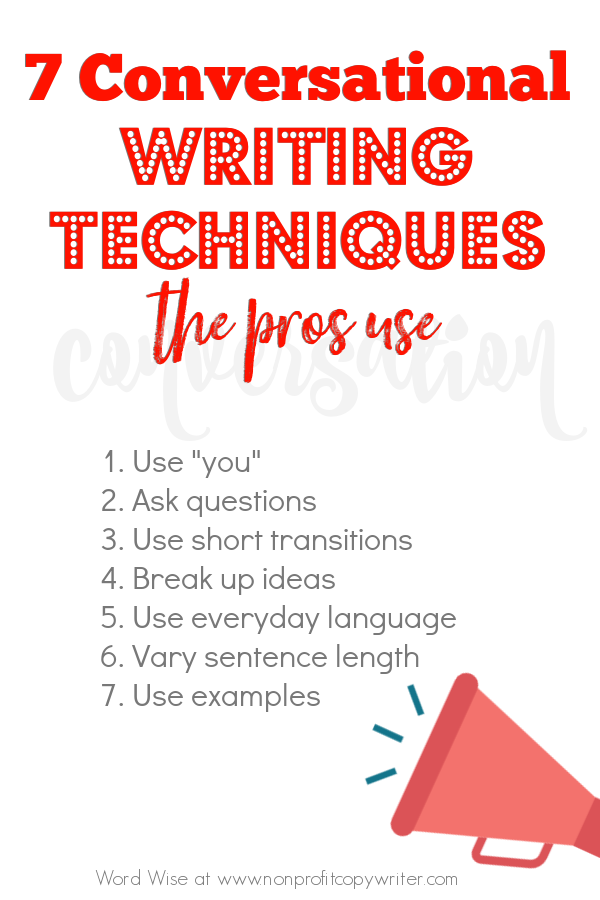
7 conversational writing techniques that mimic listening
1. Don’t avoid your reader
Your reader is not an ex to ignore at a party, and he’s not that awkward neighbor you desperately try to slip past on the sidewalk. So don’t talk around him in third person, like he’s not there.
That’s why using you, your, you’re, and yours creates a sense of connection, like you’re having a real conversation. It’s a small change, but it instantly makes your reader feel included. People respond better when they feel you’re speaking with them, not avoiding them.
- Instead of: “Writers should understand the difference between conversational writing and formal writing.”
- Try: “You should understand the difference between conversational writing and formal writing.”
As an Amazon Associate I earn from qualifying purchases.
2. Ask questions
Questions are a natural part of conversation, aren’t they? They’re like little invitations in your writing. A question — even rhetorical — shows your reader you’re thinking of him.
Questions make readers pause, think, and get mentally involved in your content — even push back at you in their minds. Readers can feel you listening for their answers, like when you write …
“Ever wonder why some articles feel easy to read while others seem exhausting?”
By asking questions, you’re simulating a conversation instead of delivering a monologue.
3. Use short transition phrases
Ever been in a conversation with a Chatty Cathy who doesn’t pause for a breath? You can’t get a word in edgewise.
Don’t be that person on paper. Good conversational writing uses natural transition phrases that mimic speech — short expressions like:
- “Here’s the thing…”
- “The good news is…”
- “But there’s a catch.”
- “Let’s take a closer look.”
- “Now imagine this.”
Use these phrases to let your reader breathe and gather their thoughts.
4. Break ideas into bite-sized pieces
My dad was a brilliant engineer, which accounts for his complicated explanations about how things worked. I should have asked him to unpack one point at a time. Most of Dad’s comments were way over my head.
Your readers won’t indulge you when you dump large amounts of information — especially complicated explanations — onto them at once. Instead …
- Break complex ideas into smaller, manageable chunks.
- Introduce ideas one step at a time.
- Shorten sentences. Use bullet points.
For instance, “Start with your main point. Explain it in one or two sentences. Give an example. Then move on.”
Bite-sized pieces mirror how everyday people (not brilliant engineers) naturally explain things. It's one of those conversational writing techniques that keeps your readers from feeling overwhelmed.
Write tighter and cleaner in 10 minutes or less with these 5 tips.
5. Use everyday language
That friend who uses words you can’t pronounce? He doesn’t know that he makes listeners feel dumb.
Don’t try to sound “smart” by using fancy words when you write. It may make you think you’re superior, but it makes your reader feel bad — and dump you.
Instead, choose clear, familiar words instead of complicated ones. Aim to write between a 6th and 8th grade level. Yes, get rid of as many 4-syllable words as you can. Simple, familiar language shows you care that your reader understands you.
Compare these:
- “Individuals frequently encounter difficulty comprehending excessively technical language.”
- “Plenty of folks struggle to understand technical writing.”
You don’t lose authority by being clear. If anything, you gain credibility because it’s hard to make the complex simple.
6. Vary your sentence length
Stop and listen to a conversation between family members … shoppers at the grocery store … people at work. You’ll notice a combination of short sentences (<10 words), medium-length sentences (11–20 words), and long sentences (21+ words).
Do the same when you write. Varying your sentence length imitates speech rhythmic patterns. Here’s what I mean:
“Most people don’t read online the way they read books.
They scan.
They skim.
And they move on quickly if something feels hard to read.”
7. Use relatable examples
Laughter and conversation flowed — it was a fun evening with friends. We swapped stories about our kids and struggles at work. We compared home repair ideas and snapshots from our vacations.
When you write, pretend you’re catching up with friends. Give your reader tangible examples and stories to make abstract ideas concrete. It’s the difference between these two:
- “Short sentences increase readability.”
- “Short sentences are easier to read. Think of them like small stepping stones instead of one giant leap.”
The best conversational writing technique
Back to our tête-à-tête over tea, where I pepper you with questions … answer problems one by one … anticipate what you’ll ask next.
Be that listener-turned-writer.
- Use the techniques — they’ll help you get there. In fact, pretty soon they’ll become natural for you.
- Listen to your friend’s questions.
- Speak in short, thoughtful sentences — not long, complicated ones.
- Explain things clearly, give examples, pause here and there, and keep the conversation flowing.
- Anticipate what your friend asks next.
In doing so, you’ll discover that the best way to write conversationally is to listen first.
And when you start listening to your reader without thinking twice about it, you’ll know you’re on your way to being a pro.
More Conversational Writing Tips
Conversational Writing vs Formal Writing: What Every Content Writer Needs to Know ...
Why You MUST Master a Conversational Writing Style ...
3 Ways to Write Conversationally ...
The Top Online Writing Tip: Write Conversationally ...
19 Practical Conversational Writing Tips ...
Run-On Sentences Can Be Your Friend. Fragments, Too...
Get more writing tips on our Pinterest board ...
Return from 7 Conversational Writing Techniques to Nonprofit Copywriter home
Share This Page

Named to 2022 Writer's Digest list
BEST GENRE/NICHE WRITING WEBSITE


Stop Wasting Time!
Grab your exclusive FREE guide, "5 Simple Writing Tips You Can Put to Use in 10 Minutes or Less"
 Subscribe To This Site