
Save Time: Get 5 Simple Writing Tips
you can put to use in 10 minutes
50 SEO Terms Every Content Writer Should Know (and Why)
Award-winning writer Kathy Widenhouse has written 9 books and garnered 800K+ views for her writing tutorials.
Posted 9.3.26
If you’re a content writer, you’ve probably heard SEO terms tossed around like search intent, backlinks, and SERPs — sometimes enough to make your head spin.
The good news? You don’t need to become an SEO expert to write content that gets found.
But you do need to understand the language.
Knowing what SEO pros, editors, and clients mean when they talk about things like rich results, topical authority, CTR, and featured snippets can make you a smarter, more confident writer — and help you create content that actually gets results.
In this guide, we’ll break down 50 SEO terms every content writer should know, in plain English. This way, you can stop nodding along when someone says “optimize for search intent” … and actually know what they mean.
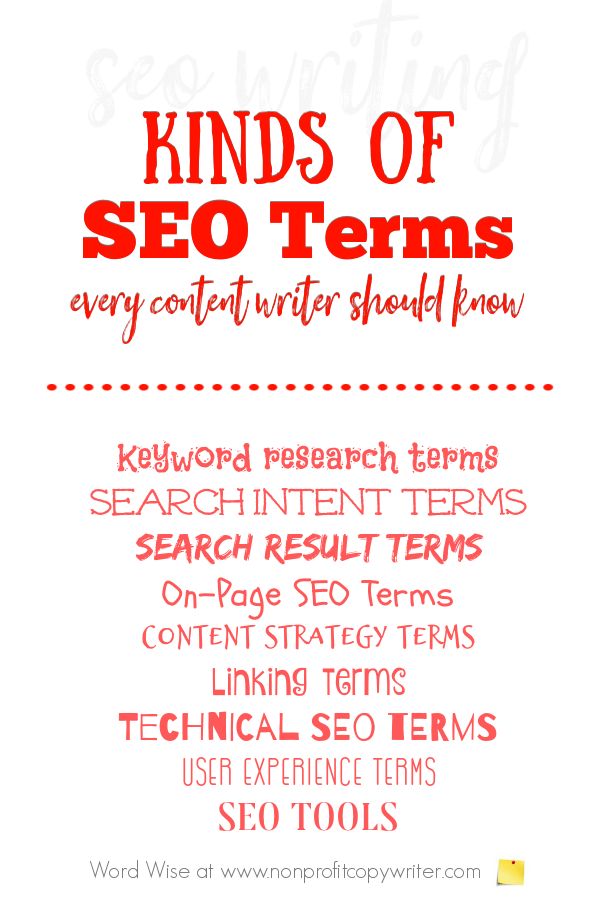
50 SEO terms every content writer should know
Keyword Research Terms
These terms help you discover what people are looking for online.
1. Keyword
Definition: A word or phrase people type into search
engines.
Why it matters: Keywords help search engines understand your content.
2. Primary Keyword
Definition: The main keyword a page targets.
Why it matters: It provides the central focus for the article.
3. Secondary Keyword
Definition: Supporting keywords related to the primary
keyword.
Why it matters: They help expand topical relevance.
4. Long-Tail Keyword
Definition: A longer, more specific search phrase.
Why it matters: Often easier to rank for long-tail keywords — they attract targeted visitors.
5. Search Volume
Definition: The estimated number of monthly searches for a
keyword.
Why it matters: Indicates potential traffic opportunities.
6. Keyword Difficulty
Definition: An estimate of how hard it is to rank for a
keyword.
Why it matters: Helps writers choose realistic targets.
7. Semantic Keywords
Definition: Related words and phrases connected to the main
topic.
Why it matters: Help search engines understand context.
8. LSI Keywords
Definition: Terms often associated with a topic.
Why it matters: Improve topical coverage. (Though "LSI" is often used
loosely in SEO.)
9. Search Query
Definition: The exact words typed into a search engine.
Why it matters: Helps writers understand audience language.
10. Keyword Cannibalization
Definition: Multiple pages competing for the same keyword.
Why it matters: Can weaken rankings.
11. Keyword Stuffing
Definition: Excessively repeating keywords.
Why it matters: Hurts readability and can harm rankings.

ID your site's seed keywords with this step-by-step guide.
Search Intent Terms
These SEO terms help you understand why people search the way they do.
12. Search Intent
Definition: The reason behind a search query.
Why it matters: Matching intent improves rankings and user satisfaction.
13. User Intent
Definition: What a searcher hopes to accomplish.
Why it matters: Content that solves the user's problem performs better.
Search Results and Ranking Terms
These terms describe how your content appears in search engines.
14. SEO (Search Engine Optimization)
Definition: The process of improving content so it ranks higher in search engines.
Why it matters: Better rankings can lead to more traffic and visibility.
15. SERP
Definition: Search Engine Results Page.
Why it matters: Understanding SERPs helps writers create competitive content.
16. Ranking
Definition: A page's position in search results.
Why it matters: Higher rankings mean more clicks and more traffic.
17. Featured Snippet
Definition: A highlighted answer appearing above regular
search results.
Why it matters: Can dramatically increase visibility.
18. Organic Traffic
Definition: Visitors who arrive through unpaid search
results.
Why it matters: Often represents high-quality traffic.
19. Click-Through Rate (CTR)
Definition: The percentage of users who click a search
result.
Why it matters: Strong titles and descriptions can improve CTR.
20. Rich Results
Definition: Enhanced search listings with extra information.
Why it matters: Attract more attention in search.

On-Page SEO Terms
These are elements you directly control.
21. Meta Title
Definition: The title displayed in search results.
Why it matters: Influences rankings and clicks.
22. Meta Description
Definition: The summary shown beneath the title in search results.
Why it matters: Helps persuade users to click.
23. URL Slug
Definition: The part of a URL that identifies a page.
Why it matters: Clean URLs improve usability and SEO.
24. Heading Tags (H1, H2, H3)
Definition: Structured headings used within content.
Why it matters: Improve readability and topical organization.
25. H1 Tag
Definition: The main page headline.
Why it matters: Signals the primary topic of the page.
26. Alt Text
Definition: Descriptive text for images.
Why it matters: Improves accessibility and image SEO.
27. Schema Markup
Definition: Code that helps search engines understand page
content.
Why it matters: Can increase eligibility for rich results.
Content Strategy Terms
These terms explain how you can build authority and organize your content.
28. Pillar Page
Definition: A comprehensive guide covering a broad topic.
Why it matters: Serves as the hub of a content cluster.
29. Topic Cluster
Definition: Related content supporting a central pillar
page.
Why it matters: Builds authority around a subject.
30. Content Cluster
Definition: A group of related articles linked together.
Why it matters: Strengthens topic relevance.
31. Topical Authority
Definition: Expertise demonstrated through extensive
coverage of a topic.
Why it matters: Helps sites rank for related searches.
32. Cornerstone Content
Definition: A site’s most important, authoritative content.
Why it matters: Often becomes a ranking powerhouse.
33. Evergreen Content
Definition: Content that remains useful over time.
Why it matters: Can generate traffic for years.
34. Content Freshness
Definition: How recently content has been updated.
Why it matters: Important for time-sensitive topics.

Use this guide to create your own personalized content strategy.
Linking and Authority Terms
These terms help search engines evaluate a page’s trust and relevance.
35. Internal Link
Definition: A link to another page on the same website.
Why it matters: Helps search engines understand site structure.
36. External Link
Definition: A link to another website.
Why it matters: Can improve credibility and provide context.
37. Anchor Text
Definition: The clickable text in a hyperlink.
Why it matters: Provides clues about linked content.
38. Backlink
Definition: A link from another website to yours.
Why it matters: Remains a major ranking factor.
39. Domain Authority
Definition: A score predicting a site's ranking strength.
Why it matters: Helps evaluate competition.
40. Page Authority
Definition: A score estimating a page's ranking potential.
Why it matters: Useful for competitive analysis.
41. E-E-A-T
Definition: Experience, Expertise, Authoritativeness, and
Trustworthiness.
Why it matters: Influences how search engines evaluate content quality.
Technical SEO Terms
Writers don’t need to be developers, but you should understand the basic lingo.
42. Crawl
Definition: When search engines discover pages.
Why it matters: Content must be crawlable to be indexed.
43. Indexing
Definition: Adding a page to a search engine's database.
Why it matters: Indexed pages can appear in search results.
44. Sitemap
Definition: A file listing important website pages.
Why it matters: Helps search engines find content.
45. Core Web Vitals
Definition: Metrics measuring page experience and
performance.
Why it matters: Site speed and usability affect SEO.
User Experience Terms
These terms measure how your readers interact with your content.
46. Bounce Rate
Definition: The percentage of visitors who leave without
further interaction.
Why it matters: Can indicate content relevance issues.
47. Dwell Time
Definition: How long users stay on a page before returning
to search results.
Why it matters: Often reflects content usefulness.
48. Conversion
Definition: A desired action taken by a visitor.
Why it matters: Traffic is valuable only if it supports goals.
49. Conversion Rate
Definition: The percentage of visitors who complete a
desired action.
Why it matters: Measures your content effectiveness.
SEO Tools
Tools help you measure performance.
50. Search Console
Definition: Google’s tools that show your website’s search
performance.
Why it matters: Reveals rankings, clicks, and indexing issues.
The 10 most important SEO terms for new content writers to know
If you’re just getting started, focus on these first:
- SEO (#14 above)
- Keyword (#2 above)
- Primary Keyword (#3 above)
- Search Intent (#12 above)
- SERP (#15 above)
- Meta Title (#21 above)
- Internal Link (#35 above)
- Backlink (#38 above)
- E-E-A-T (#41 above)
- Topical Authority (#31 above)
Master these 10 concepts first, and you’ll understand about 80% of what content writers need to know about SEO. The remaining terms build on those foundations.
Why these SEO terms matter to you
You don’t have to be an SEO wizard to be a great content writer. But knowing your E-E-A-Ts from your indexing and your Core Web Vitals from your conversion rate can make you a whole lot more effective — and a whole lot more valuable to clients.
Think of these 50 terms as your SEO toolkit. You may not use every tool on every assignment, but knowing what each one does helps you write smarter, follow SEO briefs with confidence, and create content that has a better chance of being found by the people who need it.
Download this list, keep it handy, and start putting your new SEO vocabulary to work. The better you understand how search works, the better you can make your words work for you.
More Web Content Writing Tips
Web Content Writing: A Quick Tutorial ...
What Are Keywords in SEO, Anyway? A Simple Tutorial ...
How Keywords Work: an overview ...
6 places to use keywords in web pages and blog posts ...
Long Tail Keywords: A Quick Guide to Using Unpopular Search Terms ...
The 3 Types of Links Your Website Needs and How to Build Them ...
Contextual Links and Why You Need Them on Your Website ...
Build Backlinks and Build Your Traffic: A Beginner’s Guide ...
How to Search for Keywords the Easy Way ...
More Online Writing Tips on our Pinterest board ...
Return from 50 SEO Terms Every Content Writer Must Know to Nonprofit Copywriter home
As an Amazon Associate I earn from qualifying purchases.
Share This Page

Named to 2022 Writer's Digest list
BEST GENRE/NICHE WRITING WEBSITE



Stop Wasting Time!
Grab your exclusive FREE guide, "5 Simple Writing Tips You Can Put to Use in 10 Minutes or Less"
 Subscribe To This Site