Save Time: Get 5 Simple Writing Tips
you can put to use in 10 minutes
The 40 40 20 Rule for Writers: A Smarter Formula for
Successful Writing
Updated 9.22.26
You’ve poured hours into your blog post … article … email campaign … sales page. Finally, you hit “Publish.”
Then … crickets.
Why do some pieces get attention while others flop and disappear into the noise … even after you’ve slaved to perfect it?
The answer is quite simple, dear writing friend.
It’s a hard truth. But grasp it — and your writing will succeed.
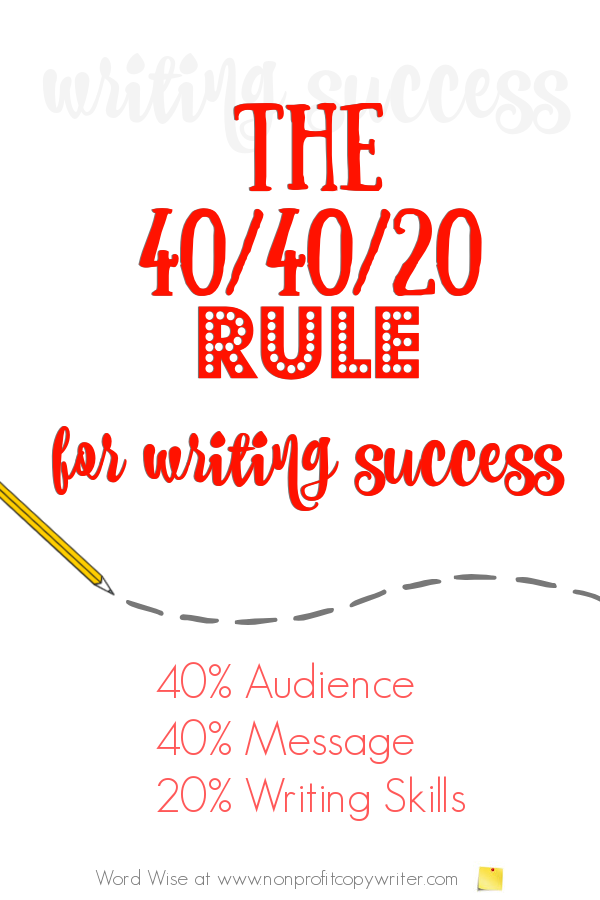
Successful writing is only 20% about your words
Like so many of us, you make a deadly assumption: That successful writing is mostly about talent, grammar, or creativity.
Experienced marketers and professional copywriters know differently. Great writing is only part of the equation.
That’s where the 40/40/20 Rule comes in.
It’s a marketing principle. Simply put, a piece of content’s success depends mostly on who you’re talking to and what you’re offering — not just how beautifully you write it.
The 4/40/20 Rule is credited to direct marketing pioneer Ed Mayer (19076–1975), one of the 1960’s original “Mad Men.”
And although the rule’s roots are in advertising, the formula is surprisingly useful for freelance writers, bloggers, nonprofit writers, SEO writers, email marketers, and content creators today. It’s straightforward:
- 40% of your content’s success is from your choice of audience
- 40% of your content’s success is from your offer or message
- 20% of your content’s success is from the writing itself
At first glance, that last number is shocking to writers. Only 20%? Really?
But once you understand how the formula works, it can completely change how you approach successful writing.
The first 40%: Audience
The first and most important 40% is your audience.
You can write the most brilliant article in the world, but if it’s aimed at the wrong people (or to no one specifically), it won’t perform well. Successful writing starts with understanding exactly who the reader is, what they struggle with, what they want, and what motivates them to keep reading.
When you read a piece of content that feels like it was created just for you — well, you keep reading, don’t you?
This is why experienced writers spend so much time researching readers and their problems before they ever type a headline … search for keywords … choose a slant.
For example, a beginner gardener searching for “why are my tomato leaves turning yellow?” needs very different information than an experienced commercial grower researching soil pathogens. If you confuse the two audiences, your content loses power immediately.
How can you research your audience and find out what they need?
- Read comments and forums
- Look at keyword search intent
- Study customer questions
- Review analytics
- Interview readers or clients
- Understand emotional triggers
The better you know your content’s target reader, the easier successful writing becomes.
Why does the audience matter more than perfect writing?
Many writers secretly believe they need more talent, better vocabulary, or a more impressive style. But often, the real problem is poor audience alignment.
Think about viral social posts. Most are not masterpieces of literary writing. What they do well is connect with a specific audience at exactly the right moment.
That’s why audience targeting is one of the highest-value content writing skills today.
When readers feel like you understand them, they keep reading.
How to check for the first 40%
Your content will gain more traction when you ask, “Who am I writing this content for?” — before you type a single word. If you can give a detailed description of your target reader, you’ve taken a big step towards successful writing.
Example: I am writing this article for new or wannabe content writers who have good basic skills but struggle to break into freelancing.
Use this worksheet from Nonprofit Copywriter to find your content’s target reader.
The second 40%: The message (or offer)
The second 40% of the 40 40 20 Rule focuses on the value you’re presenting in your content.
In traditional marketing, this means the product or offer. For content writers, this translates into the core promise or main benefit of the content.
In other words … why should your reader care? Your content needs a compelling reason for readers to continue reading your content rather than clicking off.
For example …
- “7 Fundraising Email Mistakes That Cost Nonprofits Donations”
- “The Beginner Writer’s Guide to SEO Content Writing”
- “How to Write Faster Without Losing Quality”
You can see a clear benefit or core promise in each of these examples, whether it’s helping the reader avoid mistakes or getting started with a new skill or saving time.
This part of the 40/40/20 Rule is especially important in online writing because readers scroll and then make split-second decisions. If the headline, introduction, or opening promise feels weak, they leave.
Strong offers can include:
- Solving a painful problem
- Saving time
- Making money
- Reducing confusion
- Preventing mistakes
- Achieving a desired outcome
- Learning a shortcut
- Getting emotional reassurance
Successful writing isn’t just about sounding good. It’s about delivering value readers actually want.
Why writers ignore this step
Many writers jump straight into drafting before clarifying the core message or the main idea of the piece. It’s easier than digging deep to find the benefit of the product, service, fundraising appeal, lead magnet, article, blog post …
And it’s tempting to focus on the words instead of asking critical questions, such as: Is this solving an urgent problem? Is the benefit clear? Is the value obvious? Is there a strong reason to act now? You wrongly assume that strong copy can persuade people to want something they don’t already value. Or that excellent writing can mask a nonexistent message.
Successful writers understand that great writing amplifies a strong offer or solid message. It rarely rescues a weak one.
How to check for the second 40%
One of the simplest ways to improve your writing is to check for this second 40% in your writing. Ask, “What is the main transformation or benefit this content provides?”
If you can answer clearly, your writing automatically becomes stronger.
Example: I want new writers to have a simple-to-use, practical tool that helps them create value-laden content for their specific readers.

ID your main idea or core message before you write using this worksheet
The final 20%: The writing itself
Now we arrive at the part most writers expect to matter most: the actual writing.
According to the 40/40/20 Rule, the wording, formatting, style, and presentation account for the final 20%.
Small number. This rule reminds writers that polished sentences alone cannot save poor targeting or a weak message. But that doesn’t mean writing quality is unimportant. Far from it. Weak writing can absolutely damage strong ideas.
Good writing amplifies a strong idea. It rarely rescues a bad one. Yes, by all means, work on your craft. Make sure your skills are up to snuff with …
- Writing headlines
- Storytelling
- Formatting
- Persuasive writing
- Emotional language
- Clarity
- Calls to action
- SEO optimization
- Readability
- Conversational tone
How the 40 40 20 Rule applies to SEO content writing
Here’s how the 40 40 20 Rule aligns perfectly with modern SEO.
- Search engines reward writers who understand search intent (Audience: 40%)
Who are you writing to, and what is the reader actually trying to accomplish? - Search engines reward writers who provide helpful information (Message: 40%)
Does the article solve the problem completely? - Search engines reward writers who produce clear and compelling content (Writing Quality: 20%)
Is the content easy and enjoyable to read?
How freelance writers can use the 40 40 20 Rule
You can use this formula to improve nearly every type of project. Before writing, ask:
Audience questions
- Who is this for?
- What problem are they trying to solve?
- What emotions are involved?
- What objections might they have?
Message questions
- What is the main takeaway?
- Why should readers care?
- What benefit does this content promise?
Writing questions
- Is the introduction engaging?
- Is the structure easy to scan?
- Are examples included?
- Does the content sound conversational?
Take the 40/40/20 Rule Quiz
Take this quiz:
- Do you write content that speaks to “every writer on the Internet” rather than a specific niche audience?
- Do you choose topics based on what you want to say … instead of what readers want to know?
- Do you endlessly tweak wording, obsess over transitions, or chase “perfect” prose while neglecting audience research and topic selection?
If you answered “yes” to any one of those questions — and if you want to reach more readers — then take the 40/40/20 Rule to heart.
- Successful writing starts with identifying a specific reader.
- Successful writing is grounded in curiosity about your reader — not your own self-expression.
- Successful writing invests 80% in understanding your audience and their needs. One of the biggest mistakes you can make is over-investing in the final 20%.
Use the 40 40 20 Rule to write successfully
Create content people genuinely want. Provide an answer that solves the problem immediately or gives the reader value. Show them a significant benefit. Then — and only then — go ahead and clean up all that weak writing.
Writing success comes from matching …
- The right message,
- To the right audience,
- With the right value proposition.
That’s why successful writing today is rarely just about beautiful sentences.
It is about being relevant and useful … to the right reader.
More Writing Tips for New Writers
New writers need just 2 skill sets to succeed ....
The Best Writing Habit for New Writers ...
How To Build Social Proof When You Have Zero Clients or Readers ...
Wannabe Writer? Say Goodbye to Your Worst Enemy ...
Branding Basics for Writers (Especially Non-Marketers) ...
10 Simple Writing Tips for Beginners (and Seasoned Writers) ...
Get Cured of The Imposter Syndrome ...
The 2 Main Ways to Build Your Freelance Writing Business ...
Your Writing: Is It “Good Enough”?
How To Get Ideas for Writing – and Never Run Out ...
Selling Your Services: 6 Writing Tips for Starting Out as a Freelancer ...
The 4 Ps of Marketing for Writers ...
7 Streams of Income for Writers ...
Don’t Market Your Writing. Do This Instead...
How to use writing formulas ...
More writing tips for new writers on our Pinterest board ...
Return from The 40 40 20 Rule for Writers to Nonprofit Copywriter home
As an Amazon Associate I earn from qualifying purchases.
Share This Page

Named to 2022 Writer's Digest list
BEST GENRE/NICHE WRITING WEBSITE


Stop Wasting Time!
Grab your exclusive FREE guide, "5 Simple Writing Tips You Can Put to Use in 10 Minutes or Less"
 Subscribe To This Site