Save Time: Get 5 Simple Writing Tips
you can put to use in 10 minutes
Online Writing: It Plays By Different Rules
Award-winning writer Kathy Widenhouse has helped hundreds of nonprofits and writers produce successful content , with 750K+ views for her writing tutorials. She is the author of 9 books. See more of Kathy’s content here.
Updated 5.7.26
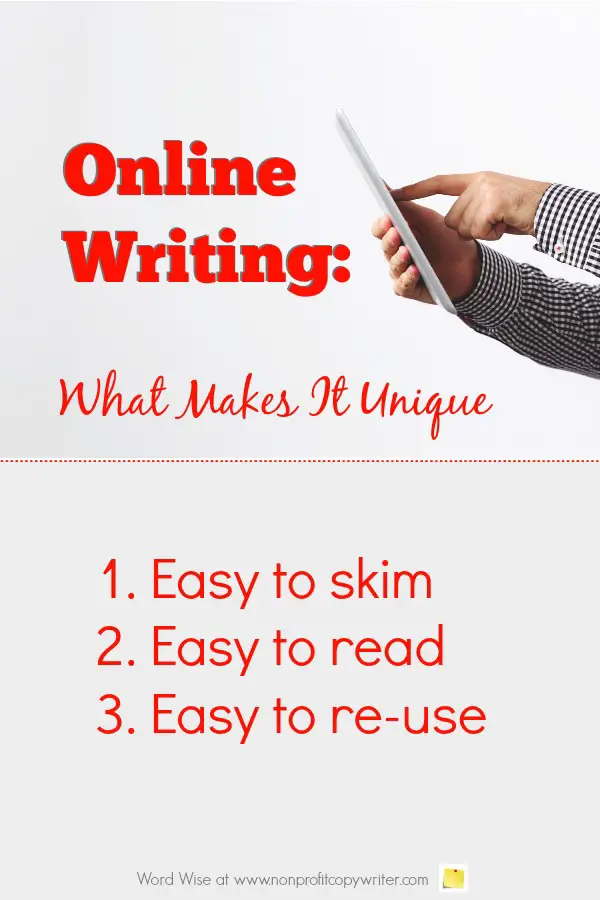
Online writing is any kind of text that you read on a digital device – on a computer, tablet, or smartphone. It’s also called web content writing or digital writing.
Writing online can take different formats – websites, blogs, sales pages, social media posts, eBooks – even text messages. But good online writing is not a simple cut-and-paste job from print matter into the back end of a web page or onto a social media post.
Online writing plays by different rules.
Traditional print writing has its own set of guidelines. You work through a publisher. You examine every word and sentence for proper grammar. You play a long game, because you cannot know a reader’s reaction until he holds the book or the letter in his hands. And in print, once it’s published, it’s done (unless you publish a second edition).
That doesn’t mean online writing is easier—or harder—than print writing or other types of writing. It means it’s different. The reader is different. The environment is different. And the way your words are consumed is different.
Once you understand the online writing “rules,” everything—from structure to tone to word choice—starts to make a lot more sense. Let’s break it down.
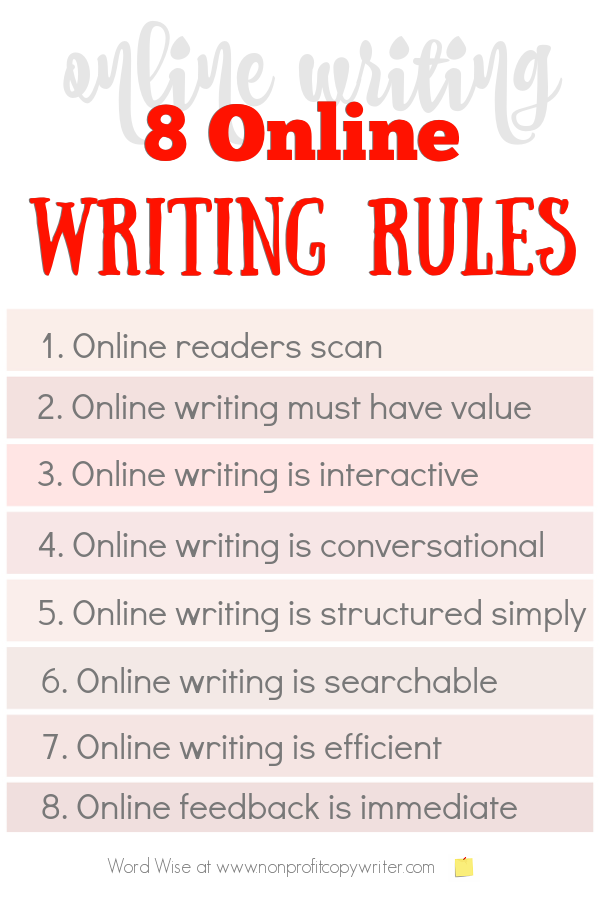
Follow these rules to succeed at online writing
1. Online readers don’t read. They scan.
One of the biggest differences between online writing and print writing is how people consume it. In print, readers move word by word, paragraph by paragraph, through content. However, on the web, most readers …
- Skim headlines
- Jump to subheads
- Scan bullet points
- Read the first few lines… then decide whether to stay
They’re not sitting down with a cup of tea and a highlighter. They’re usually multitasking … on the phone … short on time … looking for something specific.
What this means for writers: Your writing has to be visually inviting and easy to move through. Short paragraphs, clear subheads, lists, and white space aren’t “dumbing things down”—they’re showing respect for the reader’s attention.
2. Online writing must offer value
In print, a reader who opens a book, magazine, or newspaper has already opted in. They’re seated, focused, and mentally prepared to read. Long paragraphs and slow builds work because the reader isn’t deciding every ten seconds whether to quit.
Online, readers arrive undecided. They scan first, sample a few lines, and constantly evaluate: Is this worth my time?
They’re trying to solve a problem … learn something … decide what to buy … get assurance … feel understood. Even entertaining content usually serves a purpose—it gives readers relief, escape, or connection. When you write for the web, you’re not just competing with other articles on the same topic. You’re competing with:
- Email notifications
- Social media
- Text messages
- Ads
- Open tabs
- The reader’s to-do list
What this means for writers: Your opening matters
more than ever. So does your ability to keep momentum. Online writing works
best when it’s helpful and offers value to your reader. That doesn’t mean it
can’t be creative or story-driven. It means the reader should quickly
understand why this piece exists and what’s in it for them.
3. Online writing is interactive
Once print content is published, it’s done. The relationship is one-way.
But online, readers click, comment, sign up, download, share, bookmark, and respond. Content can be updated, expanded, or improved with a mouse click. Even purely informational content often nudges the reader toward a decision or action.
What this means for writers: Links, calls to action, and next steps are part of the writing—not an afterthought. Use them.
4. Online writing is conversational
Offline, dense paragraphs, layered arguments, and extended explanations are expected. The reader is willing to slow down.
But the web rewards writing that feels human. Stiff, academic, overly formal writing tends to fall flat online because it feels slow and distant. Readers respond better to content that sounds like a knowledgeable friend, a helpful guide – or even a trusted expert who doesn’t talk down to them. They want to feel understood, not impressed.
What this means for writers: Online writing works best when it feels like a one-to-one conversation, not a lecture. Contractions are welcome. So are short sentences. So are moments where you speak directly to the reader.
5. Online writing demands a simple structure
In online writing, how information is organized can be just as important as what you say.
Clear structure helps readers find what they need quickly. They stay oriented as they scroll through your content. A simple structure allows readers to understand complex ideas.
That’s why web writing relies heavily on:
- Descriptive subheads. Your subheads, if extracted from your web content, should read like an outline of your piece.
- Logical flow. Good online writing anticipates your reader’s thought process. You explain one point and then anticipate the reader’s next question by answering it.
- Signposting. Guide the reader with signals like “First…”, “Here’s why…”, “The key takeaway…”
What this means for writers: You’re not just writing sentences—you’re designing an experience. Good internal structure makes your content feel easy to digest. Even when the topic is complex, simplify concepts for readers with subheads, bullet points, and lots of white space.
6. Online writing is searchable
Unlike print, online writing is often discovered before it’s read—through search engines, links, and social shares. That means your writing has to work on two levels:
- It needs to be understandable and useful to humans.
- It needs to be clear enough for search engines to categorize.
What this means for writers: Clarity beats cleverness in headlines. Use clear keywords for your topic and position them in your meta description, headline, subheads, and consistently throughout your content. Write to answer a question, and your content will perform better than writing that dances around the point.

Use this worksheet to find keywords for your web content.
7. Online writing is efficient
In print, you can take your time with slow openings, scenic leads, and literary flourishes that give readers room to breathe.
Online? No way. Attention is scarce. Readers want to know quickly, “What is this about—and why should I care?”
What this means for writers: Get to the point fast. Value is front-loaded. You can still tell stories and unpack your point further down the page—but your content must earn its length.
8. Online feedback is immediate
Print writers rarely see how readers respond, and when they do, it’s slow and indirect. Feedback can take months or years.
Online, reactions are instant. You can see what people read, click, skip, share, comment on, or abandon. And you get data that measures your effectiveness.
What this means for writers: When it comes to online writing, you can learn,
adjust, refine, and improve faster than in almost any other medium. That’s a
huge advantage—especially for new writers.
Why online writing is good for writers
If all of these “rules” feel like pressure, here’s the upside to online writing:
- You don’t need to sound brilliant. You need to sound helpful.
- You don’t need fancy words. You need to respect the reader’s time.
When you understand these simple online writing rules, you can stop trying to write the “right” way.
You don’t need to be an expert. Just be a helpful friend.
That’s the more effective approach online – and that’s how you can build true confidence and a following.
More Online Writing Tips
3 Simple Tips for Writing Better Web Pages ...
What Are Keywords in SEO, Anyway? A Simple Tutorial ...
Use 3 Types of Web Traffic to Build Your Blog or Website ...
Build Backlinks and Build Your Traffic: A Beginner’s Guide ...
Searching for Keywords? Use These SEO Writing Terms ...
The Best Word Count for SEO ...
Want Steady Traffic? Write 3 Different Types of Articles that Deliver ...
Contextual Links and Why You Need Them on Your Website ...
How to Write Better Bullet Points ...
Long Tail Keywords: A Quick Guide to Using Unpopular Search Terms ...
What Is SEO Content Writing? Tips for Strong Search Results ...
Web Writing and Writing for Print: how they are different ...
The Inverted Pyramid: Article Writing Format for Online Content, Too ...
Web Content Copywriting for Newbies ...
The Top Online Copywriting Tip ...
3 Ways You Can Make Money Writing Content on Your Own Site ...
How Keywords Work: an overview ...
Keyword Glossary: Quick SEO Jargon at Your Fingertips ...
How to Search for Keywords the Easy Way ...
6 places to use keywords in web pages and blog posts ...
3 Ways to Write Conversationally Online (and Off) ...
Review: Conversational Copywriting - an Online Writing Course ...
More Online Writing Tips on our Pinterest board ...
Return from Online Writing: What Makes it Unique to Nonprofit Copywriter home
As an Amazon Associate I earn from qualifying purchases.
Share This Page

Named to 2022 Writer's Digest list
BEST GENRE/NICHE WRITING WEBSITE


Stop Wasting Time!
Grab your exclusive FREE guide, "5 Simple Writing Tips You Can Put to Use in 10 Minutes or Less"
 Subscribe To This Site