
Save Time: Get 5 Simple Writing Tips
you can put to use in 10 minutes
White Space in Writing: Why It’s Not Wasted
Award-winning writer Kathy Widenhouse has written 9 books and garnered 800K+ views for her writing tutorials.
Posted 9.7.26
Here’s a strange writing tip: Sometimes, the best thing you can add to your writing is nothing.
- No words.
- No clever transition.
- No extra explanation.
Just a little breathing room.
That breathing room is called white space, and it’s one of those simple writing tools that writers often overlook.
What is white space in writing?
White space in writing is the empty areas surrounding your words. Designers also call it negative space.
Think of writing like a conversation with a friend, but the other person talks to you like
thiswithoutstoppingforbreathandcrammedeverythoughtintoeveryavailablemoment,
andsoonyouprobablystartlookingforanescape.
Writing without pauses can feel the same way.
That’s why white space in writing is a valuable tool. It acts like the pauses in a conversation that make things comfortable for your reader.
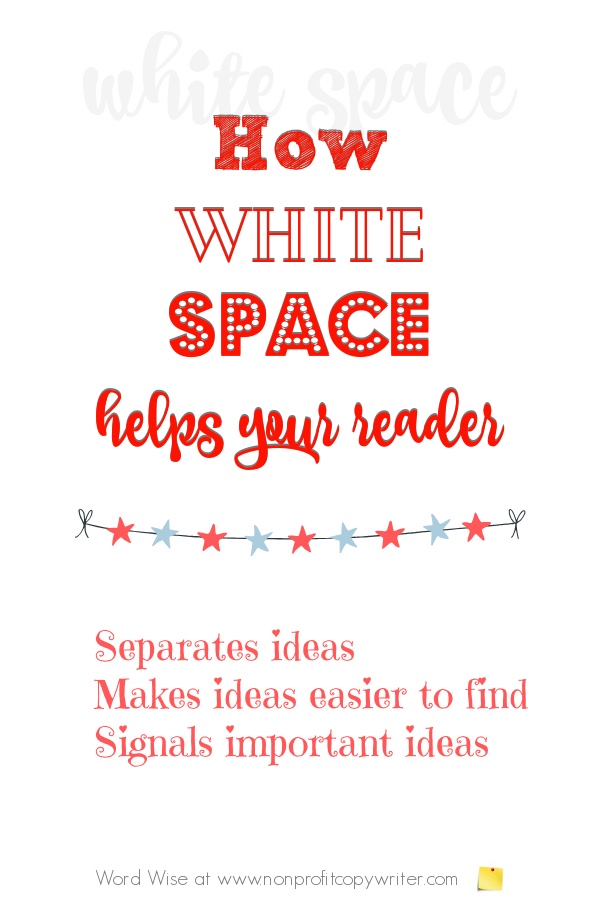
What does white space in writing look like?
White space in writing is openings …
- Between paragraphs
- Around headings
- Between sections
- Around images
- Between lines of text
- Around buttons or calls to action
- Between individual elements on a page
A wall of text says, Here. Read ALL of this.
White space says, Take a breath. Here’s the next thing.
The biggest reason I was afraid to use white space in writing
Early in my writing life, I was afraid of white space. I’ve had to train myself to use it.
My biggest hang-up? I wrongly believed that more words equal more value.
As in, This article needs to be 2,000 words. After all, I want it to rank on Google, right? I can’t leave all that space sitting here!
But a voluminous word count isn’t the same thing as high value. If I can explain something clearly in 1,400 useful words, then padding it to 2,000 words doesn’t magically make it better.
In fact, quite the opposite. Extra wads of content make it harder for my reader to understand my point.
Good writers aren’t paid by the pound.
We are paid to communicate ideas clearly so readers can understand, enjoy, and act on our words.
Two more of my stumbling blocks to using white space in writing
1. I’ve had to unlearn paragraph writing.
It’s what your language arts teachers drilled into you from the time you were 10 years old: You must start a paragraph with a topic sentence. Then, add a few supporting sentences. Write a conclusion. Repeat. Pretty soon you’ve got 16 paragraphs with at least 11 sentences apiece, and each one is more than 23 lines long.
Good for the SAT exam. Crummy for engaging online readers.
Even Google’s developer style guide recommends avoiding “walls of text.” Paragraphs longer than five or six sentences are a sign that you’re trying to pack too much information into one paragraph.
2. I’ve had to learn to write for handheld devices.
Screens have changed how we write.
A five-line paragraph on my desktop might become ten or twelve lines on a smartphone.
Suddenly, that perfectly reasonable paragraph looks like a small novel. Online readers have become accustomed to shorter chunks of information, headings, lists, and other visual signposts.
So a one-sentence paragraph isn’t necessarily bad writing.
It’s good visual writing.
Why is white space in writing so important?
Readers need clues.
Your reader isn’t a word-processing machine. Readers need visual signposts to help them navigate information.
This is particularly important online, where people tend to scan before they commit to reading. Jakob Nielsen’s well-known usability research found that 79% of people scan web pages while only 16% read word by word.
Your reader is not sitting down with a cup of tea thinking:
“Ah, wonderful. A 14-paragraph block of uninterrupted text. I shall savor every sentence.”
- They’re scanning.
- They’re looking for the answer.
- They’re deciding whether your article looks manageable.
- They’re searching for the section that interests them.
That’s a pretty good reason to stop thinking of white space as “empty.”
White space is simply doing a job. It tells the reader where to look.
An example of how to use white space in writing
Imagine you’re writing an article about saving tomato seeds. You could write a tidy little paragraph, like this:
Saving Tomato Seeds
Saving tomato seeds is easy. Choose a ripe tomato, scoop out the seeds, ferment them for several days, rinse them, dry them thoroughly, and store them in a cool, dry place. If you want to save seeds from multiple varieties, be sure to label them so you know what you planted next year. Properly dried tomato seeds can remain viable for several years when stored correctly.
That’s not terrible. But now imagine organizing the information a little differently.
Saving Tomato Seeds
Want to save seeds from this year’s tomatoes?
Here’s the basic process:
1. Choose a ripe tomato.
2. Scoop out the seeds.
3. Ferment the seeds for several days.
4. Rinse and dry them thoroughly.
5. Label and store them.
Same basic information. Completely different reading experience. The second version gives your eye places to land.
That’s what white space does. It creates visual landmarks.
Write with more white space using these 5 simple writing tips, yours free from Nonprofit Copywriter
How to create white space in your content
1. Break content into lists
Your job is to make information easy to find and easy to understand for your reader. The perfect place to do so is when you have a body of content that can be broken into different kinds of lists, like …
- Short paragraphs
- Descriptive headings
- Bulleted lists
- Numbered lists
- Bolded key phrases when appropriate
- Tables
- Short sections
- Plenty of breathing room
These elements create a visual hierarchy. They tell the reader …
Here’s the big idea.
Here’s the supporting information.
Here’s the next thing you need to know.
The key: White space makes important information more important.
2. Break when one idea needs extra attention
Not every idea needs company.
That sentence got your attention, didn’t it? It is standing on its own. Isolation creates emphasis.
This is why a short paragraph — or a one-liner — can have more punch than a long one. The space around the words gives them room to land.
Use this technique strategically for:
- Key takeaways
- Important warnings
- Statistics
- Memorable statements
- Calls to action
- Quotes
- Conclusions
- Transitions
- Images and captions
The key: If you put an important point in the middle of a giant paragraph, it disappears. Set it apart.
3. Break when the idea changes
Caution: Too much random white space isn’t helpful. If every sentence gets its own paragraph, your writing can start to feel like a collection of disconnected thoughts.
Like this.
Seriously.
It gets annoying.
Very quickly.
The goal in using white space isn’t to turn your article into a staircase. The goal is to make the organization of your ideas obvious. Paragraphs should stick to a single idea. You shouldn’t break them apart just for the sake of making them shorter.
The key: Break when the idea changes. Not simply because you’ve reached three sentences.
Drill down your main idea so you can use more white space in your content.
A simple white-space test for writers
Before you publish your next article, don’t just proofread it.
Look at it. Forget the words for a minute. Squint at the screen. What do you see?
If you see one giant gray rectangle, you’ve probably got some work to do. Look for:
- Paragraphs that run too long
- Sections that need headings
- Lists hiding inside paragraphs
- Important information that’s difficult to find
- Places where two paragraphs could become three
- Sections that need a visual break
- Sentences that deserve to stand alone
Then ask yourself: Could my reader find the main point of this section in five seconds?
If the answer is no, white space may help.
White space is not wasted space
I’ve learned to love white space rather than fear it. And that change of heart came from thinking of my readers first.
White space is not space I failed to fill. It’s space I’m giving to my reader.
- I’m giving their eyes a place to rest.
- I’m separating one idea from another.
- I’m making the next section easier to find.
- I’m signaling that something important is coming.
- I’m making a 2,000-word article feel less like 2,000 words.
Good writing isn’t just about the words you put on the page. It’s also about how you arrange those words so your reader can actually use them.
The next time you look at your draft and think, Hmm. There seems to be a lot of empty space here … don’t panic.
You may not have a problem. You may have just given your reader a place to breathe.
And that’s not empty space. That’s good writing.
More Writing Craft Tips
How to Write Better Bullet Points ...
The Case for Short vs. Long Form Content ...
Point of view (POV) explained for copywriters and content writers ...
6 Secrets to Effective Subheads ...
How to Write a Sidebar that Adds Value to an Article ...
Parallel Construction Explained: A Mark of Quality Content Writing ...
10 Simple Writing Tips for Beginners (and Seasoned Writers) ...
More about The Writing Craft on our Pinterest board ...
Return from White Space In Writing to Nonprofit Copywriter home
As an Amazon Associate I earn from qualifying purchases.
Share This Page

Named to 2022 Writer's Digest list
BEST GENRE/NICHE WRITING WEBSITE


Stop Wasting Time!
Grab your exclusive FREE guide, "5 Simple Writing Tips You Can Put to Use in 10 Minutes or Less"
 Subscribe To This Site