Save Time: Get 5 Simple Writing Tips
you can put to use in 10 minutes
Does Your Content Pass The 7-Second Rule?
Award-winning writer Kathy Widenhouse has written 9 books and garnered 800K+ views for her writing tutorials.
Posted 10.2.26
You worked hard on that article.
You researched it. You outlined it. You polished the introduction. You found the perfect statistic. You even came up with a clever headline.
And then Robert Reader lands on the page, looks at it for a few seconds, and thinks, Meh.
Click. He’s gone.
Welcome to The 7-Second Rule.
Before you panic, there isn’t actually a tiny digital referee standing beside every website visitor with a stopwatch. The 7-second figure is a useful rule of thumb, not a scientific law.
But the idea behind it is important: Your reader makes a very fast decision about whether your content deserves more of their attention.
And for content writers, that means the opening seconds matter enormously.
What is The 7-Second Rule?
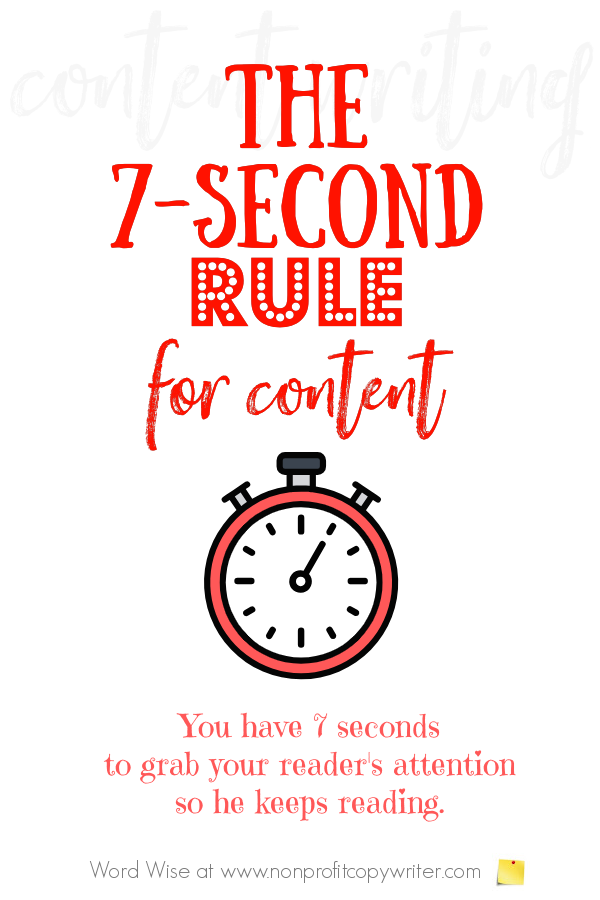
The 7-Second Rule posits that you have roughly seven seconds to grab Robert Reader’s attention and give him a reason to keep reading your article.
Think of those first few seconds as a content audition. Robert is silently asking …
- Am I in the right place?
- Is this going to answer my question?
- Is this useful to me?
- Is this worth my time?
- What am I going to get if I keep reading?
If your opening doesn’t answer those questions — or at least make Robert curious enough to find out — the rest of your brilliant article may never get read.
And here’s the important part: Passing the 7-Second test doesn’t encourage flashy content.
It shows you’ve made your article’s value obvious.
Research backs up the 7-Second Rule concept
While there isn’t a “7-second rule” per se, backed up by research, usability studies show that the first few seconds of a web visit are critical.
Nielsen Norman Group has found that users often leave webpages within the first 10–20 seconds. The first 10 seconds are particularly important. Pages that clearly communicate value to a particular reader have a better chance of holding attention.
Further, 79% of test users scanned a new page, while only 16% read word-by-word.
Which means Robert Reader isn’t necessarily sitting down with a cup of coffee saying, “Let’s carefully study this 1,500-word article.” He’s more likely thinking:
- “Can this page help me?” Scan.
- “Maybe this section?” Scan.
- “Oh, that’s interesting.” Read.
Your job is to make those moments happen.
The 7-second mindset
Maybe you’re like my early writing self, who spent the bulk of my writing time in the article body. I thought in terms of proportions. The body is longer than the hook, so I should spend more time on it than the headline and opening — right?
Nope. You must persuade right out of the gate. Your first sentence carries a lot of weight. It needs to make the second sentence feel worth reading.
Consider these two openings.
Version A: In today’s fast-paced digital environment, content writers face many challenges when trying to capture and maintain the attention of their target audiences.
Technically fine. Emotionally? Zzzzz.
Version B: You can write the best article on the internet and still have nobody read it.
If I’m Robert Reader, I want to know why.
How to beat the 7-Second Rule
Don’t try to cram your entire article into the opening. Instead, give readers four things.
1. Tell Robert Reader he is in the right place
Avoid the “warm-up” intro. The biggest mistake you can make is easing into a topic with generic sentences like “Let me tell you a story…” or “I’ve been thinking a lot about…”. These lines take up precious seconds without giving the reader any immediate value.
Skip the preamble. Tell Robert he is in the right place.
He has searched for “how to write a fundraising letter” and lands on your page. So don’t make Robert wade through three paragraphs about the history of philanthropy. Tell him what he’ll get, like …
Want to write a fundraising letter without staring at a blank screen for three hours? Here’s a simple five-part formula you can use today.
Boom. Robert knows this is for me.

Show readers they’re in the right place by using this FREE worksheet to write a solid headline.
2. Lead with Robert’s problem
If you address a highly relatable pain point or frustration in your first sentence, Robert Reader’s brain flags the content as personally relevant.
In truth, Robert doesn’t care that you’re writing about fundraising letters. He cares that his nonprofit needs donations.
Instead of: This article explains five types of calls to action to use in your fundraising letters.
Try: Still getting zero engagement with your fundraising letters despite spending hours writing them?
Now you’ve introduced a problem and promised a solution. See the difference? Put another way, you’ve emphasized benefits over features. Features are facts that describe the content (“five types of calls to action to use in your fundraising letters”). Benefits explain why the reader should care about your content (“Still getting zero engagement?”)
Lead with “why you should care.”
3. Create an information gap for Robert
Curiosity is a useful tool. At the start, give your reader just enough information to make them think, “Wait. What?” Use a counterintuitive fact, a challenge to a common belief, the promise of a specific transformation…
For example: Your introduction may be the reason people aren’t reading your fundraising letter. And the problem may not be your writing.
That’s a challenge to a common belief, which says that successful fundraising letters are rooted in grammatically correct writing. And if I’m reading that opening line, I’ve now got a question. What’s wrong with the introduction to my letter? I’m going to keep reading to find out.
There’s a fine line here. Don’t use clickbait. Your headline and introduction should create curiosity that your article actually satisfies.
A reader who clicks because you promised an answer — and gets the answer — is happy.
But if Robert clicks because you made a dramatic promise and gets a completely unrelated lecture? Not so much. You’ll lose his trust.
4. Make your content easy for Robert to read
A 7-second window means Robert isn’t looking at individual words yet. He is looking at the overall format. Nielsen Norman Group’s eye tracking research found that people frequently scan webpages in an F-shaped pattern, paying particular attention to information near the top and toward the left side of the page.
If Robert sees a dense wall of text, he will feel overwhelmed by the work involved … and he’ll bounce away.
Make it easy for him to consume your content.
- Use short, punchy sentences.
- Create white space by keeping paragraphs to 1–3 sentences.
- Use bolding or bullet points to create visual anchors for the eye.
Make your writing easier to read with these 5 simple tips -- yours for FREE.
Take The 7-Second Test
Here’s a simple exercise you can use the next time you finish writing an article draft. Forget the body copy for a moment. Look only at …
Now ask, if I knew nothing about this article, would I immediately understand why I should keep reading?
If the answer is no, don’t immediately rewrite the whole thing.
Start small.
- Make the headline more specific.
- Strengthen the first sentence.
- Tighten the first paragraph.
- Make your subheads useful.
Suddenly, your page becomes much easier to scan. And much harder to abandon.
Great content isn’t just about what you have to say. It’s also about whether you can convince a busy, distracted, scrolling reader to stick around long enough to hear you say it.
You’ve got a few seconds. Make them count.
More Content Writing Tips
Get Powerful Content When You Ask this ONE Question ...
Identify Your Audience With These 3 Questions ...
The 2 Best Ways to Narrow Your Topic for Your Content..
How to Build a Content Writing Strategy for Your Blog or Website ...
Your Elevator Speech: Can You Explain What You Do in 30 Seconds?
How To Choose Content Topics for Your Content Calendar ...
7 Content Ideas to Build Your Audience ...
The Case for Short vs. Long Form Content ...
7 Different Types of Content Writing You Need to Master ...
More Tips for Writing Content on our Pinterest board ...
Return from The 7-Second Rule to Nonprofit Copywriter home
As an Amazon Associate I earn from qualifying purchases.
Share This Page

Named to 2022 Writer's Digest list
BEST GENRE/NICHE WRITING WEBSITE

Stop Wasting Time!
Grab your exclusive FREE guide, "5 Simple Writing Tips You Can Put to Use in 10 Minutes or Less"
 Subscribe To This Site