
Save Time: Get 5 Simple Writing Tips
you can put to use in 10 minutes
How to Make Your Content Unique: 5 Ways to Stand Out in
the Age of AI
Award-winning writer Kathy Widenhouse has written 9 books and garnered 800K+ views for her writing tutorials.
Posted 11.7.26
Once upon a time, being a good content writer meant knowing how to string together sentences, research a topic, and explain something clearly.
Those skills still matter. But there’s a new kid on the block.
And this kid can churn out a 1,000-word blog post before you’ve finished your morning coffee.
Hello, artificial intelligence.
AI has changed the content writing game. Suddenly, just about anybody can produce articles, emails, website copy, and social media posts with a few clicks.
Which raises a rather uncomfortable question for freelance writers.
If AI can write content so quickly, why would anybody pay you to do it?
The answer is surprisingly simple.
There’s a big difference between producing content and creating content that’s worth reading.
The secret is in how to make your content unique — not merely different from everything else online, but genuinely more useful, interesting, and memorable.
And that’s where you, dear human writer, have an opportunity. Unique content isn’t simply content that passes a plagiarism checker. Nor is it an article that rearranges familiar information into different sentences. That’s rewriting.
Your unique content gives readers something they didn’t have before.
Your reader wants the unique, the offbeat — even the wacky
Think about the last time you searched online for an answer. You probably found several articles saying roughly the same thing … same advice … same examples … same straight-laced tone.
Then you found one that made you think, Aha! Now I get it. Or, Hm. That’s a twist.
That’s the article that you want to write.
Google encourages this approach, too. Its guidance on creating helpful, people-first content asks whether articles offer original information, research, analysis, and meaningful value beyond what’s already available.
Don’t just add more words to the internet. Add something useful or valuable or even unconventional. Here’s how.
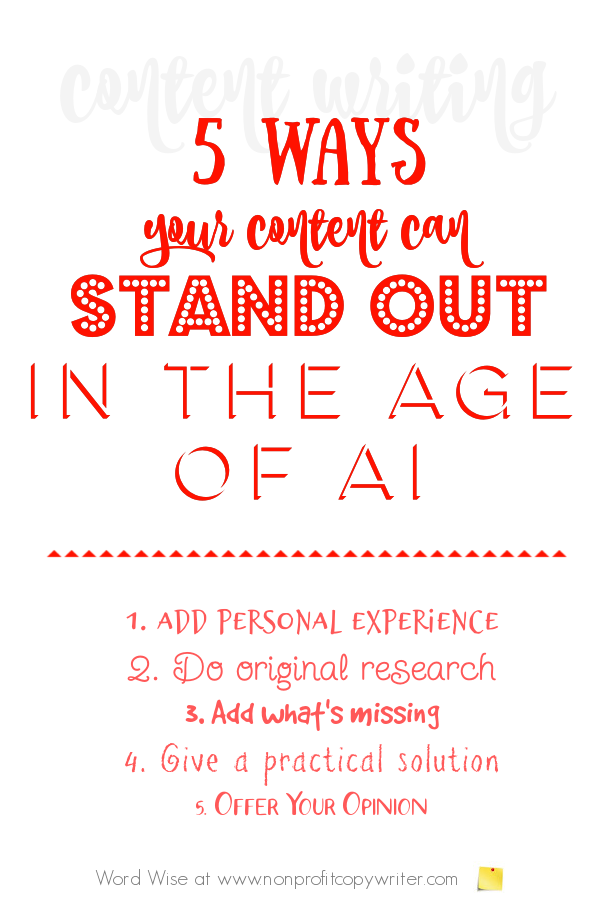
5 ways to make your content unique, valuable, useful … and human
1. Add your own experience (even if you’re a beginner)
AI can summarize thousands of articles about traveling to the Caribbean. But it hasn’t piloted a Tall Ship to Abaco for 7 days with your Boy Scout troop. (My son did.)
Let me toot your horn for a minute. You have something AI doesn’t: firsthand experience. Those experiences can make your writing more credible, relatable, and interesting. For instance …
- Generic content: “Freelance writers should establish a regular writing schedule to improve productivity.”
- Content with personal experience: “When I started freelancing, I waited until I felt inspired to write. Some days, inspiration never showed up. Eventually, I discovered that writing for 30 minutes before checking email helped me get more done than waiting around for my muse.”
See the difference? The second version gives readers a real situation, a lesson, and a practical idea to try.
How to add experience to your content
- Share something you tried and explain what happened.
- Describe a mistake you made and what you learned.
- Walk readers through a problem you solved.
- Include before-and-after examples from your own work.
- Explain what surprised you while researching or completing a project.
Freelance writing tip: Don’t assume you need 20 years of professional experience to have something valuable to say. Use the life experiences you’ve already accumulated.
2. Do a little inventive digging
AI-generated articles are built from other online articles. One writer quotes a statistic. Another repeats it. Before long, the same fact appears on dozens of websites.
One easy way to make your content unique is to use information others haven’t bothered to find — or that is proprietary to you.
Suppose you’re writing an article about the challenges of working from home. Rather than simply listing common problems, ask five remote workers what distracts them most.
ChatGPT doesn’t take the time to do this.
Maybe you’ll discover that interruptions aren’t their biggest problem. Instead, it’s the difficulty of shutting down work at the end of the day. Now you’ve got a fresh angle. Even better, you’ve got original observations that can make your article stand apart.
To dig inventively, you can …
- Conduct a mini interview. Ask an expert or someone with relevant experience three thoughtful questions.
- Run a small poll. Ask your newsletter subscribers or social media followers for their opinion or about their experiences.
- Test something yourself. Compare two writing tools, headline approaches, or productivity methods — and write about what you decide works or doesn’t work for you.
- Find primary sources. Go directly to original studies, government reports, or research organizations. Gather that info and draw your own conclusions. Yes, do your own critical thinking and analysis!
- Collect real examples. Scrutinize actual websites, emails, advertisements, or articles to illustrate your points.
- Use personal data. Draw on the anecdotal evidence you find at your workplace … in your classroom … from your organization.
Sure, five interviews don’t constitute a scientific study. But dig up your own data, and you’ll have original material. Plus, you’ll have fun!
Freelance writing tip: Original research can become part of your selling proposition. Instead of telling a prospective client, “I’ll write a 1,200-word article,” try: “I’ll write a 1,200-word article that includes an original interview with an industry professional.”
Now you’re offering something more valuable than word count. You’re offering information readers won’t find anywhere else.
3. Use the “What’s Missing? method
“There’s nothing new under the sun.” So wrote King Solomon (970–931 BC) about 3,000 years ago. Then as now, just about every subject has been covered.
But while every subject has a finite amount of information, it has an infinite number of slants.
For instance, let’s say you’ve been assigned an article about email marketing. Yawn. Not because email marketing is boring. But because there are approximately a gazillion articles explaining how to write better emails.
Instead of writing another generic guide, do a bit of homework. What’s not been written about email marketing? And get very, very specific. Develop topics like …
- Why your beautifully written emails aren’t getting opened
- Five email mistakes small nonprofits make without realizing it
- What I learned after rewriting 20 email subject lines
- How to write a welcome email when you have only 50 subscribers
- Why shorter emails aren’t always better
You’re not writing a definitive version of a topic. You’re giving the topic a specific purpose … and specificity is your friend.
Here’s how to find those funky slants
Before you write, examine several articles that already rank for your topic. Ask yourself:
- What questions do these articles leave unanswered?
- Which examples are missing?
- Are they overlooking a particular audience — or can I write for a very specific reader?
- Is there a common assumption worth challenging?
- What could I explain more clearly or thoroughly?
The answers reveal a fresh angle you can take.
Freelance writing tip: A fresh angle can also help you find a niche. When you learn to approach familiar subjects from a particular audience’s perspective, you become more useful to clients serving that audience. And useful writers are easier to hire.

Find your own unique slant with this useful checklist.
4. Give readers something they can actually use
Let’s say you’ve written a wonderful article explaining how to create a content calendar. You’ve covered the benefits. You’ve explained the steps. You’ve included some examples.
Good job!
But what if you also gave readers a simple content calendar template they could start using immediately? Now your article isn’t just informative. It’s actionable.
That’s a powerful way to add unique value to content. Readers appreciate information … but they can get information from ChatGPT. Readers really appreciate information that helps them accomplish something for themselves.
Turn information into a useful tool when you offer …
- Checklists: Help readers complete a process without missing a step.
- Templates: Give them a starting point they can customize.
- Worksheets: Walk them through a decision or planning exercise.
- Comparison charts: Make complicated choices easier.
- Step-by-step examples: Show exactly how a process works.
- Troubleshooting guides: Help readers solve problems when things go wrong.
Freelance writing tip: Ask, What can my reader do after reading this that they couldn’t do before? Make sure you have a practical answer.
5. Add your own opinion
AI can imitate conversational writing. It can generate jokes, create metaphors, produce friendly paragraphs, and sprinkle personality into sentences.
But AI cannot make thoughtful choices about what deserves emphasis … what advice is overrated … what matters most to your audience.
You can. For example …
- Generic content: “Writers should publish blog posts consistently to maintain audience engagement.”
- Content with a point of view: “Publishing three forgettable blog posts every week won’t do your website much good. Been there … and my traffic didn’t increase one bit. If you’re a new writer, publish one genuinely helpful article a month and over time, you’ll build true fans.”
The second version takes a position. I’m giving you my opinion and I’m explaining it to you.
How to add your point of view
You don’t have to have an opinion about everything. But when you do, use your opinion to take a stand. Share what generates your point of view … the evidence you’ve seen … the experiences you’ve had.
Freelance writing tip: Practice writing the same paragraph for three different audiences: a small business owner, a nonprofit director, and a new freelance writer. Notice how you share different experiences with different audiences. This is a skill that prospective clients value because they want to connect with their readers.
Use this step-by-step worksheet to ID your core message to use in your marketing.
How to make your content unique when you’re using AI
Now for the million-dollar question. Can you use AI and still produce original, valuable content?
Absolutely. AI can be a useful writing assistant. It can help you brainstorm angles, organize research, outline articles, and identify gaps in your draft.
The problem isn’t using AI.
The problem is publishing generic output without adding meaningful human effort.
Google’s guidance on generative AI content emphasizes accuracy, quality, relevance, and added value. Producing large quantities of content without offering readers something useful can run afoul of its spam policies.
So think of AI as an assistant, not your replacement. Let it help with the groundwork. Then do the work that makes the finished piece worth reading.
Why unique content matters for freelance writers
When you’re starting a freelance writing career, it’s tempting to compete on price. You figure that if you can write an article for less than the next freelancer, you’ll win the assignment.
But that strategy presents a problem. There’s almost always somebody willing to write for less. And AI has made basic content production faster and cheaper than ever.
That’s why learning how to make your content unique is also learning how to make yourself more valuable as a freelance writer.
- You can offer clients more than a finished document.
- You can offer original interviews, careful research, practical resources, audience insights, and writing that reflects their brand’s personality.
- You can explain not just what you wrote, but why your approach will be useful to their readers.
That’s a much stronger selling proposition than promising 1,000 words by Friday. And it’s a skill you can continue developing throughout your writing career.
Your greatest writing advantage? You’re human.
The next time you sit down to write an article, don’t start by asking, “What can I say about this topic?”
Ask a better question: “What can I add that my reader won’t find just anywhere else?”
That’s how to make your content unique.
And that’s how you become the kind of writer clients want to hire (or read) again and again.
More about Your Uniqueness
Don't Be A Writer For Everyone. Choose Your Niche Audience...
How Are You Unique? Write Your Personal Brand Statement...
What Is a Freelance Writing Niche? Frequently Asked Questions
How to Find Your Niche: Take the Quiz...
What's Your USP (Unique Selling Proposition)?
The Most Important Factor in Choosing A Content Writing Niche
Should You Specialize in a Freelance Content Writing Niche?
Do Writers Get Imposter Syndrome? Here's What You Can Do About It
Why Consistency Beats Talent In Writing ...
As an Amazon Associate I earn from qualifying purchases.
Share This Page

Named to 2022 Writer's Digest list
BEST GENRE/NICHE WRITING WEBSITE



Stop Wasting Time!
Grab your exclusive FREE guide, "5 Simple Writing Tips You Can Put to Use in 10 Minutes or Less"
 Subscribe To This Site