
Save Time: Get 5 Simple Writing Tips
you can put to use in 10 minutes
6 Copywriting Templates Every Writer Should Steal
Award-winning writer Kathy Widenhouse has written 9 books and garnered 800K+ views for her writing tutorials.
Award-winning writer Kathy Widenhouse has written 9 books and garnered 750K+ views for her writing tips, found here.
Posted 8.19.26
If you write, you’re in the sales business. (Bold statement, I know.)
Maybe you’re not writing to sell a product. But as you write that article or blog post or book, you’re selling an idea, a perspective, a cause, or a story. Every piece that you write asks your reader to do something …
- Make a decision
- Change their mind
- Take an action
- Remember a principle
- Identify with a cause
- Start a conversation
- Make an internal commitment
… even simply to keep reading.
That’s why all writers — not just copywriters or marketing writers — should be familiar with copywriting templates.
And yes, we should steal them from our copywriting friends.
A copywriting template is a structured blueprint for persuasion. And no, you won’t sound like an AI bot when you use a copywriting template. A writing template doesn’t make your writing formulaic. It makes your writing intentional.
Why copywriting templates work
A writing template provides a handy outline for you to follow. Good templates are proven and have stood the test of time. They’re effective when used by all kinds of writers in all kinds of niches because …
- Copywriting templates mimic how humans process information. Psychologist Daniel Kahneman, author of Thinking, Fast and Slow, explains that much of our decision-making is fast, emotional, and pattern-driven. A template like Problem-Agitate-Solution? Yep, our human minds love a shortcut — one that’s quick and creates tension, clarity, and forward momentum — just as a novelist needs readers to turn the page eagerly. Structure fuels that momentum.
- Copywriting templates force clarity. We writers are trained to focus on expression — voice, description, craft. To write with beautiful words. Copywriting formulas shift the focus to outcome: What is the reader thinking right now? What question do they need answered next? What resistance needs addressing?
Legendary advertiser David Ogilvy famously said, “If it doesn’t sell, it isn’t creative.” If you want readers to embrace your point, you need a clear plan to make that point. - Copywriting templates reduce guesswork. They are time-tested frameworks used by professionals for decades because they work. I like to think of writing templates as maps I can follow as I write. The map gives me confidence (“This has worked for zillions of other writers!”) and freedom (“Plus, I can inject my own style and personality.”)
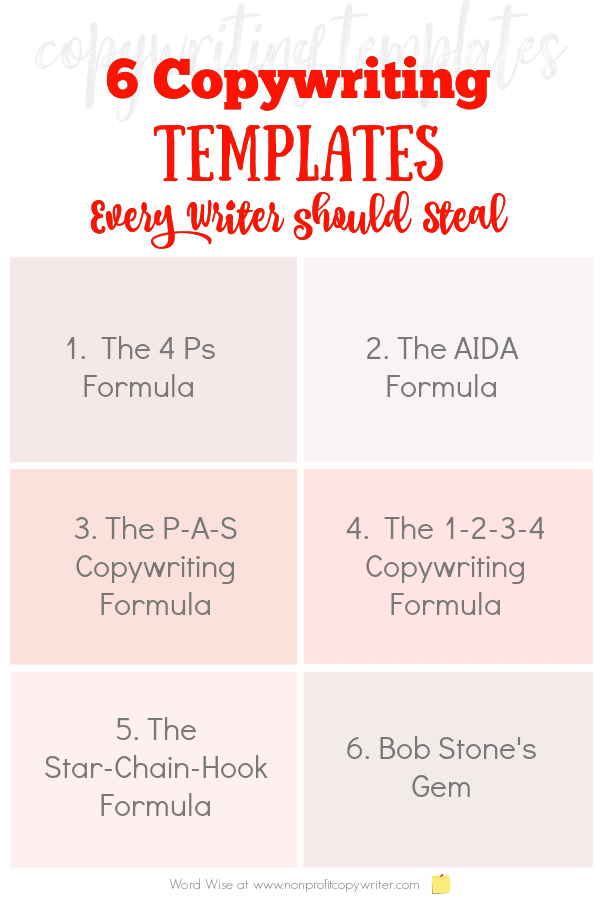
6 copywriting templates you should try
Here are my 6 favorite copywriting templates. I use them all the time when I write content. (And when I write copy, of course.)
1. The 4 Ps
The 4 Ps copywriting template grew up in the early–mid 20th century, alongside mail-order advertising, newspaper ads, and magazine sales letters. Advertising pioneers like Claude Hopkins (1866 -1932), John E. Kennedy (1864 -1928), and Victor Schwab (1898–1965) used the bones of the 4 Ps — even if they didn’t call it that. Their ads consistently …
- Led with a clear benefit.
- Helped readers imagine life after the purchase.
- Backed claims with reasons, demonstrations, or testimonials.
- Ended with a clear call to act.
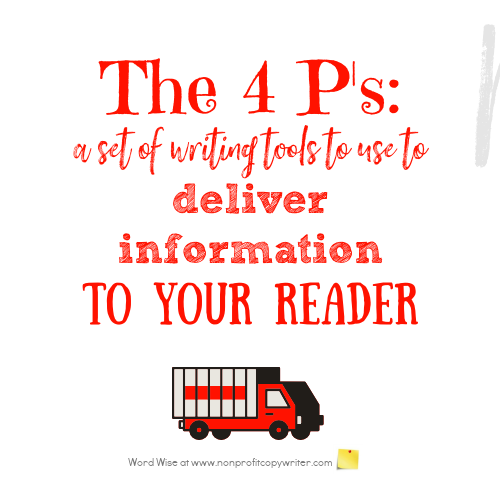
The template is a mnemonic device — a word, phrase, or sentence that helps you remember a message or group of objects. Each of the 4 Ps helps you recall the structural parts to a persuasive piece of content. It’s a series of four questions your reader needs answered to be persuaded. Each task begins with the letter P:
1. Promise: Capture your reader’s attention with a benefit. He asks, What’s in it for me?
2. Picture: Build your reader’s desire. He asks, What does this look like in my real life?
3. Proof: Earn your reader’s belief with facts. He asks, Why should I believe you?
4. Push: Move your reader to act. He asks, What do I do now?
Use your content to answer each of the questions — in order. The 4 Ps is a useful writing formula to follow for writing articles, blog posts, and presentations.
2. The AIDA Formula
The AIDA formula started its life as a tried-and-true advertising model. It is a framework credited to American advertising pioneer Elias St. Elmo Lewis (1872–1948).
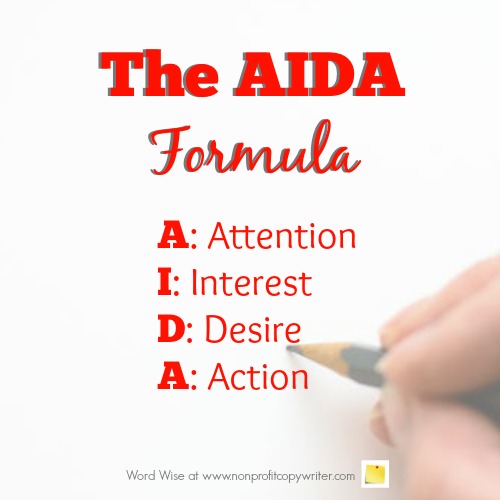
Much like The 4 Ps, the AIDA formula outlines 4 stages a consumer goes through when making a purchasing decision. Those 4 stages are:
- A: Attention. Grab the reader’s attention with an interesting fact, story, statistic, or startling statement about a problem and the need for a solution.
- I: Interest. Keep the reader’s interest by explaining the need or the problem further — and why your organization or product or solution is the answer to the problem.
- D: Desire. Build the reader’s desire to alleviate the problem by outlining the benefits of your product, service, or cause.
- A: Action. Move the reader to action with clear instructions about what she should do, such as buying a product now or giving a gift before it is too late.
A reader becomes aware of the product, then develops interest in its benefits, cultivates a desire for it, and finally takes action to buy it.
The formula worked so well in persuading consumers to consume that it’s been seized by content writers. A reader becomes aware of the problem presented in the content, then develops interest in the writer’s solution, cultivates a desire for it, and finally takes action to embrace the next step.
3. The P-A-S Copywriting Formula
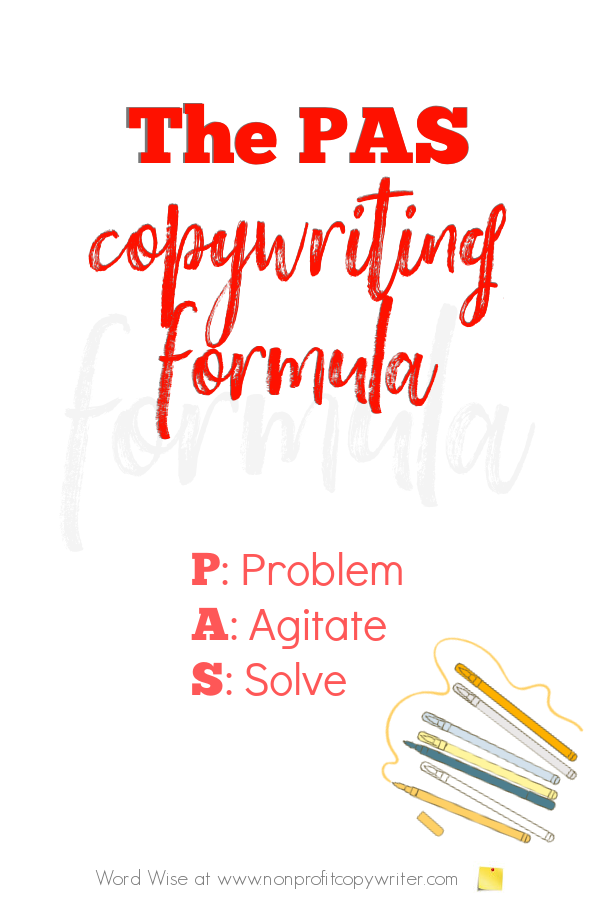
The PAS copywriting formula, says millionaire-maker and business strategist Dan Kennedy, is “the most reliable sales formula ever invented.” The framework is straightforward.
- Problem: You start by describing a problem. When you set forth a problem in your writing, you uncover readers’ pain. Readers are not interested in staying in that zone of discomfort.
- Agitate: Then you point out what would happen if the problem persisted or got worse. Stir it up — agitate — and readers want out.
- Solution: By now, readers are ready to jump at your solution. You show readers why they’re uncomfortable and offer them an out. So you explain how your answer, product, or service solves the problem.
Because P-A-S is so neat and tidy, it’s particularly useful for social media posts.
4. The 1–2–3–4 Copywriting Formula
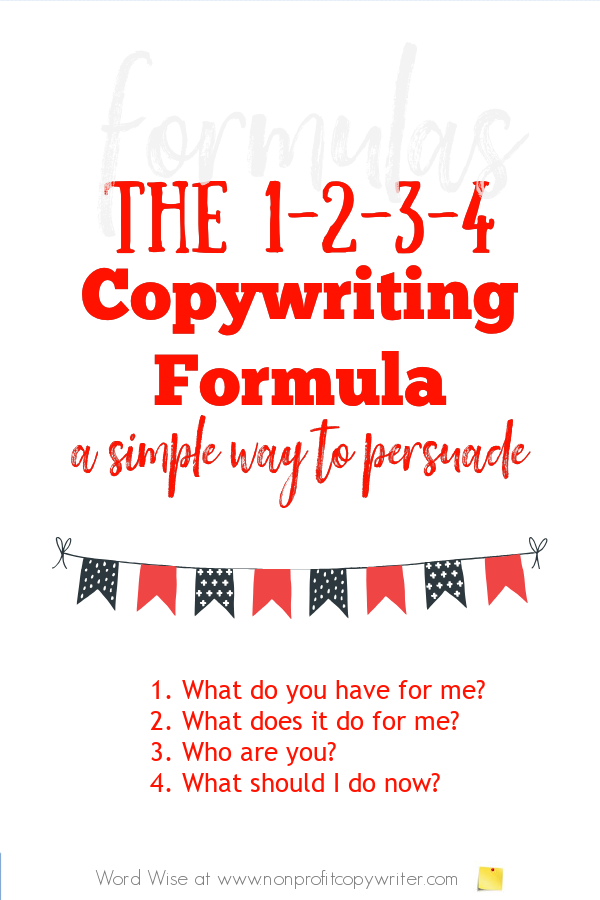
Like The 4 Ps, the 1–2–3–4 Copywriting Formula is a series of four simple questions — questions your reader asks quietly in her mind. Each represents a piece of information the reader must know to be persuaded.
The four questions are …
- What do you have for me?
- What is it going to do for me?
- Who are you and why should I believe you?
- What should I do next?
When you answer each of those questions, your writer sees that you understand her. She is more apt to be persuaded to buy, give, click, respond, or act. Or in the case of a piece of content, she is more apt to embrace your idea, ask for more information, or change her mind about an issue.
5. The Star-Chain-Hook Formula
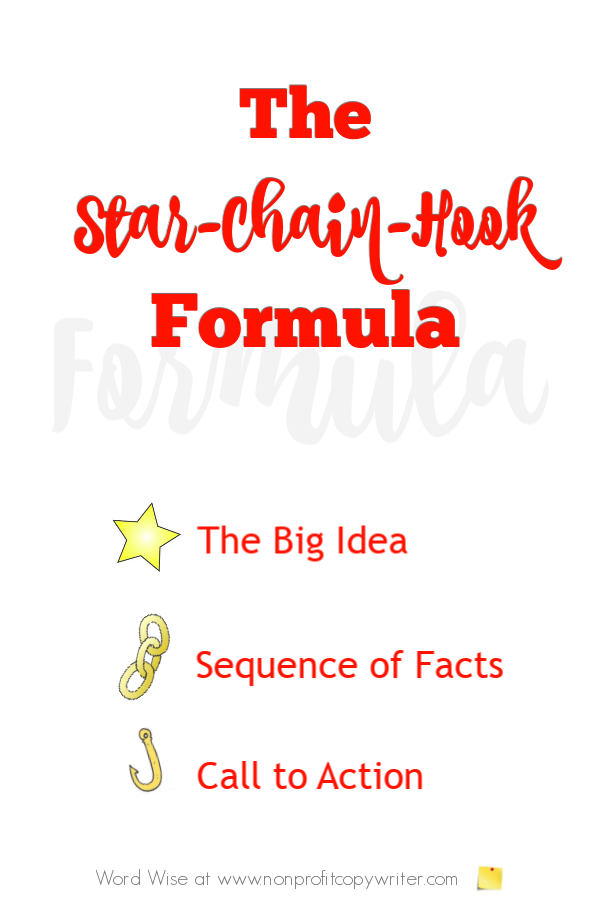
Years ago, Dr. Frank Dignan of the University of Chicago Press created this lovely word picture as a guide in crafting a letter or advertising message. It prescribes the same elements as AIDA and the 4 P’s, but uses metaphors to explain how to set them up.
- Star: Start with an attention-getting opening that is positive and upbeat. Think of the “star” as your Big Idea.
Example of a Big Idea: “Golden retrievers are among the most intelligent, easy-to-train canines.” - Chain: Create a chain of convincing facts, benefits, and reasons that transform the reader’s attention into interest and interest into desire. Each word and paragraph is a link within that chain. Links in the chain must be strong to lead the reader to the desired outcome.
Example of a Chain: “Golden retrievers can learn a command in less than five repetitions. In fact, goldens can begin retrieving objects when they are less than eight weeks old. Even your adult golden can learn commands when you know how to prompt them.” - Hook: Entice the reader with a powerful call to action, making it easy to respond. Even if one or two links in the chain are weak, a strong hook at the end will compel the reader to act … reeling him in. If you’ve drilled down to one Big Idea at the top of your piece and then created a credible chain of persuasive facts, then you will only need a short hook to convince the reader to take action.
Example of a Hook: “Click here to see how to help your golden retriever learn three basic commands. And let me know if you have any questions.”
Star-Chain-Hook is unique among persuasive formulas because it focuses on a series of positive, upbeat facts and logic to get the reader to act.
6. Bob Stone’s Copywriting Formula
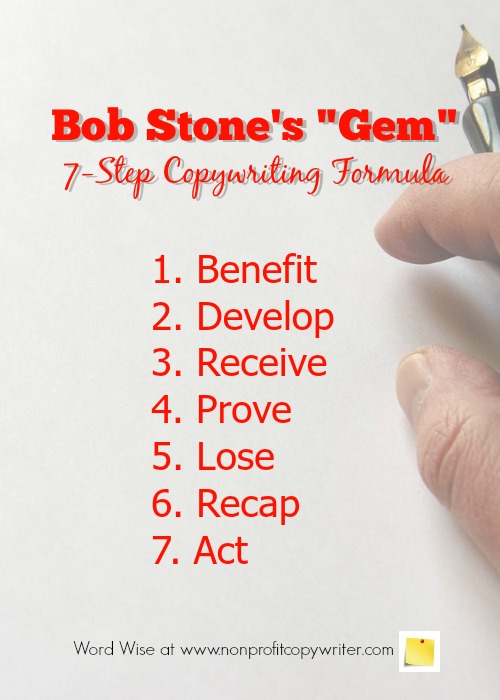
This highly-respected copywriting formula created by direct marketing pioneer Bob Stone (1919–2007) remains an enduring tool even decades later. Stone’s 7-step formula was originally meant for sales letters and direct response advertising.
Yet copywriters everywhere have learned that “Bob Stone’s Gem” (as it is fondly called by marketing professionals) is useful in nearly any kind of content … because it focuses on benefits.
- Benefit. Begin with your strongest benefit — either in the headline or first paragraph.
- Develop. Expand on the most important benefit.
- Receive. Tell the reader specifically what he will get, using all details, features, and benefits.
- Prove. Demonstrate how those benefits are true and valuable by providing proof, facts, evidence, and endorsement.
- Lose. Tell the reader what he will lose and what benefits he’ll miss out on if he doesn’t act.
- Recap. Sum up the most important benefits.
- Act. Give a call to action. Tell the reader to respond immediately and give him a good, logical reason why they should. Show how the benefits will kick in.
This FREE glossary can help you get familiar with copywriting terms.
Why should you steal these templates for your content?
Look closely at these 6 formulas, and you’ll see they’re pretty similar. They point to a key truth about writing successful content: Your job as a writer is to focus on your reader, the problem he needs to solve, the solution you offer — and how you can move him to act.
Copywriting templates pave the way to that end.
Try these 6 different approaches. You’ll soon find one or two (or more) that work best for you — in any piece of content.
You needn’t fret about sounding “salesy.” Rather, you’ll see how a copywriting template gives you clarity and structure as you write. A template trains your brain to:
- Lead with the reader’s problem
- Build emotional tension
- Present transformation
- Direct the next step
That’s not “sales writing.” That’s effective communication.
And every writer — bloggers, authors, freelancers, nonprofit communicators, and content marketers — wants that. I do. Don’t you?
More Writing Formulas and Writing Templates to Try
How to use writing formulas ...
The Foolproof Article Formula I’ve Used to Write 1,000+ Articles ...
Write Great Headlines With One Simple Formula ...
The 40 40 20 Rule for Writers: A Smarter Formula for Successful Writing ...
Formulas for Writing: the 2 kinds of categories they're grouped into ...
The SELWAB Formula: great for writing leads and headlines ...
How To Create a Lead Magnet: A Simple Writing Formula ...
5 Proven Headline Formulas ...
See more on our Writing Formulas Pinterest board...
As an Amazon Associate I earn from qualifying purchases.
Share This Page

Named to 2022 Writer's Digest list
BEST GENRE/NICHE WRITING WEBSITE


Stop Wasting Time!
Grab your exclusive FREE guide, "5 Simple Writing Tips You Can Put to Use in 10 Minutes or Less"
 Subscribe To This Site