
Save Time: Get 5 Simple Writing Tips
you can put to use in 10 minutes
Article Writing Tips: News Story vs Feature Story - What's The Difference?
Award-winning writer Kathy Widenhouse has written 9 books and garnered 800K+ views for her writing tutorials.
Updated 3.3.26
The difference between a news story and a feature story can feel blurry.
- They both tell stories.
- They both inform readers.
- They both might appear in the same publication.
But they are not the same animal. And plenty of writers confuse them.
That’s a no-no.
Both news articles and feature articles are standard fare in magazines, newspapers, newsletters and blogs. But you don’t want to deliver a full-fledged feature when your client, an editor, or a publication asks for a news story. And vice versa.
Understanding the difference affects how you research, structure, pitch, write, revise, and even how you get paid. A good set of article writing tips must simplify the distinctions.
And as you may know, I’m all about simplifying the writing process.
So here’s the gist:
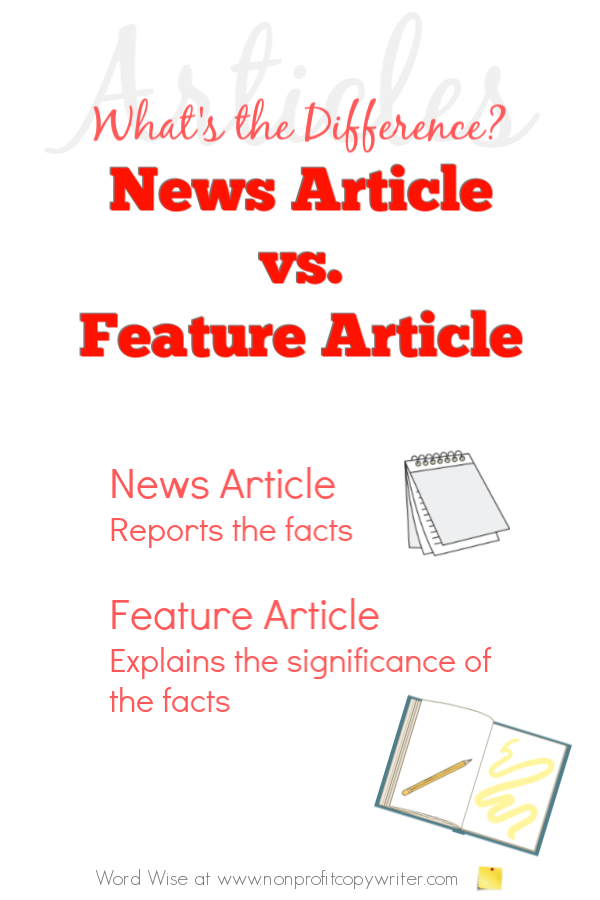
- A news story reports the facts about an event.
- A feature story explains the significance of an event. It offers analysis.
Let’s break it down in a way that actually helps you write both well.
Article writing tips: What is a news story?
A news story reports timely, factual information about something that just happened—or is about to happen. Think:
- A city council vote
- A new law
- A school policy change
- A business opening
- A court decision
- An election result
Your goal when writing a news story is simple: inform quickly and clearly.
The core characteristics of a news story are …
- Timely – It matters now.
- Factual and verifiable – Everything must be accurate and sourced.
- Objective in tone – No opinion. No emotional language.
- Efficient structure – Information is prioritized.
The structure of a news story is …
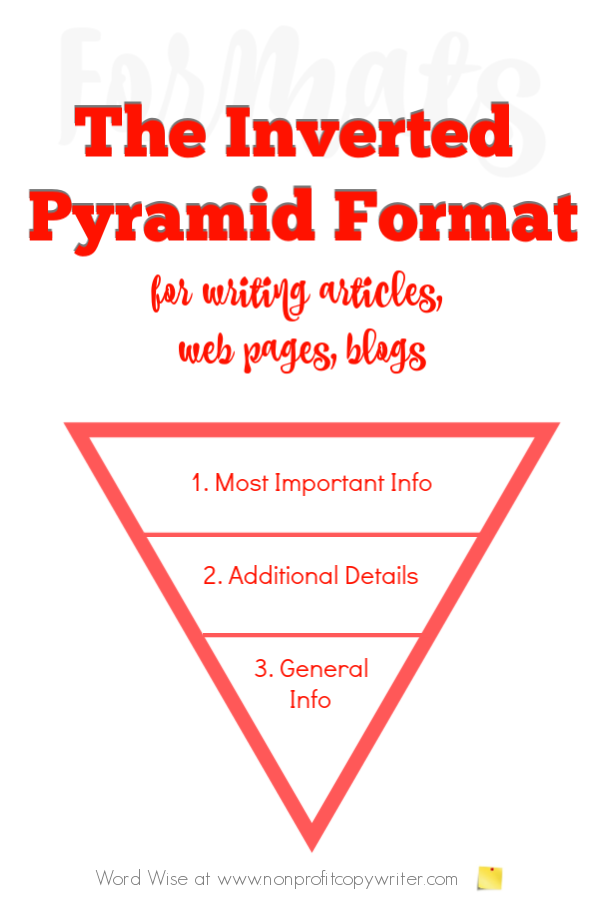
Most news stories follow the inverted pyramid format. The most important information appears first, followed by supporting details. Background information brings up the rear.
A news story’s first paragraph (the “lede”) answers Who, What, When, Where, Why, and How. For instance ....
The Charlotte City Council voted 6–3 Tuesday night to approve a new zoning ordinance that will allow duplexes in previously single-family neighborhoods.
Notice what that does. There’s no suspense … no storytelling. Just the facts. With a news story, readers need to know what happened—fast.
News stories are published in …
News stories typically appear in:
- Daily or weekly newspapers (The New York Times or The Belmont Banner, for instance)
- News websites
- Broadcast outlets
- Wire services (think AP or Reuters)
- Trade publications
But news stories also appear in:
- Industry newsletters
- Local publications
- Nonprofit updates
- School publications
If it’s timely and factual, it’s news—regardless of platform.
Article writing tips for writing a news story
If you’re writing news, think like a reporter—not a storyteller.
Step 1: Gather facts
- Conduct interviews.
- Confirm spellings, titles, dates.
- Cross-check everything.
- Get multiple sources when possible.
- Accuracy is non-negotiable.
Step 2: Write a strong lede
Get to the point immediately. Your first paragraph should summarize the most critical information. Avoid cute openings, long setup paragraphs, and vague beginnings. Editors want clarity, not suspense.
Step 3: Organize by importance
After your lede, add supporting facts and include relevant quotes to reinforce the gist of your opening paragraph. You can also provide additional context for the events. Finish up with background detail.
Each paragraph should become progressively less essential. That way, if an editor cuts from the bottom, the story still works.
Step 4: Keep your voice out of it
Avoid adjectives like shocking, wonderful, or devastating. Let the facts and quotes do the work.
How your news story can have the greatest impact
“I don’t want to write dry, boring articles.” You don’t need to. Use these tips to write news stories that impact readers.
- Be ruthlessly clear. Confused writing weakens impact.
- Get strong quotes. They provide humanity without opinion. A compelling quote can elevate even a routine city council story.
- Provide relevant context. Don’t just report what happened—briefly explain why it matters.
- Write with immaculate accuracy. Accuracy builds trust. Trust builds readership. In news writing, credibility is your impact.
Article writing tips: What is a feature story?
A feature story explores, explains, or humanizes a topic. It is less about breaking news and more about meaning, context, or experience. A feature story may be …
- A profile of a local entrepreneur
- A behind-the-scenes look at a nonprofit
- A seasonal gardening story
- A deep dive into how a policy affects families
- A narrative about someone overcoming hardship
Your goal when writing a feature story isn’t just to inform. It’s to engage, illuminate, or inspire the reader.
The core characteristics of a feature story are …
- Less time-sensitive – potentially evergreen
- More narrative-driven
- Descriptive and scene-based
- Exploratory rather than immediate
Features answer deeper questions than a news story's simple Who, What, Where, When, Why, How. Questions like ...
- What does this mean?
- How does this affect people?
- Why does this matter long term?
- What’s the story behind the headline?
The structure of a feature story is …
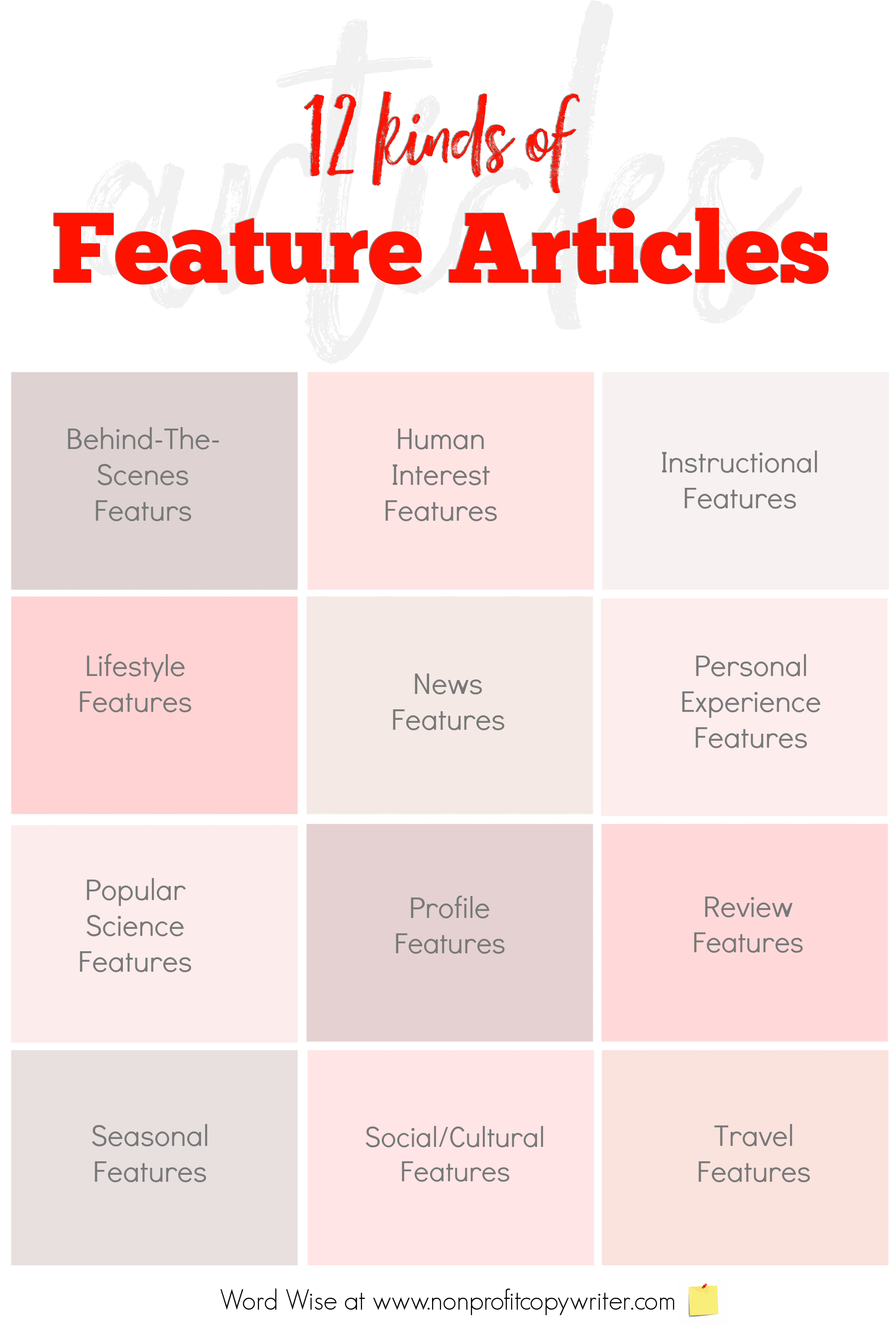
Determined by the topic. Features follow endless formats from profiles to narratives, interviews, essays, exposés, how-to's, columns, and reviews.
Feature stories are published in …
- Publications (both online and in print)
- Magazines (The Atlantic, National Geographic, Southern Living – and thousands of lesser-known periodicals)
- Sunday editions
- Online publications
- Branded content platforms
- Blogs
- Niche industry sites
Features also work beautifully for:
- Content marketing
- Nonprofit storytelling
- Business websites
- Community publications
If you write for businesses or nonprofits, feature-style storytelling can be incredibly powerful.
Article writing tips for writing a feature story
Feature writing requires a different mindset. Here, you are not simply regurgitating facts. You are telling a story.
Step 1: Find the human angle. Ask …
- Who is affected?
- Who represents this issue?
- What scene can I open with?
Features often begin with a moment, a quote, a scene, or a person,such as …
At 5:30 every morning, Maria Alvarez unlocks the doors to her bakery before the sun rises over Florence, South Carolina. By 7 a.m., the smell of cinnamon and yeast fills the block.
See the difference? A news story reports what happened. A feature story puts you there.
Step 2: Choose a structure. Feature structures vary. Experiment and choose which fits your angle, whether it’s:
- Narrative arc
- Problem–solution
- Chronological journey
- Thematic exploration
Unlike news, you don’t have to put everything important first. You can build tension. You can withhold certain information for effect.
Step 3: Use details purposefully. Features allow you to include sensory detail – what things look like, smell like, taste like, sound like – as you set the scene and write dialogue. Be intentional about what you include. If a detail doesn’t help advance your point, leave it out.
Step 4: Provide an insight. A good feature does more than tell a story. It explains why the reader should care. Use the close of your feature to demonstrate the larger issue – the point you want your reader to take away.
How your feature story can have the greatest impact
Who is your reader? Speak directly to that individual and connect with him. Then write your feature so that it’s relevant to him. You’re not just writing a nice little tale about a fun person or event. What’s the takeaway – the lesson or point – that your particular reader can gain from your feature?
To do that, you can …
- Open with a scene. Don’t summarize. Immerse.
- Focus on one clear thread. New writers often try to cover too much. Choose a central angle or main point and stick with it.
- Balance story with substance. A feature without facts is fluff. Facts without story feel like news. The magic is in the blend.
- End with resonance. Features often circle back to the opening scene … to a powerful quote … to a forward-looking insight. Reward your reader with a tidy thought to take with them.
Article writing tips: News story and feature story side-by-side
Timing
- A news article is time-sensitive and of immediate interest. Think election results, an accident, a robbery report, a product launch, a court verdict, a medical report release, a set of basketball game scores.
- A feature article can be published at any point. Its content is often evergreen or at least lasting.
Content
- A news article reports the facts: who, what, where, when, why, and how. It is written in a straightforward, concise reporting style.
- A feature article is a human interest story about a person, event, or place. Rather than simply summarizing the subject, a feature article highlights one aspect or significance of the story. Its less formal style may take an odd twist or heartwarming angle.
Structure
- A news story is structured in the inverted pyramid format with key facts at the beginning of the article . This way the reader can get basic information in the first sentence or two.
- A feature story allows the subject matter to determine its format, whether in a standard outline form (such as a list, sequence, or comparison) or one of the 7 main story formats. As for subject matter, features cover endless topics from profiles to narratives, interviews, essays, exposes, how-to's, columns, and reviews.
Length
- News articles are short, averaging 100-400 words depending upon the type of news and where it is placed in the publication. They are meant to be digested quickly. Plus, news articles are deadline-driven, so you need to write fast – which can mean less substance and bare bones facts.
- Feature articles are longer and dig more deeply into the topic. You’ll need time to research and conduct several interviews. Length varies for each publication, but a typical feature word count runs between 1,000 – 2,000 words.
Editing
- News editors cut aggressively. They simply don’t have extra space, so they prioritize brevity over length and clarity over beauty. And since you’re simply reporting the facts, you need to remain invisible and neutral. Let specifics speak for themselves.
- Feature editors care deeply about flow and pacing. They’ll look for strong transitions. And in feature writing, your voice—while not opinionated—becomes part of the reading experience. Yet you need to write with sensitivity. Writers with integrity don’t exploit interviewees, but operate with integrity.
Can a writer produce both news articles and feature
articles?
Absolutely. In fact, learning both skills makes you stronger.
News writing teaches you discipline and structure, since you have only so much space. Meanwhile, you must be accurate with your reporting, or you won’t be asked to write again. And short timelines require you to write efficiently.
And to pull off feature articles, you need to understand narrative craft (fancy lingo for “storytelling.”) How to pace your content to make a point. And most of all – how to speak directly to a specific reader to engage both his heart and his mind in your article.
Article writing tips: If you’re a new or growing writer …
Try this exercise.
Take the same topic and write:
- A 300-word news story.
- A 1,000-word feature story.
You’ll quickly feel the difference in structure, tone, and mindset. And that awareness alone will put you ahead of other writers and help you develop your skills.
Because once you understand why each type exists—and what readers expect—you stop guessing.
You start writing with purpose.
More Article Writing Tips
Learn To Write Content When You Learn To Write an Article ...
How to Write An Article: Get Started With These 12 Steps ...
3 Article Formats You Can Learn to Write Easily ...
12 Tips for Successful Interviewing ...
How to Choose an Article Topic...
Choose a Story Angle Using These 3 Tips ...
6 Types of Articles New Freelancers Can Get Paid to Write ...
Want Steady Traffic? Write 3 Different Types of Articles that Deliver ...
Write an Article or Write a Book? Here’s How to Decide ...
How to Write a How To Article that gets read from start to finish ...
29 Kinds of Articles You Can Write ...
The Inverted Pyramid: Article Writing Format for News Articles ...
How to Write a Sidebar that Adds Value to an Article ...
Top Article Writing Tip: the One-Point Rule ...
Writing Articles Tips on our Pinterest board ...
Return from News Story vs. Feature Story to Nonprofit Copywriter home
As an Amazon Associate I earn from qualifying purchases.
Share This Page

Named to 2022 Writer's Digest list
BEST GENRE/NICHE WRITING WEBSITE


Stop Wasting Time!
Grab your exclusive FREE guide, "5 Simple Writing Tips You Can Put to Use in 10 Minutes or Less"
 Subscribe To This Site