Save Time: Get 5 Simple Writing Tips
you can put to use in 10 minutes
Write An Article or Write A Book? Take The Quiz To Find Out!
Award-winning writer Kathy Widenhouse has written 9 books and garnered 800K+ views for her writing tutorials.
Updated 3.23.26
Should you write an article or write a book?
It’s a question you face at different junctures in your writing journey: when you’re first starting and working towards publication … when you’re building your stable of writing clips … when you’re thinking of breaking into a new niche …
It’s a surprisingly important decision. Choose the wrong format, and you may end up struggling with a book that feels thin. Or you have to fight to compress a powerful idea into an article that barely scratches the surface.
Article or book? My answer: It depends.
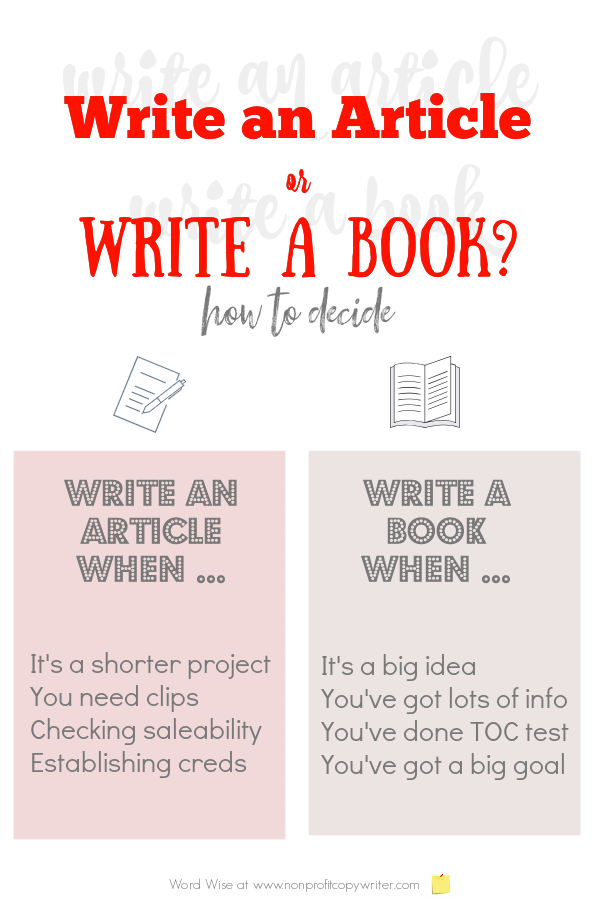
When to write an article
1. When it’s a shorter project
If you commit to writing a book, you may find out that the subject or slant has limits and there’s not enough information to fill all the pages needed to make it a topic of substance.
But an article is another matter.
A typical article ranges from 500 words to 3,000 words in length. It delivers one main insight or one practical takeaway for readers to absorb quickly.
As you plan and prepare an article, you find out how much information is available about your topic. You pull out your main idea and choose a slant … and then gather your extra research, quotes, and stories in a file to use in another article (or a book, later on).
For a new writer, a shorter project is much easier to write and finish than a longer project. If you write an article and complete it, then you have a sense of accomplishment. You can spend less time “learning the ropes” when you write an article.
2. When you need clips
Whether your article is printed on another owner’s site or you post it yourself (say on Medium or your own website), you are now a published writer.
This is helpful whether you’re a new writer or you’ve been published hundreds of times. You can include your article in your list of samples to share with potential editors and brands who want to hire writers in that particular niche.
Naturally, if you’re a new writer, you’re on a mission to accumulate a collection of clips. If you’re an experienced writer, your article allows you to break into a new niche, gain credibility, or build your following.
3. When you’re exploring saleability
Is your writing idea saleable? In other words, will the finished product pull in readers?
When you write an article, you can “test” the publishing waters to find out the depth of the subject matter’s appeal and the size of its audience.
4. When you’re establishing credibility
ou’re an avid canoer, so you write an article about canoeing with children — specifically, the best equipment to use with kids, from paddles to life jackets. You work and rework your article until it glistens. Then, the article is published in Canoeing Today magazine.
There’s a good chance that readers will contact you to ask specific questions. You’ll get emails. Fans will post comments in the online version of your article and they’ll ask for more information.
All of a sudden, you’re a bit of an expert in canoeing with kids … because you’ve studied the topic, written about it, and now you know a little bit more than the average reader. Writing an article establishes you as an authority.
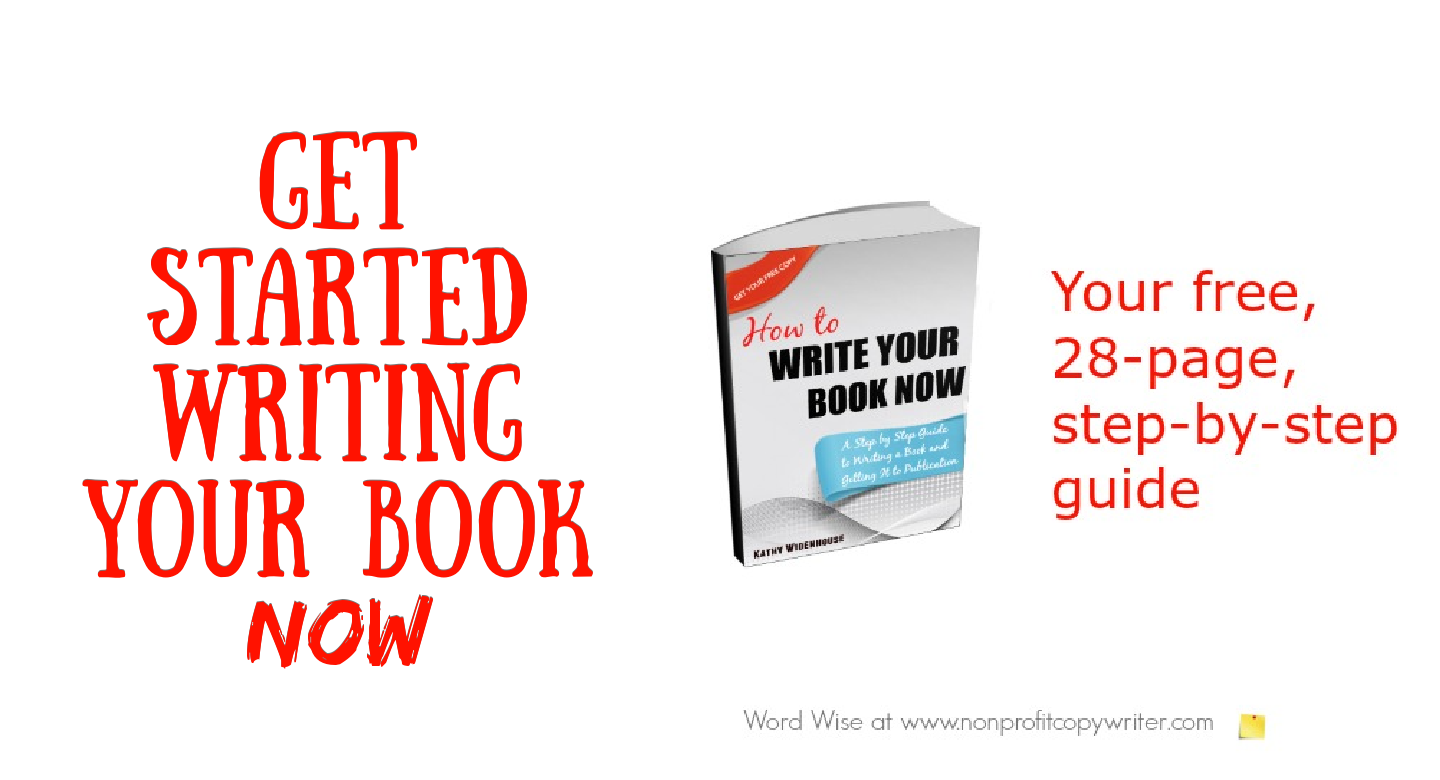
Get your free copy that gives you 8 simple steps to take to start writing your book now.
When to write a book
1. When you’ve got a big idea
A typical nonfiction book clocks in at 50,000 to 75,000 words. Even a mini-book ranges from 5,000 to 20,000 words. A book’s word count gives you room to explore a topic from different angles.
Back to our canoeing with kids idea. By now, you’ve written and published several articles on canoeing with children, and you’re ready to tackle a full book to address safety precautions … equipment … the differences in canoeing with preschoolers, preteens, and teenagers … the best size of lake or stream that’s suitable for canoeing with kids when they’re just starting out. You’ve got a substantial idea for a book.
2. When you’ve accumulated content
You’ve gathered your own articles, workshop materials, lessons, or other content. And along the way you’ve collected oodles of …
- Interviews with experts
- Data and studies
- Historical background
- Numerous real-life examples
- Personal experiences
- Detailed step-by-step walkthroughs
… then you may have more material than an article can comfortably hold. Your idea may deserve book-length treatment.
3. When you’ve completed the “Table of Contents” test
You’ve tossed around the idea of writing a book, and in the process, you’ve drafted a potential table of contents. You’ve recorded every subtopic, lesson, and question readers might ask about your subject.
As you study your list, you see 10–15 logical sections that explore the topic. Each of those sections represents a chapter for your book. And you could easily sit down and write at least 2,000 words for each of those sections.
If you’ve got that amount of content (or could acquire it through research and interviews ), then you have a potential book idea.
4. When you’ve got a long-term goal
Your first canoeing articles have helped you build an audience and establish your expertise. You’ve got a steady stream of visitors to your website.
Now, you want to be able to equip parents to canoe safely with their kids — maybe beyond just writing, but also by conducting webinars and training sessions. Or, the editor of Canoeing Today has approached you and asked if you’ll write a book. (It happens — my first book was the result of an article I wrote about a children’s program I started.)
If you’re ready for more opportunities, a book can open the door.
Write an article or write a book? Take the quiz to decide
1. How big is your core idea?
A. I’ve got one clear point… I’m teaching one skill … I’m explaining one situation.
B. I’m exploring a topic from multiple angles.
2. How much help does the reader need?
A. My reader needs a quick answer.
B. My reader requires guidance over time or through a series of steps.
3. What does my potential Table of Contents look like?
A. I’ve got 3–5 sections.
B. I’ve got 10–15 sections.
4. What am I trying to accomplish?
A. I want to test this idea with readers or simply get published to establish credibility.
B. I want to build a long-term asset and be seen as an authority.
Now that you’ve taken the quiz …
- If most of your answers were “A,” then write an article.
- If most of your answers were “B,” then consider writing a book.
Here’s why.
1. How big is your core idea?
Some ideas are naturally compact. They make one clear point, teach one skill, or explain one situation. These ideas work beautifully as articles. Example: “6 Safety Essentials For Canoeing With Kids.”
A book, on the other hand, requires a larger framework of ideas. A book usually explores a topic from multiple angles. Example: “The Complete Guide To Canoeing With Kids.”
2. How much help does the reader need?
Article: Your reader has a quick question that needs a quick solution, such as “How can I keep my preschooler safe while we’re canoeing together?”
Book: Your reader has a problem that requires transformation or step-by-step guidance over time, like “How can I help my child develop a lifelong love for canoeing?”
3. What does my potential Table of Contents look like?
If you’ve got 3–5 sections, you have the basis for an article — each of the sections will form one argument or supporting point for your main idea.
If you’ve got 10–15 sections that can be developed with research and examples, you’ve got the basis for a book.
4. What am I trying to accomplish?
If you’re just starting your writing journey, use articles to test an idea or build a collection of published clips.
If readers respond strongly, your articles can later become the foundation for a book.
Should you write an article or write a book?
A truth many writers don’t realize: Most books actually begin as articles.
Here’s how it works. You explore a topic in a short piece. Readers give feedback and want more. And you realize the idea or the topic or your personal slant has more traction than you expected.
So if you’re unsure whether your idea is book-worthy, start with an article.
And be sure to retain publishing rights to your articles if you sell them and they are printed by a publisher other than yourself. This way, you can use the guts of your articles as a chapter in your book.
Articles are faster to write, easier to test, and often reveal whether the topic truly has the depth required for a book.
If readers want more … you’ll know.
And that’s usually the moment when an article stops being just an article — and starts becoming the first chapter of a book.
More Article Writing Tips
Learn To Write Content When You Learn To Write an Article ...
How to Write An Article: Get Started With These 12 Steps ...
12 Tips for Successful Interviewing ...
How to Choose an Article Topic...
6 Types of Articles New Freelancers Can Get Paid to Write ...
Choose a Story Angle Using These 3 Tips ...
Writing Articles FAQs: Frequently Asked Questions ...
Top Article Writing Tip: the One-Point Rule ...
How to find the main idea of your article before you write ...
How to Write an Outline: Article Writing Tips ...
How to Write an Introduction (or Lead, Lede, Hook) ...
Tips for Writing a Hook for Your Article ...
How to write a conclusion: 3 tips ...
Writing Articles Tips on our Pinterest board ...
Return from Write an Article or Write a Book? to Nonprofit Copywriter home
As an Amazon Associate I earn from qualifying purchases.
Share This Page

Named to 2022 Writer's Digest list
BEST GENRE/NICHE WRITING WEBSITE
Stop Wasting Time!
Grab your exclusive FREE guide, "5 Simple Writing Tips You Can Put to Use in 10 Minutes or Less"
 Subscribe To This Site