Save Time: Get 5 Simple Writing Tips
you can put to use in 10 minutes
How to Write a How-To Article That Actually Gets Read Start to Finish
Award-winning writer Kathy Widenhouse has written 9 books and garnered 800K+ views for her writing tutorials.
Updated 6.25.26
If you’re a writer, you need to know how to write a how-to article.
A good how-to provides step-by-step instructions that help your reader complete a task. It’s an article format that has stood the test of time because it’s so practical.
Personally, the how-to one of my favorite kinds of articles to write because it is so logical and sequential. First, do this. Then, do this. Do a couple more things and POOF! You’re done with the task.
But here’s an ironic little secret about writing a how-to …
The secret
about writing a how-to
Your reader isn’t all excited-can’t-wait-to-learn how to complete the task you explain in your article.
Say what?
Yes, he wants to know the materials and the steps he needs to complete and in which order to complete the task.
But for him, your how-to article is simply a means to an end.
He reads your article to get something done. Your how-to article is a vehicle to make your reader’s life easier, simpler, happier, more fulfilling, safer, or cost less.
The secret to how-to success? Uncover what your reader is looking for and then deliver – and you’ll write a how-to that actually gets read from start to finish.
How to write a how-to article that actually gets read
Let’s say your reader wants to know how to change the windshield wiper fluid. It’s not that he loves the blue stuff. He has a mission. He reads your article …
- so that he doesn’t have to pay a mechanic to do it (he wants to save money)
- so that he can see out of his window (he wants to be safe)
- so that he can be self-sufficient (fulfilled and independent).
Notice that each of the reasons he reads your article starts with “so that.”
Writing tip: How do you find out how to write a how-to article that actually helps your reader?
Use two little words – “so that” – and complete the sentence. Then you’ll uncover the benefits your reader is seeking. And you can address them head-on in your article.

Use this FR*EE checklist to write powerful headlines every time.
How to write a how-to headline: Make a
promise
What does your reader want to accomplish? Name that activity. Then use action words in your headline to promise your reader he will achieve that goal.
You’ve already got the first two words of your headline: “How To.” Now, identify the task you’ll describe, such as …
- How to Make a Cup of Cocoa
That’s fine. It's a decent headline. But you and I know that there are a dozen ways to make a cup of cocoa. Your how-to will get read when you offer a unique benefit for your reader. What makes your how-to stand out?
Uncover your promise by using our two little words – “so that.”
- How to Make a Cup of Cocoa so that you can save time
- How to Make a Cup of Cocoa so that you can save mess
- How to Make a Cup of Cocoa that tastes rich and smooth
- How to Make a Cup of Cocoa so that you can use what you already have in the pantry
Your reader wants to drink cocoa but doesn't want to spend hours making it and leaving a huge mess. He wants to enjoy the experience. He doesn’t want to have to run out to the store first.
Put those benefits in the article headline like this:
- How to Make a Cup of Cocoa in the Microwave (so that you can save time)
- How to Make a Cup of Cocoa with Less Mess (so that you can save mess)
- How to Make a Cup of Cocoa that Rivals Hershey’s (that tastes rich and smooth)
- How to Make a Cup of Cocoa When You Don’t Have Cocoa Powder (so that you can use what you already have)
Now you’ve got a promise to your reader: “Read this article, and you’ll learn how to make a cup of cocoa in the microwave.” You’re going to make his life easier (or simpler, happier, more fulfilling, safer, or cost less …)
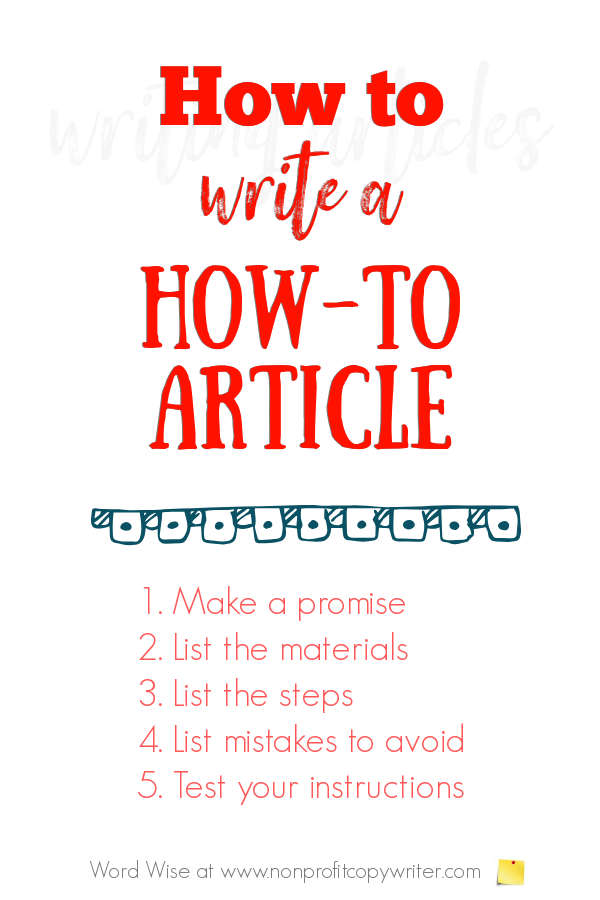
How to write the article body: Write out
the steps
Your job in the article body is to keep your promise – the promise you made in the headline. Make sure you include three elements.
1. List materials
your reader will need.
Write them in the order in which your reader will use them.
2. List the
steps for your reader to take
What steps should she take? Include every step, from start to finish, no matter how intuitive it may seem. Be specific. Don’t assume your reader knows what to do.
- Put steps in the exact order your reader should follow.
- List just one action per step.
- Use action verbs ("mix," "measure").
- Include time estimates, if you can. (“Stir for about 2 minutes until the powder is dissolved.”)
- Explain unfamiliar terms.
- Show what the reader can expect. (“The mixture will be smooth and have a uniform color.”)
3. List
mistakes the reader can avoid
- What are the common mistakes people make when carrying out these tasks? Point them out.
- Offer troubleshooting tips. (“Stir slowly so the milk doesn’t slosh over the mug.”)
- Anticipate questions readers may ask – and answer them.
Test your how-to
instructions
Once you’ve finished your How-To, test it. Carry out each step to make sure the order is correct and you didn’t leave out anything.
Ask yourself this question: “If my reader follows these steps, will her life be easier, simpler, happier, more fulfilling, safer, or cost less?” Remember, your job is to make your readers’ lives better. A missed step or an assumption can negate your goal. This is not the place to be creative or cute.
If there is more than one possible sequence, then say so and choose one for your article. For instance, you can make a mug of cocoa in the microwave or on the stove top. Your how-to should specify which.
Once you're satisfied that all the steps are there, be sure to check these extra tips for how to write a how-to.
How to write a how-to: Extra tips
- Use conversational language so your how-to is easy to read.
- Use second person. Write instructions in command form (like this sentence).
- Add images, photos, examples, and screenshots. Visuals are especially helpful in how-to articles.
One final check: Did you keep your
promise?
Go back to your headline. What promise did you make? Check your article content to confirm that your instructions accomplished what you told your reader you’d do.
In the headline of this article, I made a promise: here’s how to write a how-to article that gets read from start to finish.
You’re now here at the end of the article, so I assume you read it from start to finish. That makes me think I kept my promise.
People are surprised when people make promises and keep them.
Carefully craft your how-to promise. Then keep it. Your reader will thank you by reading the entire article from the top to the bottom. You've earned their trust. And now maybe -- just maybe -- they want to read more of the wonderful content you write.
More Article Writing Tips
Learn To Write Content When You Learn To Write an Article ...
How to Write An Article: Get Started With These 12 Steps ...
How to Choose an Article Topic...
3 Article Formats You Can Learn to Write Easily ...
What Is a Feature Article? Think News Story on Steroids ...
3 Article Formats You Can Learn to Write Easily ...
Choose a Story Angle Using These 3 Tips ...
6 Types of Articles New Freelancers Can Get Paid to Write ...
Write an Article or Write a Book? Here’s How to Decide ...
How to Write Query Letters: A Quick Tutorial ...
Article Writing Tips: News Story vs Feature Story – What’s the Difference?
Top Article Writing Tip: the One-Point Rule ...
29 Kinds of Articles You Can Write ...
What's a Listicle and How Do I Write One?
The Inverted Pyramid: Article Writing Format for Online Content, Too ...
How to Write a Sidebar that Adds Value to an Article ...
How to find the main idea of your article before you write ...
Writing Blogs vs. Writing Articles: Is There a Difference?
Writing Articles Tips on our Pinterest board ...
Return from How To Write a How-To to Nonprofit Copywriter home
As an Amazon Associate I earn from qualifying purchases.
Share This Page

Named to 2022 Writer's Digest list
BEST GENRE/NICHE WRITING WEBSITE

Stop Wasting Time!
Grab your exclusive FREE guide, "5 Simple Writing Tips You Can Put to Use in 10 Minutes or Less"
 Subscribe To This Site