Save Time: Get 5 Simple Writing Tips
you can put to use in 10 minutes
10 Urgency Words That Move Readers To Act Fast
Award-winning writer Kathy Widenhouse has written 9 books and garnered 800K+ views for her writing tutorials.
Posted 6.23.26
Time is limited. Hurry before you miss this exclusive opportunity. Act now before all spots are filled. Enrollment ends today — this is your last chance.
Makes your index finger itch to click, doesn’t it?
That’s what urgency words do.
Urgency words set off a quick response. That is, people are more likely to act when they believe time is limited … they sense access is restricted … they fear missing out.
What are urgency words?
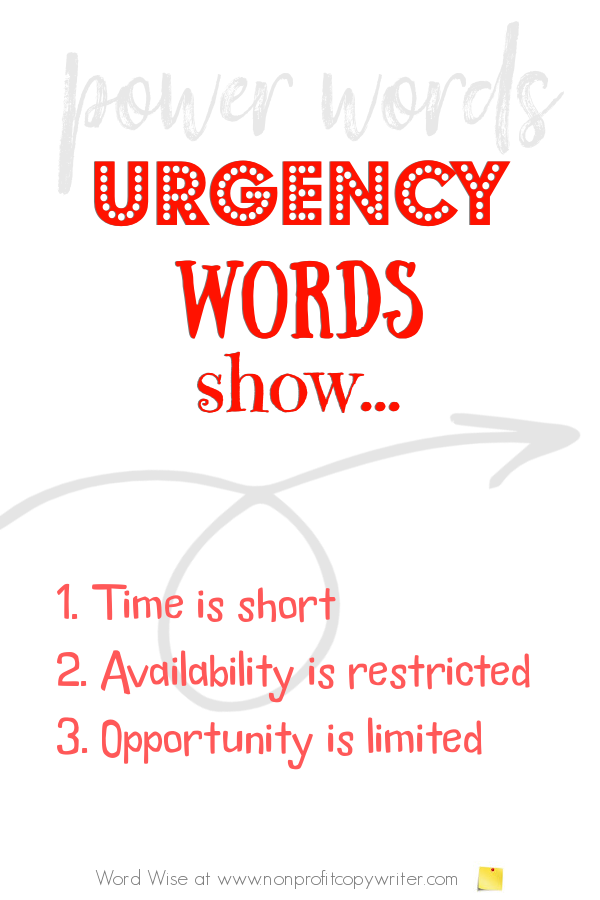
Urgency words are terms or phrases that spur readers to act fast rather than delay.
Writers, marketers, nonprofits, and copywriters use urgency words to show how time, availability, or opportunity is limited. These words tap into psychological triggers like fear of missing out (FOMO), scarcity, immediacy, and loss aversion.
Urgency words move your readers to click, donate, buy, sign up, or respond.
An example of how urgency words work
Compare these two calls to action:
- “Sign up for our newsletter.”
- “Sign up today — limited spots available.”
The second example feels more compelling. It suggests the reader could miss an opportunity if they wait.
Today and limited spots available are examples of urgency words that move readers to act.
You can inspire that movement in your readers with urgency words.
But … why should you?
Why should I use urgency words?
I don’t want to be that writer — the one who spews drama (translation: clickbait) in every headline. The writer who believes only my issues are THE most important to readers.
On the other hand, I don’t want my words to drift off into internet oblivion. And when I write copy — like an appeal letter or sales page — I want the reader to act, rather than shelve the offer for “later” (which never comes.)
Urgency words are helpful for writers of all kinds if you want to motivate readers to act now instead of putting off a decision.
- If you’re a content writer, you can use urgency words to increase clicks, engagement, and conversions. Phrases such as today, now, don’t miss, and before it’s too late encourage readers to continue reading, download a resource, subscribe to a newsletter, or take another desired action.
- If you’re a copywriter, urgency is a key persuasion tool. Consumers are constantly distracted and overwhelmed with choices. Urgency words like limited time, ending soon, last chance, act now, and while supplies last help move prospects from interest to action. When used honestly, these words create momentum and reduce procrastination.
- If you’re a nonprofit writer, urgency can be especially important because donations and volunteer support often depend on immediate action. Potential donors may care deeply about a cause but still postpone giving. Words and phrases such as urgent need, help today, immediate impact, critical shortage, and your gift can help now remind supporters that real people need assistance right away.
The key is to use urgency authentically. Readers can quickly spot exaggerated claims or fake deadlines. But when you highlight a genuine need, opportunity, deadline, or consequence, you help readers understand why acting today is better than waiting until tomorrow.
Where should I use urgency words?
Use urgency words when you want readers to act fast. When you want to fill slots sooner rather than later. When you have limited availability. Urgency words work in …
- Email subject lines
- Fundraising appeals
- Sales pages
- Headlines
- Social media posts
- Calls to action
- Landing pages
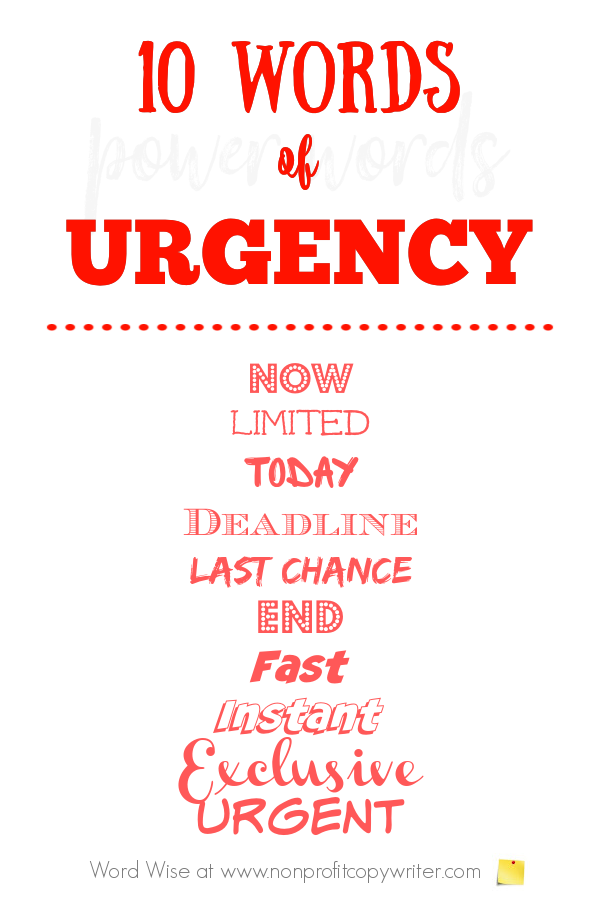
10 urgency words that move readers to act fast and act now
1. Now
Now pushes readers toward immediate behavior instead of future intention. Behavioral researchers have found that people heavily favor immediate rewards over delayed rewards, a behavioral concept known as “present bias.”
The word “now” reduces procrastination by making action feel immediate and necessary. It’s especially effective in calls to action because it removes ambiguity about when the reader should respond. Plus, now is short, direct, and easy for the brain to process quickly.
Examples:
- Donate now to help homeless mothers.
- Start your garden now before the summer heat arrives.
- Register now to save your seat.
2. Limited
Limited is an example of the Scarcity Principle as demonstrated by Stephen Worchel, Ph.D., and colleagues. Subjects in their now-famous study rated cookies in a nearly empty jar were rated as more desirable than identical cookies in a full jar.
When something appears scarce, people perceive it as more valuable. Limited tells readers that an opportunity could disappear fast, so it’s best to take advantage of it ASAP.
Examples:
- Limited spots available.
- Limited-time discount for subscribers.
- Supplies are limited.
3. Today
Today works because it creates a short, manageable timeframe. Readers feel less overwhelmed when action is tied to the next 24 hours instead of a vague future. The deadline is immediate and concrete. I like using today because it subtly creates pressure without sounding too pushy.
Examples:
- Apply today for early access.
- Give today to double your impact.
- Download the guide today.
4. Deadline
Speaking of deadlines … a specific date and time increases action. The time limit creates a clear stopping point. Without a deadline, readers can delay indefinitely.
Examples:
- The registration deadline is Friday.
- Donation deadline: midnight tonight.
- Submit your application before the deadline.
5. Last chance
FOMO (Fear Of Missing Out): it’s proven. Research on loss aversion — popularized by behavioral economists Daniel Kahneman and Amos Tversky — shows people are more motivated to avoid losses than achieve gains. The term last chance combines a time limit … and triggers fear of regret.
Examples:
- Last chance to save 30%.
- Last chance to reserve your seat.
- Last chance to support this campaign.
6. End (Ends, Ending)
Like deadline and last chance, the word ends emphasizes that an opportunity is disappearing. Humans pay attention when something is about to stop because we instinctively dislike losing access to resources or advantages. The brain prioritizes avoiding missed opportunities.
Examples:
- Sale ends tonight.
- Enrollment ends tomorrow.
- Early pricing ends Friday.
7. Fast
Quick. Convenient. Your readers prefer immediate results. Plus, fast suggests less effort. Your reader can solve his problem speedily without working too hard for it.
Examples:
- Get fast results with this strategy.
- Fast relief for dry skin.
- Learn how to grow tomatoes fast.
8. Instant
Instant is even more emotionally charged than fast because it promises immediate reward. The “Dopamine Loop” you’ve read about? With instant, your reader anticipates a rapid payoff.
Examples:
- Instant access after signup.
- Get instant download access.
- Instant tips to improve your writing.
9. Exclusive
Exclusive creates urgency through rarity and belonging. People naturally want access to things that feel special, private, or unavailable to everyone else. Research in social psychology shows that exclusivity increases perceived value because it signals status and scarcity at the same time.
Examples:
- Exclusive bonus for subscribers.
- Get exclusive early access.
- Exclusive member-only pricing.
10. Urgent
- We need volunteers.
- We have an urgent need for volunteers.
The second statement suggests that help is needed right away, not at some unspecified time in the future. When people see urgent, they understand that waiting could lead to worsening problems, missed opportunities, or unmet needs. (That’s why you have a local Urgent Care health facility … and why you look for urgency words to add to your content.)
Examples:
· We have an urgent need for food donations to support local families this week.
· Urgent: Only 6 spots remain for this workshop.
· Read this urgent cybersecurity update to protect your website.
50 terms every new writer should know - download yours for free.
A few more urgency words
You can use these as alternatives or in addition to the other urgency words.
- Before it’s too late
- Closing
- Critical
- Emergency
- Expires
- Hurry
- Immediate
- Running out
- Soon
- While supplies last
Extra tip for using urgency words
The most effective writers combine urgency words. For example, “Last chance — offer ends today” layers scarcity, immediacy, and fear of missing out into one message.
The key is authenticity. Urgency works best when the deadline or limitation is genuine. If every email screams urgency without a real reason … if readers feel manipulated by fake scarcity or endless “before it’s too late” messages … well, they’ll stop believing you.
Which leads me to one more tip.
A final caution when using urgency words
If you use an urgent claim, make sure you mean it.
- If the sale ends at midnight, then close the shopping cart.
- If the deadline is Tuesday at noon, don’t accept registrations at 12:01.
- If your offer is for an exclusive group of subscribers, then don’t send it to your entire list.
Truth always wins out. If you create urgency when there’s only informality, readers won’t trust you. And then writing with urgency won’t matter at all.
But use urgency words honestly, and you will earn clicks … conversions … sales … downloads … follows …
And you’ll move readers to act. While building your credibility, too.
More Power Words for Writers
How to use power words in content and copy ...
5 magic words that open doors for your nonprofit ....
10 nonprofit buzz words with staying power ...
The "Best" Word to Use in Content ...
The 7 Most Powerful Words in Persuasive Content...
The Power of Free: It Can Be Priceless For You ...
Want to Persuade? Use the World’s Most Powerful Word ...
Why the Word “Deadline” Is so Persuasive – and How To Use It ...
Avoid "But" in Conversation, But Use It In Writing to Show Contrast ...
Writing Made Simple with This "Simple" Power Word ...
4 trigger words that guarantee they open the envelope or email ...
Get the Best Results With This This One Power Word ...
"In Other Words": Use This Phrase for Writing More Powerful Content ...
Your 3-letter persuasive powerhouse ...
The Power of "New: It's not a gimmick - it's science ...
How to make the "You Rule" work for you ...
The Power of "Because": persuade by explaining why ...
It’s "Easy"! One Word That Makes Writing Powerful Key Phrases Simple...
See more Power Words on our Pinterest board...
Return from 10 Urgency Words to Nonprofit Copywriter home
As an Amazon Associate I earn from qualifying purchases.
Share This Page

Named to 2022 Writer's Digest list
BEST GENRE/NICHE WRITING WEBSITE


Stop Wasting Time!
Grab your exclusive FREE guide, "5 Simple Writing Tips You Can Put to Use in 10 Minutes or Less"
 Subscribe To This Site