
Save Time: Get 5 Simple Writing Tips
you can put to use in 10 minutes
Why Consistency Beats Talent in Writing
Award-winning writer Kathy Widenhouse has written 9 books and garnered 800K+ views for her writing tutorials.
Posted 7.7.26
“He’s such a naturally talented writer.”
You’ve heard people say that about an author … a blogger … a novelist.
It’s easy to believe that successful writers simply are born with a gift the rest of us don’t have. Somehow, the Writing Fairy sprinkled that particular person with Magical Writing Dust. And POOF! He writes brilliant NY Times bestsellers without one slap of the Delete key.
The naturally talented writer: It’s a myth.
If you look closely at the writers who consistently publish books, land freelance clients, grow blogs, or build loyal audiences, you’ll notice something surprising.
Their greatest strength usually isn’t talent. It’s consistency.
What being a consistent writer means
These writers show up day after day — even when inspiration is nowhere to be found. For consistent writers, rejection letters mean an opportunity to submit elsewhere. Crickets, after publishing a blog post, offer the chance to uncover how to write a better headline. A low response rate is the signal to drill down on an offer.
Talent can indeed give you a head start and make things easier in the beginning. Yet hundreds (even thousands) of gifted writers simply give up too soon.
Whether you’re naturally gifted at writing or you must put your nose to the grindstone to churn out a sentence, consistency keeps you moving forward. Be persistent, and you’ll develop stronger skills, build confidence, and achieve long-term success.
Here’s how your consistency beats talent in writing … and how you can leverage your persistence to succeed in the long run.
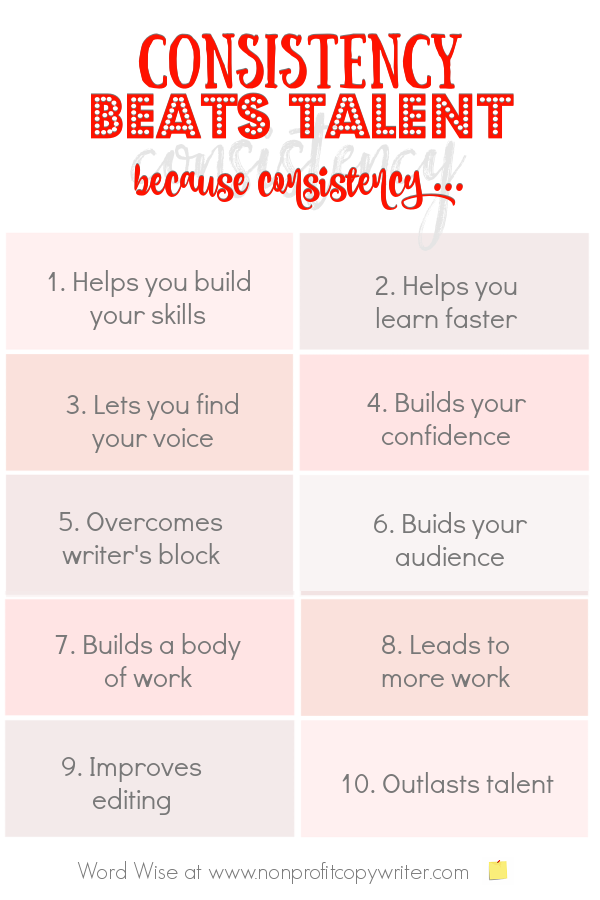
10 ways your consistency beats talent in writing
1. Consistent writing builds better skills.
Writing is a skill. Like playing the piano, becoming a gymnast, or learning another language, it improves through regular practice.
No one becomes an excellent writer after completing one article. Strong writing develops over hundreds — or even thousands — of writing sessions. Each time you sit down at the keyboard, you strengthen your research skills … organization … sentence flow … word choice … editing … yes, even your grammar.
I’ve seen this as I review blog posts and web pages I created a decade ago. It’s not that I was a slacker back then — quite the contrary. I sweated over each sentence. But since then, I’ve written thousands of articles. My skills have improved. So now I slash, add, subtract, and rewrite content — and republish it.
Small improvements in your writing skills add up over time. A writer who practices four days a week for a year will almost always outperform someone with more natural talent who only writes occasionally.
2. Consistency helps you learn faster.
Reading books about writing is valuable. Taking courses is helpful. Watching videos can teach useful techniques. But nothing can teach you to write faster than actual writing.
Write more often, and you’ll get better quicker. It’s like training for a sport — more reps build muscle memory. Every writing project teaches lessons you couldn’t learn any other way. You discover:
- What captures readers’ attention
- Which introductions work best
- How to explain difficult ideas
- Where readers lose interest
- What mistakes you make repeatedly
Those lessons compound every time you sit down to write. Sit down to write often, and you’ll learn faster.
3. Consistency helps you find your writing voice.
Concerned about discovering your “voice” — your unique writing style? Here’s the truth: You don’t suddenly come upon it one day by accident. Your writing voice develops as you write consistently. You’ll begin to notice …
- Your favorite topics
- Your sentence rhythm
- Your sense of humor
- Your preferred style
- The way you explain ideas
- Patterns you use
4. Consistency builds your confidence.
“I just need to get more confident before I write this article.” Or my favorite: “I’ll reach out to that client when I have more confidence.” And just exactly when will that be?
Confidence doesn’t come before writing. It comes because of writing.
Each completed article proves that you can finish another one … and each challenge you overcome prepares you for the next project.
Freelance writers get pitches rejected. Author manuscripts land in the slush pile. Copywriters lose clients. Grant writers don’t win every grant. Consistent writers ask:
- What can I improve?
- Where else can I submit this?
- What did I learn?
Over time, writing feels less intimidating because you’ve solved similar problems before. Experience replaces uncertainty.
5. Consistency helps you overcome writer’s block.
Every writing session should produce something brilliant. Right?
Consistent writers know that’s unrealistic. Some days produce excellent work. Other days simply move the project forward. Either outcome is progress.
When writing becomes a habit instead of a performance, writer’s block loses much of its power. Getting started becomes easier because writing becomes part of your routine. Instead of asking yourself whether you feel inspired today, you simply write because it’s what you do … and writer’s block flies out the window.

Use this FREE checklist to build content 20 minutes at a time.
6. Consistency builds your audience.
Search engines reward your consistency.
Let’s say you write an article about traveling in Europe for $100 a day. Your article may take weeks to get indexed. Months later, it climbs in the search rankings — perhaps taking longer to become a top-performing page.
Meanwhile, when you’re consistent in building adjacent content around your first article, you begin to accumulate readers who read your articles about the cheapest fares on European trains … how to save 50% when you barter for food at Portugal’s open-air markets … the least expensive times to travel by air overseas. Search engines notice. You start gaining followers because you’re consistently publishing useful, high-quality content about your topic.
Don’t be one of those writers who quit before their content has a chance to succeed.
7. Consistency allows you to build a body of work.
Ask a would-be writer about his ideas or his unfinished manuscripts sitting silently on his computer. He’ll nod and tell you all about his plans.
One article won’t establish your authority. But …
- 50 articles can.
- 200 articles can.
- 500 articles can.
- 1,000 articles can.
Consistent writers finish. They complete articles. They submit assignments. They publish blog posts. They revise drafts. They submit. Each piece becomes another asset that can attract readers, clients, or customers.
8. Consistency leads to more work.
If you’re a freelance writer, consistency becomes part of your professional reputation.
Editors, clients, and readers appreciate writers who respond professionally, meet deadlines, and repeatedly deliver quality work. Do that, and you’ll become a writer they call upon when they have a looming project — because they know they can count on you. Reliability builds trust.
I experienced this firsthand after delivering my first book manuscript. My editor had another project in mind and reached out to me to find out if I was interested. A second book contract without having to pitch a proposal? Yes, please — and thank you.
Consistency leads to …
- Referrals.
- Repeat clients.
- Speaking invitations.
- Book deals.
- Newsletter subscribers.
- Higher-paying projects.
9. Consistency builds your editing skills.
The first draft is rarely the final draft. Persistent writers are willing to:
- Rewrite introductions.
- Tighten sentences.
- Improve headlines.
- Remove unnecessary words.
- Reorganize sections.
- Polish until the message is clear.
Excellent writing is the result of excellent editing.
10. Consistency outlasts talent.
Writing careers are built over years — not weeks.
- You’ll receive rejections to your pitches.
- You’ll write articles that get little traffic.
- You’ll get negative feedback.
- You’ll have projects that don’t go as planned.
Learn from every project. And keep writing anyway.
Persistence allows you to improve long after others have stopped trying. Your consistency will be the deciding factor as to whether you eventually succeed … or quietly give up.
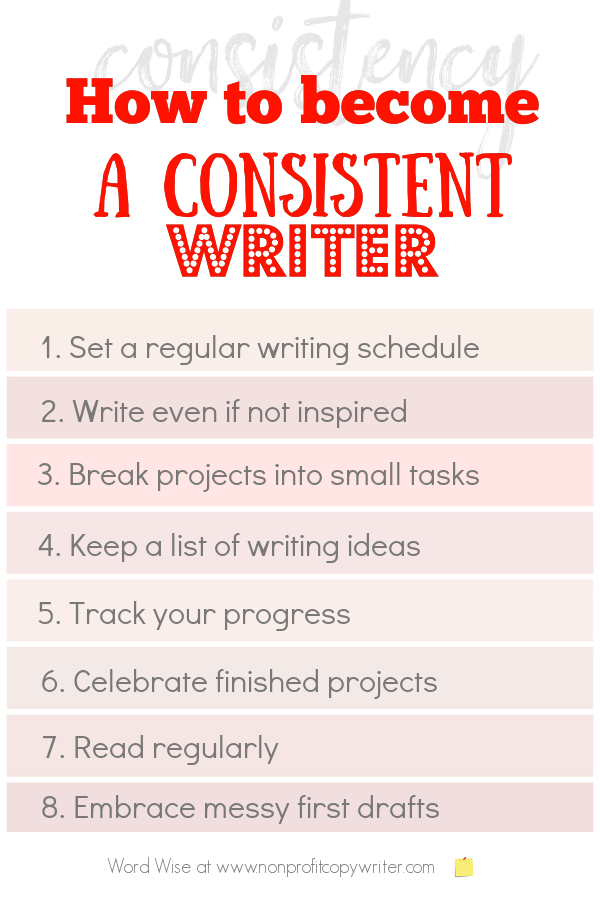
How to become a more consistent writer
You don’t need to write thousands of words every day. Instead, focus on building a sustainable habit. Try these strategies:
- Set a regular writing schedule.
- Write even when you don’t feel inspired.
- Break large projects into smaller tasks.
- Keep a running list of writing ideas.
- Track your progress in a notebook or spreadsheet.
- Celebrate finishing projects — not just publishing them.
- Read regularly to improve your writing.
- Accept that first drafts are supposed to be imperfect.
Consistency is about showing up, not writing perfectly.

It's easier to stay consistent with this DIY Content Calendar.
Consistency beats talent: Frequently asked questions (FAQs)
Q. Is consistency really more important than talent?
For most writers, yes. Natural ability may provide an early advantage, but consistent practice develops stronger writing skills, greater confidence, and a larger body of published work over time.
Q. How often should writers write?
There’s no perfect schedule. Writing several times a week — or even 20 to 30 minutes a day — can lead to significant improvement if you maintain the habit. The key is (you guessed it) consistency.
Q. Can anyone become a better writer?
Absolutely. Writing is a learned skill. While people begin at different levels, regular practice, thoughtful feedback, and revision help nearly everyone improve.
Q. What if I miss a day?
Don’t let one missed session become a missed week. Simply return to your routine the next day. Long-term consistency matters far more than perfection.
Consistency is an investment in your future
- Talent can open a door.
- Inspiration can help you take the first steps.
- Consistency is what keeps you walking through it.
The writers who succeed over the long haul aren’t always the most naturally gifted. They’re the ones who keep showing up.
Every time you write, you’re investing in your future as a writer. You’re creating work that didn’t exist before.
“Nothing in the world can take the place of persistence,” wrote Calvin Coolidge, the 30th president of the United States (1874–1933), during the throes of the Great Depression. “Persistence and determination alone are omnipotent. The slogan ‘Press On’ has solved and always will solve the problems of the human race.”
Press on, dear writer. Your consistency beats talent every time.
More about The Writing Life
Newbie Writer FAQs (Frequently Asked Questions) ...
Do Writers Get Imposter Syndrome? Here's What You Can Do About It
5 Non-Writing Skills Every Writer Needs ...
The Writing Life: You Can Make A Living With Your Words ...
Beat Writer’s Block When You Eat the Frog First ...
The 20-Minute Blogger: Build Your Blog 20 Minutes at a Time...
The Shiny Object Syndrome for Writers ...
Your Writing: Is It “Good Enough”?
Don’t Finish Writing – and Get More Done ...
Maker Time vs. Manager Time For Freelance Writers ...
More Writing Tips on our Pinterest board ...
Return from Why Consistency Beats Talent to Nonprofit Copywriter home
As an Amazon Associate I earn from qualifying purchases.
Share This Page

Named to 2022 Writer's Digest list
BEST GENRE/NICHE WRITING WEBSITE



Stop Wasting Time!

Grab your exclusive FREE guide, "5 Simple Writing Tips You Can Put to Use in 10 Minutes or Less"
 Subscribe To This Site