Save Time: Get 5 Simple Writing Tips
you can put to use in 10 minutes
The 7 Types
of Email Writers Must Master
Award-winning writer Kathy Widenhouse has written 9 books and garnered 800K+ views for her writing tutorials.
Updated 10.9.26
Over the years, I’ve written plenty of emails for my writing biz. And clients have hired me to write dozens of different kinds of emails, like abandoned cart emails. Upsell emails. Nurture emails. Cross-sell emails. Review requests and surveys …
I noticed a trend. A few types of emails pop up again and again. They’ve become what I call my “greatest hits” list for email. And after all that practice, I’ve become proficient at writing these 7 types of email.
Proficient in that I get opens, click-throughs, sales, and forwards from them.
You don’t need to be an expert to get pro results from email. Writers and business owners who succeed with email aren’t necessarily top-tier writers. They simply understand one thing:
Different types of emails achieve different things for you.
- Some build your reader’s trust.
- Some open doors to new customers.
- Some keep you at the top of a user’s mind.
- Some bring in cash.
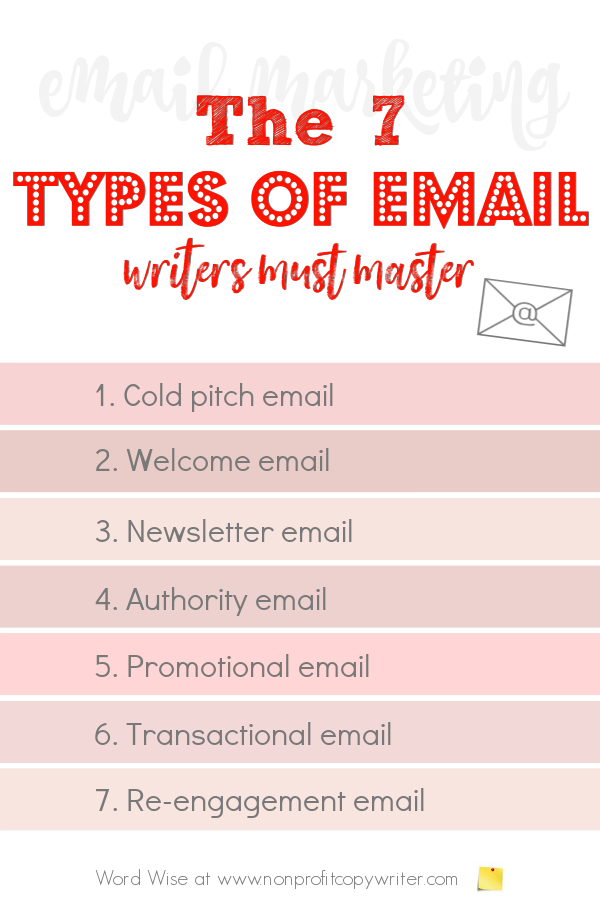
The 7 most-requested types of email aren’t random
These 7 types of email aren’t just a “list of projects to write.” Combined together, they create a system.
Understand how to work the system … and you become incredibly valuable to prospective clients. Plus, you can use your email skills to grow your own reach as a writer.
Then, email stops feeling like a guessing game.
These 7 types of email build a system
Every person who interacts with you online moves through a handful of predictable stages:
- They discover you.
- They check you out.
- They see you pop up again.
- They decide what they think of you.
- They consider buying (or clicking, hiring, downloading).
- They buy or read more – or don’t.
- They either stay engaged … disappear … or find you again.
Why not write emails that purposefully line up with those moments? Here’s what that looks like.
- Cold pitch emails → Readers discover you.
- Welcome emails → Readers check you out.
- Newsletter emails → Readers see you again and again … consistently.
- Authority emails → Readers see your credibility.
- Promotional emails → Readers buy from you.
- Transactional emails → Readers trust you even more.
- Re-engagement emails → Readers are recovered when they lapse.
As you plan and write emails, follow your reader’s pattern. It’s just smart.
Each type of email solves a different problem
I got stuck with email because I tried to use one type to do everything. I had to learn to use each type of email to solve a specific problem:
- No leads or no new readers? → Cold pitch emails fix that
- Poor customer experience? → Welcome emails fix that
- People forget me? → Newsletters fix that
- Low trust? → Nurture emails fix that
- No sales? → Promotional emails fix that
- Few repeat opens or orders? → Transactional emails fix that
- Low retention? → Re-engagement emails fix that
Identify your problem and use a specific type of email to fix it.
Better yet, create a sequence of emails that are ready to go. Set your sequence into motion. Review and update your email sequence as needed.
Use these 28 FREE tips to grow your email list at no cost.
The 7 types of email you MUST know how to write
Here’s how to write each of the 7 types of email (with examples).
1. Cold pitch email (helps readers discover you)
No audience? No problem. Write an email to create opportunities.
What to include:
- A personalized opener
- A clear reason you’re reaching out
- A specific way you can help
- A low-friction next step
What makes your email stand out: Use an email template as the foundation, but tweak the content so it’s relevant and specific to each reader (not generic).
Example
Subject: Idea for your wellness blog
Hi [Name],
I came across your recent article on stress management — I really appreciated your practical approach because [give reason why].
I noticed that you accept guest submissions. Since you write for [name the blog’s target audience], I thought they might enjoy an article on “5-Minute Yoga Routines for People Who Hate Long Workouts.”
I’m a yoga writer who focuses on simple, approachable practices for busy people, and I think this would fit well with your content.
May I send you a quick outline?
Thanks,
[Name]
2. Welcome email (helps readers get to know you)
This isn’t just one email — it’s a series. Your welcome series turns a new subscriber into someone who trusts you. He understands what you offer and then sticks around for more.
What to include:
- Email 1: Welcome + expectations
- Email 2–3: Value + quick wins
- Email 3–5: Story + credibility
- Final: Soft introduction to your offer
What makes your email stand out: You intentionally help your reader get to know you and what you can do for them. Each email builds on the last, so he sees he can trust you.
Example
Subject: Welcome — let’s make yoga simple
I’m so glad you’re here.
If you’ve ever felt like yoga is overwhelming (too many poses, too much pressure), you’re not alone.
Around here, we keep things simple and realistic — short practices, clear guidance, and no perfection required.
Over the next few days, I’ll send you a few easy ways to build a yoga habit that actually sticks.
To start, here’s a gentle 5-minute reset you can do today:
[Link]
Talk soon,
[Name]

Use these proven templates when you pitch to prospects for freelance writing gigs.
3. Newsletter email (helps you stay in front of your readers)
Once your reader has discovered you and gotten to know a little about you, you want to stay in their mind. He may not need you now. But down the road, you want him to know that you’re still here, still helpful, and still relevant. Send a regular email newsletter.
What to include:
- A useful tip, insight, or update
- A story or observation (optional but powerful)
- A light call-to-action (read, reply, click)
What makes your email stand out: You’re consistent. You keep popping into your reader’s inbox each week with useful information.
Example
Subject: The stretch I come back to every week
I’ve tried a lot of yoga routines over the years.
But there’s one simple stretch I keep coming back to — especially on busy weeks.
It takes less than 2 minutes and instantly releases tension in your back and hips.
Here’s how to do it: [Link to blog or quick demo]
If you try it, let me know how it feels — I’d love to hear.
[Name]
4. Authority emails (help deepen your credibility with your readers)
These emails are a newsletter’s cousin. While a newsletter’s job is to show up consistently and be useful, an authority email offers more depth. Its goal is to build your credibility. You want readers to think, “This person sounds smart. I’m now thinking differently about this topic, and I want to read more from this person.”
What to include:
- A clear tip, framework, or idea
- A simple explanation
- A real-world example
- Optional tie-in to your offer
What makes your email stand out: An authority email offers a “lightbulb moment” to your readers, usually with a tip or insight that’s immediately useful.
Example
Subject: Why your yoga practice feels inconsistent
Most people think they need more discipline to stay consistent with yoga.
But that’s usually not the problem.
The real issue? The practice doesn’t fit their life.
If your routine feels too long, too complicated, or too rigid… you’re less likely to stick with it.
Instead, try this: Shrink your practice down to something you can do on your busiest day.
Consistency builds from there — not the other way around.
Try it.
[Name]
5. Promotional emails (helps you make an Ask)
This is where you make the Ask — whether it’s for a download, sale, an upsell, a click, a referral, a gig …
“But,” you say, “I hate to sell.” Me, too. The good news is this: The best promotional emails don’t feel like you’re promoting. You can write yours so it feels like you’re offering your reader a solution to their problem. Which you are!
What to include:
- A clear problem
- Your offer as the solution
- Specific benefits
- A direct call-to-action
What makes your email stand out: You focus on the fix you’re offering your reader. It’s focused on outcomes, not features.
Example
Subject: A simple way to stay consistent with exercise
If you’ve been trying to “get into” yoga but can’t seem to stick with it…
It’s probably not you. It’s the approach.
That’s exactly why I created the “7-Day Simple Yoga Reset.”
Each session is short, beginner-friendly, and designed to fit into real life — not disrupt it.
No pressure. No long routines. Just a clear path to consistency.
You can start here: [Link]
Let me know how it works for you.
[Name]
6. Transactional emails (help build trust with your readers)
These are your most opened emails — and the most underused. Yes, by all means, include that order confirmation, receipt, download link, or appointment confirmation.
But then, don’t drop the ball (like so many writers do). Tell the reader his next step.
What to include:
- Clear confirmation of what just happened
- Key details (what, when, how to access)
- Reassurance (“You’re all set”)
- A next step (this is the missed opportunity)
What makes your email stand out: Your transactional email doesn’t just confirm. Use it to continue the relationship.
Example
Subject: Your yoga class is ready
You’re in!
Your “Morning Flow for Energy” class is ready for you here:
[Access your class]
I recommend starting with the 10-minute version if you’re short on time — it’s a great way to build consistency.
I’ll also send a few tips over the next couple of days to help you get the most out of your practice.
Enjoy the flow,
[Name]
7. Re-engagement emails (helps recover lapsed readers)
Save yourself the silence … the random sends … the occasional updates … the unsubscribes. These emails bring quiet subscribers back. They also help clean your list.
What to include:
- Acknowledge that you haven’t heard from your reader in a while or that your emails have gone unopened.
- Offer a fresh or useful tool, tip, or freebie.
- Give your reader a reason to stay.
- Optional: let your reader opt out. (It’s okay! You want readers who want your content … and there are plenty out there.)
What makes your email stand out: It feels real — not desperate. You show that you understand your reader’s packed inbox, but at the same time, you want to continue to offer valuable help.
Example
Subject: Still practicing yoga these days?
Hey — quick check-in.
I noticed you haven’t opened a few emails lately, and I totally get it — life gets busy.
But if you’re still trying to build a simple yoga routine, I’ve got some helpful things coming your way.
And if not, no worries at all — you can unsubscribe here.
Either way, I’m glad you were here for a while.
[Name]
How the 7 types of email work together
These 7 types of email aren’t just a list. They’re a system.
- Cold pitch emails grow your opportunities to connect with new readers.
- Welcome emails jumpstart the relationship.
- Newsletters keep you in front of your readers.
- Authority emails deepen your credibility with your readers.
- Promotional emails generate revenue.
- Transactional emails build trust with your readers.
- Re-engagement emails protect your list.
Get your free email subject line checklist here.
Write emails that work together as a strategy
Most small business owners and freelancers think they have an email problem. They don’t. They have a “wrong email at the wrong time” problem.
Once you understand …
- The types of emails that exist
- When to send each one
- What each one is meant to do …
Writing gets faster. Your emails are more focused, and they’re easier to write.
And most importantly, you’re helping your readers. And they respond.
More Email Writing Tips
7 Bad Email Subject Lines to Avoid — and How To Fix Them ...
5 Reasons You Should Create an Email Newsletter ...
Should You Build an Email List? Advantages and Disadvantages ...
How to write an email step-by-step ...
What’s the Ideal Email Length?
What’s the Best Email Subject Line Length?
The 5 Biggest Email Marketing Mistakes to Avoid ...
How to Build an Email List for No (or Very Little) Cost ...
More email writing tips on our Pinterest board ...
Return from 7 Types of Email to Nonprofit Copywriter home
As an Amazon Associate I earn from qualifying purchases.
Share This Page

Named to 2022 Writer's Digest list
BEST GENRE/NICHE WRITING WEBSITE



Stop Wasting Time!
Grab your exclusive FREE guide, "5 Simple Writing Tips You Can Put to Use in 10 Minutes or Less"
 Subscribe To This Site