Save Time: Get 5 Simple Writing Tips
you can put to use in 10 minutes
5 Tips to Help You Write Cleaner Right Now
Award-winning writer Kathy Widenhouse has written 9 books and garnered 800K+ views for her writing tutorials.
Updated 11.17.25
"Write cleaner." You hear that all the time from writing coaches.
In order to hook your reader and keep him, you’ve got to grab his attention with enticing content – facts, anecdotes, statistics, angles, ideas.
But even if your reader is passionately interested in your topic, they will only stick with you if your content is easy to read. Clean writing will make or break you.
Clean text flows. It holds your interest. You’re not writing to impress your 10th-grade language arts teacher … you’re writing to engage your reader.
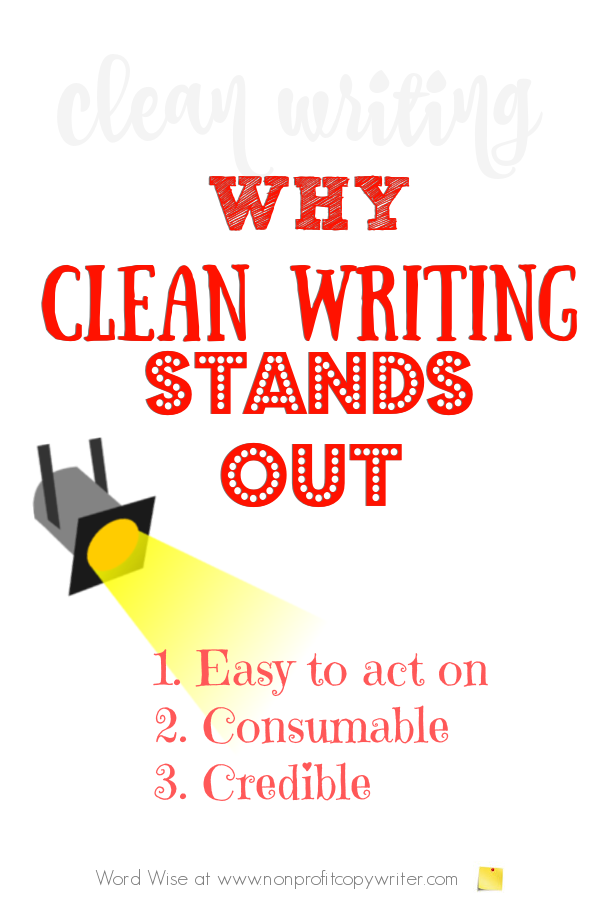
Why clean writing stands out
Every day, the average adult reads 1-4 articles and 60–150 written messages (if you count SMS, email, and notifications). Plus, there are forms … ads … recipes … memos from a child’s teacher … print mail … instruction manuals … books…
That’s a lot of words competing with yours to be understood, whether it’s on the web, in social media, or in print. Clean writing stands out because …
- It’s easier to act on than complex writing. Studies show that when dense text is rewritten in plain language, readers are 20% more likely to use the information.
- It’s more consumable than complex writing. Usability research shows people read only 20–28% of the words on a typical web page. All that complicated mumbo-jumbo you include? It gets ignored. Which just proves that …
- It boosts your credibility. Expert analysis shows that simple language makes the writer more trustworthy and authoritative in readers’ eyes … not less.
Clean writing isn’t just a style choice. It’s an evidence-backed way to communicate so readers stay with you. And who doesn’t want that?
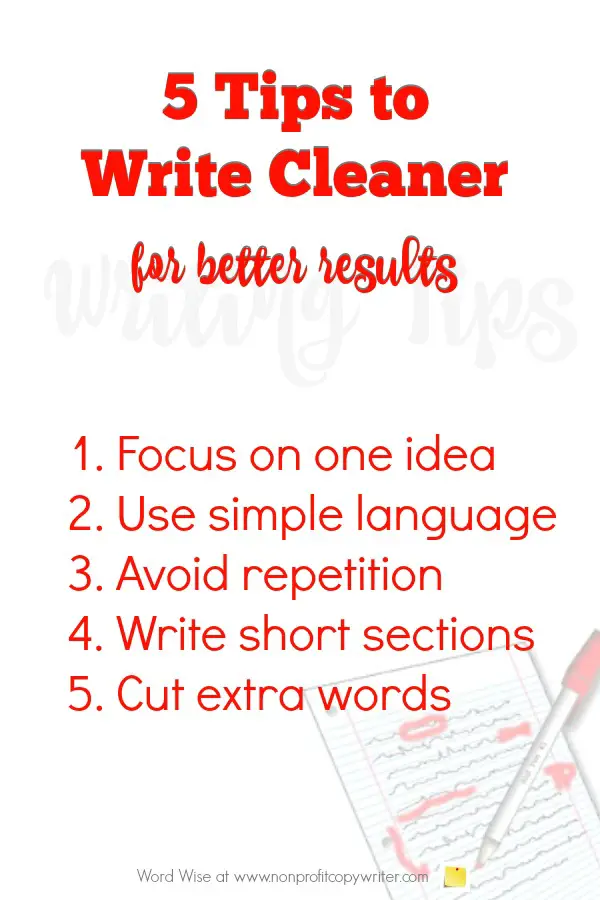
5 simple
ways to write cleaner right now
You can get started right now by using your current writing project to learn clean writing principles. Use these five simple tips.
1. Focus on one idea
Consumers are bombarded with distractions. The best way to focus your message is to identify the purpose of your writing project.
Are you announcing an update of your organization’s activities? Sharing information in an article or essay? Thanking a client for a sale? Soliciting a donation? Asking for a grant? Clarify the purpose of your piece of content.
State your main idea upfront, at the top of your piece. Use the rest of your content to support it. Readers stay with writing that tells them quickly what matters and why they should care.
Writing tip: Summarize the message of your piece in one sentence. Make sure every bit of writing supports or advances your summary sentence.
2. Use simple language
People read for information. They don’t want to work hard to understand what you’re saying. If you can use a 10-cent word instead of a 10-dollar word, do so. Think, “total” rather than “aggregate,” “cut” rather than “eliminate,” “use” rather than “utilize.”
Writing tip: Read your piece aloud. Does it read the way you talk? If not, replace words you never use in everyday conversation.
3. Avoid repetition
Repetitive writing obscures your point. Worse, it wastes your reader’s time.
Look for repeated ideas. Do you try to beef up your writing by saying the same thing several different ways? That technique will bore your reader and make him think your content is fluff. He’ll click off your site, turn the page to a different article, toss your letter into the trash can, or scroll to the next post.
Writing tip: Check for one idea per sentence, one main point per paragraph. Make sure none of these duplicates another. To write cleaner, combine thoughts where there is overlap.
4. Write in short sections
Use a structure that readers can see. Visual organization helps readers scan, understand, and remember your content. They like information quick and tight.
- Break text into short paragraphs.
- Add subheads.
- List ideas with bullet points.
- Use short sentences, paragraphs, and sections. Aim for an average of 15–20 words per sentence, and break long thoughts into two shorter ones. Readers process shorter content more quickly and retain it better.
- Make sure there’s plenty of white space on your document.
- Keep paragraph length to five lines or less.
Writing tip: Use the breath test. Can you read a sentence or a paragraph in one breath? If the answer is no, then break it into sections.
5. Cut out unnecessary words
Read each and every sentence slowly. Check to see if every word is absolutely essential. Make use of the “delete” key where needed.
Or … read each sentence. Check every word. Use the “delete” key where needed.
Remove ideas that don’t move the message forward. Clean writing is the result of good trimming.
Writing tip: Pare down your piece to its bare bones. Does it still get your point across? Go back and read it one more time … and strike for any additional, remaining unessential words.
Write
cleaner, no matter how long your content
Is the “write cleaner” principle possible only in short content?
Long-form content – a written project that clocks in at 1,200 words or more – is favored online these days because it earns search engines’ favor. Books, too, are long-form content. General nonfiction averages 60,000-90,000 words. Novels clock in at 70,000 – 100,000 words. Even novellas are at minimum of 20,000 words. Must long-form projects be relegated to the “hard-to-consume” pile?
No. “Length” is not synonymous with “complicated.”
A 3,000-word online guide or a 50,000-word nonfiction book can still be clear, scannable, and engaging … if you follow simple clean writing principles.
- Make a well-defined point.
- Organize your ideas.
- Use plain language, avoid repetition, and cut out excess.
Bottom line: write cleaner – no matter what project you create. Then, your readers will be able to understand and use what you say.
Which is the point of writing that piece of content, after all.
More Tips for Self-Editing
Write Simply: Avoid 3 obstacles that keep you from being readable ...
Simplify Your Writing: Why Word Choice Matters ...
Want Clear Writing? Make It Short ...
Slay Superlatives to Show, Rather Than Tell ...
Write First, Edit Later: Stop Editing While Writing With These Tips ...
11 Weak Words to Avoid in Writing ...
How to Write Better Bullet Points ...
Self-Editing: Swap Out These 7 Overused Writing Words ...
3 Great Reasons to Use an Online Word Count Tool ...
Quick Tip to Get Started Writing Strong Each Day ...
5 copywriting fixes to make you sound professional ...
Easy copywriting tips anyone can master ...
Parallel Construction Explained: a simple mark of quality content writing ...
Weed out weasel words for stronger writing ...
Write better descriptions when you ditch these 2 words ...
The simplest, best copywriting tip ...
Readability check: an easy way to make your writing cleaner ...
Self-Editing Tip: Start a sentence with the subject, not extra words ...
Exclamation Point?! When in Doubt, Leave It Out ...
Passive voice: it's an easy fix with this writing tip ...
Basic copywriting: what is it and who you need it ...
More editing tips on our Pinterest board ...
Return from Write Cleaner for Better Results to Nonprofit Copywriter home
As an Amazon Associate I earn from qualifying purchases.
Share This Page

Named to 2022 Writer's Digest list
BEST GENRE/NICHE WRITING WEBSITE
Stop Wasting Time!
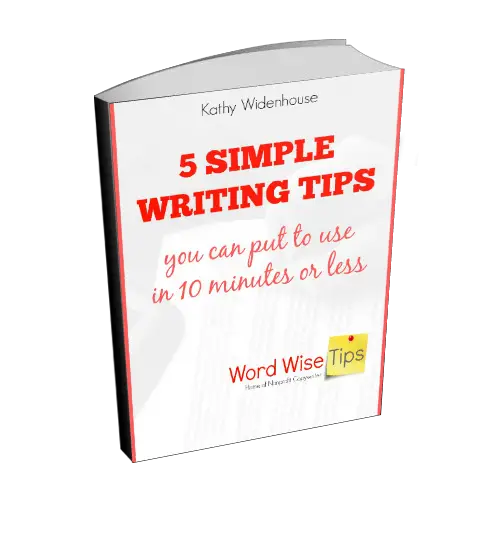
Grab your exclusive FREE guide, "5 Simple Writing Tips You Can Put to Use in 10 Minutes or Less"
 Subscribe To This Site