Save Time: Get 5 Simple Writing Tips
you can put to use in 10 minutes
Write a Call to Action in 3 Words or Less
Award-winning writer Kathy Widenhouse has written 9 books and garnered 800K+ views for her writing tutorials.
Updated 10.19.26
When it’s time to write a call to action, you may hit a writing roadblock.
Because it's awkward.
Your call to action (CTA) tells your reader what to do as a result of reading your post, letter, or email. You ask her for money or time or permission to invade her personal space and you may be stumped about what to say.
Because for many of us, it’s hard to ask for something.
Here’s a helpful writing tip to get you over that hump: use fewer words.
Three or less should do it.

You need just 3 words ... or less
Three words. That’s all you need to get a reader to click a link, download a resource, sign up for your newsletter, or buy your product.
Sometimes you need just two.
Think about the calls to action (CTAs) you encounter every day:
- Shop Now
- Learn More
- Get Started
- Download Your Guide
- Join Us
- Try It Free
- Donate Today
They’re short. They’re direct. And they leave little doubt about what you’re supposed to do next.
That’s the beauty of a three-word call to action. It cuts through the clutter and gives your reader one simple instruction.
But here’s the catch: writing a short CTA isn’t necessarily easy. In fact, those two or three little words may be some of the most important words you write.
Here’s why short CTAs work.
What makes a 3-word call to action so powerful?
A call to action is simply an invitation or instruction that encourages your reader to take the next step.
That step might be small, like clicking a link to read another article. Or it might be significant, like making a donation or purchasing a $500 course.
Either way, your CTA has one job: move your reader from thinking to doing.
And often, the fewer words you use, the easier that becomes because …
1. Short CTAs are easy to understand
Your reader is busy. She’s scrolling through her inbox, skimming a website, or glancing at a social media post. She doesn’t want to work hard to figure out what to do next.
Compare these two calls to action:
If you’d like to learn more about our free writing resources, please click the button below to explore what’s available.
Or:
Explore Free Resources
Which one is easier to understand at a glance? Yep. The second CTA eliminates the extra language and tells your reader exactly what to do.
2. Short CTAs stand out visually
White space is your friend, especially when you’re writing online.
A two- or three-word CTA fits neatly into a button, stands out at the end of a paragraph, and is easy to spot on a crowded page. Shorter copy is easier to scan and gives a clear focal point.
Compare these.
- Click Here to Download Your Free Copy of Our Helpful Guide
- Get Your Guide
The second version is more compact. It’s easier to read. And it tells the reader what she’ll get. This is particularly important on mobile devices, where screen space is limited.
3. Short CTAs reduce hesitation
Every extra word gives your reader another piece of information to process.
That doesn’t mean longer CTAs are always less effective. But when the next step is simple, a short instruction can help the reader make a quick decision.
Consider: Start Free Trial
The reader immediately knows what action to take.
Or: See Pricing
There’s no mystery about what happens next.
The trick is to make the next step feel clear and manageable, not confusing or overwhelming.
Get the course and have your letter done this afternoon.
The secret to writing a CTA in three words or less
The point is to get your reader to take action. She may take more than one action, of course. But your words focus on getting her to take one specific step. Choose that step as the goal when you write your call to action. Do that by completing this sentence:
I want my reader to …
Now, here’s a simple formula you can use to write your quickie CTA:
Action Verb + Benefit or Object
Start with a strong action verb. Then add one or two words that identify what the reader will get or do. That’s it. For example …
- Download Your Checklist
- Build Your Website
- Find More Clients
- Save Your Seat
- Improve Your Writing
- Get Writing Tips
- Support Local Families
Notice something else? Most of these CTAs focus on the reader, rather than the business. They tell the reader what she can accomplish. And that’s an important distinction.
Submit describes what the website wants.
Get Your Guide describes what the reader wants.
Whenever possible, write your CTA from the reader’s point of view.
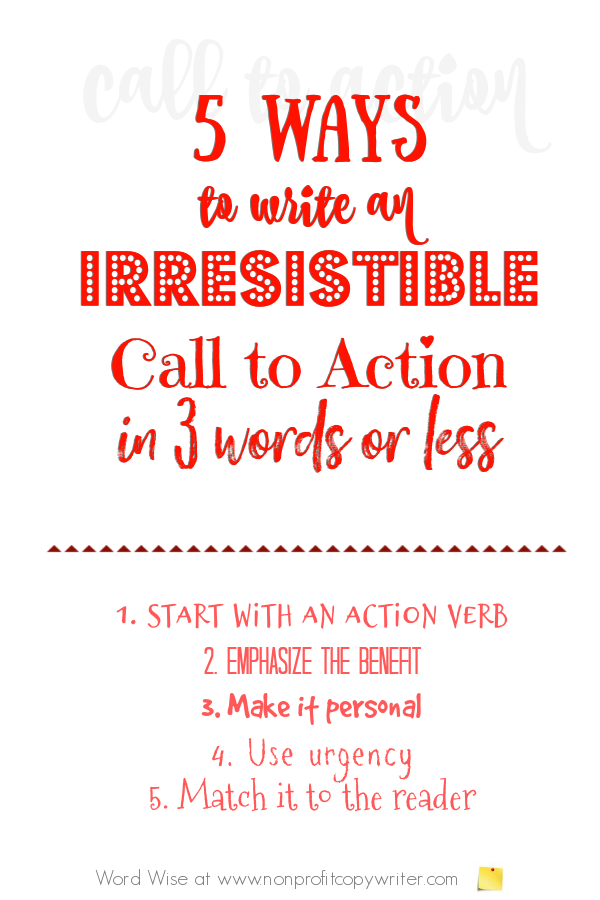
5 ways to make a three-word CTA irresistible
1. Start with an action verb
Your CTA should tell the reader to do something. Use a strong action verb like get, start, join, discover, download, explore, save, find, try, build, or give.
Compare Our Newsletter with Get Weekly Tips.
The first is a label. The second is an invitation to act.
2. Emphasize the benefit
People don’t click buttons just because you ask them to. They click because they expect something worthwhile on the other side.
Consider these examples:
Ordinary CTA (left) and Benefit-focused CTA (right)
- Click Here versus Get Free Tips
- Submit versus Send My Guide
- Sign Up versus Join Free
- Read More versus Discover Writing Secrets
- Buy Now versus Get Your Planner
- Donate versus Help Local Families
The revised versions give readers more information about the value of taking action.
Note: Just make sure the benefit is genuine. If you promise a free guide, the guide really should be free.
3. Make it personal
Sometimes one little word can make your CTA more appealing. That word is your.
Compare Download Guide with Download Your Guide.
The second sounds more personal. It helps readers picture the resource as something intended for them.
You can also experiment with first-person wording, using my:
- Start My Trial
- Get My Copy
- Save My Spot.
First-person language can make the action feel more immediate, although it won’t necessarily outperform second-person wording in every situation.
4. Use urgency when it’s real
Urgency gives readers a reason to act sooner rather than later. For example …
- Register By Friday
- Claim Your Discount
- Enroll Before Midnight
- Donate By December 31
- Reserve Your Spot
Warning: Don’t manufacture urgency. If your offer doesn’t expire, don’t pretend it does. A false deadline can damage trust far more than it improves conversions.
5. Match your CTA to the reader
Not everyone who visits your website is ready to buy. Some readers are curious. Others are comparing options. Still others are ready to pull out their credit cards.
Your CTA should match where they are in that decision-making process.
- A first-time visitor might respond to Explore Our Services.
- Someone evaluating a product might prefer See Customer Reviews.
- A reader ready to purchase needs the nudge to Buy Your Copy.
The best CTA isn’t necessarily the most aggressive one. It’s the one that makes sense as the reader’s next step.
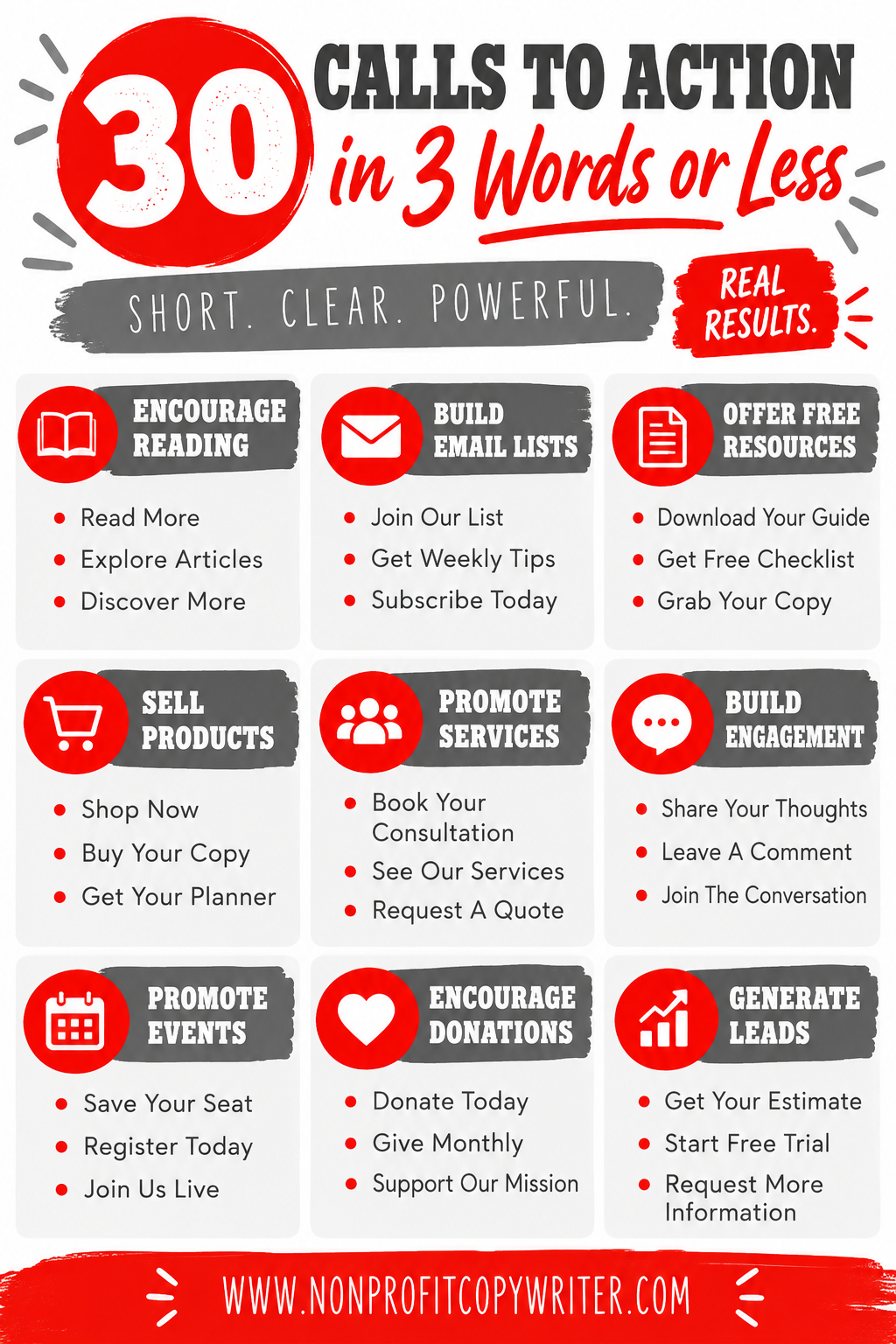
30 calls to action in three words or less
Need a little inspiration? Here are 30 short CTAs you can adapt for your own writing (above). Use these as starting points, rather than guaranteed winners. The words that work best depend on your audience, your offer, and the context surrounding your CTA.
Where should you use a three-word CTA?
Short calls to action work especially well where readers need to make a quick decision. Think email newsletters, landing pages, website navigation, product listings, digital ads, social media posts, and downloadable resource promotions.
They’re particularly useful on buttons, where every word takes up valuable space.
But don’t overlook their usefulness in ordinary text. Suppose you’re writing a blog post about organizing a content calendar. You explain the benefits of planning ahead, provide several practical tips, and offer readers a downloadable template. You might close with ...
Ready to stop scrambling for content ideas? My printable calendar helps you plan your next month of posts in minutes. Get Your Calendar.
The surrounding copy explains the value. The CTA simply tells readers what to do next.
It’s a useful one-two punch. Which leads me to this important point ...
The biggest mistake writers make with short CTAs
Don’t try to make the CTA do all the work.
Your call to action is only one part of your message. Your headline attracts attention … your content or copy builds interest … your examples and evidence establish credibility … your offer explains the benefit.
Then your CTA tells the reader what to do. So don’t squeeze your entire sales pitch into three words. Here’s an example.
Not sure whether your email subject lines are helping or hurting your open rates? Use this free checklist to spot common mistakes before you hit Send. Get your checklist.
The short CTA works because the preceding copy has already answered the reader’s questions. The linked text doesn’t need to repeat the explanation.
More FREE tips for writing tight and short.
When three words aren’t enough
Short CTAs are useful, but three words aren’t a magic number. Sometimes clarity requires four, five, or even more words.
For example, Start Now might be too vague if the reader doesn’t understand what happens next. Start Your Free 14-Day Trial is longer, but it communicates an important detail.
Don’t sacrifice clarity just to meet an arbitrary word count. A vague two-word CTA can perform worse than a clear six-word one.
The only reliable way to know which wording works best for your audience is to test it. Try two versions of the same CTA, keep the surrounding offer and design consistent, and compare the percentage of readers who take the intended action.
A quick exercise: Can you cut your CTA to three words?
Try this with your next blog post, sales page, or email. Take your current call to action and ask yourself three questions:
- What’s the one action I want my reader to take? Choose a verb that describes it.
- What’s the main benefit or object? Identify what the reader will get, discover, or accomplish.
- What can I eliminate? Remove filler words without sacrificing clarity. For example …
Click on the link below to receive your free copy of our beginner’s guide to freelance writing.
Becomes …
Get Your Guide
Now try writing three versions of your CTA. Read them aloud. Which one sounds most natural? Which one tells readers exactly what they’ll get? Start there.
Three words. One action.
Good writing isn’t about using the fewest words possible. It’s about using the right words to accomplish your purpose.
And nowhere is that more important than in your call to action. Its job is to tell the reader what to do next.
You can write a wonderful article, craft an irresistible offer, and explain every benefit beautifully. But if your reader doesn’t know what step to take, your message may fall flat.
A short, clear CTA helps bridge that gap.
So the next time you’re tempted to write a long, complicated instruction, challenge yourself to cut it down.
Start with a verb. Focus on the reader. Make the next step obvious. Three words might be all you need. Like …
Start Writing Now.
More Writing Tips for Making The Ask
Free Download: a Simple (and Powerful) Fundraising Letter Template ...
Write a Winning Fundraising Letter in 2 Hours or Less ...
Call to Action: Have You Told Your Reader What to Do?
Top 10 Mistakes to Avoid in Your Direct Mail Fundraising Letter ...
5 Opening Lines for Fundraising Messages ...
Two writing tips for making the ask ...
Use These Call To Action Examples to Move Readers to Act ...
12 Tips for Writing Winning Asks: use these templates to show benefits ...
What your fundraising letter must have ...
How to write a P.S. with punch ...
The anatomy of a strong email campaign ...
6 elements in a successful appeal letter writing format ...
5 Deadly Nonprofit Fundraising Mistakes in Your Content ...
More fundraising ask tips on our Pinterest board ...
Return from Write a Call to Action in 3 Words or Less
to Nonprofit Copywriter home
As an Amazon Associate I earn from qualifying purchases.
Share This Page
Named to 2022 Writer's Digest list
BEST GENRE/NICHE WRITING WEBSITE


Stop Wasting Time!
Grab your exclusive FREE guide, "5 Simple Writing Tips You Can Put to Use in 10 Minutes or Less"
 Subscribe To This Site