
Save Time: Get 5 Simple Writing Tips
you can put to use in 10 minutes
How To Get Ideas for Writing – and Never Run Out
Award-winning writer Kathy Widenhouse has written 9 books and garnered 800K+ views for her writing tutorials.
Posted 1.21.26
“Ideas are all around you.” My first writing instructor drilled that principle into my head. Yet I felt deficient rather than encouraged. If ideas were all around me, why couldn’t I grasp them?
Perhaps you’re among the majority of writers (old and new) who struggle to generate ideas. Envy bubbles up at the select few — they overflow with fresh angles on worn topics.
As a content writer, I wanted to know their secret for how to get ideas. How could I produce content if I could not come up with a single thought to write about?
That is, until I learned that getting ideas for my writing had nothing to do with a sprinkle of Idea Fairy Dust bestowed on select creatives. Nor did getting ideas rest on the intellectually superior who barely touch down on earth in time to jot down their profound contemplations for mere mortals to consume.
Getting ideas is not a special ability bestowed at birth. Instead, it’s a mindset — a way of thinking — that I can cultivate. And you can, too.
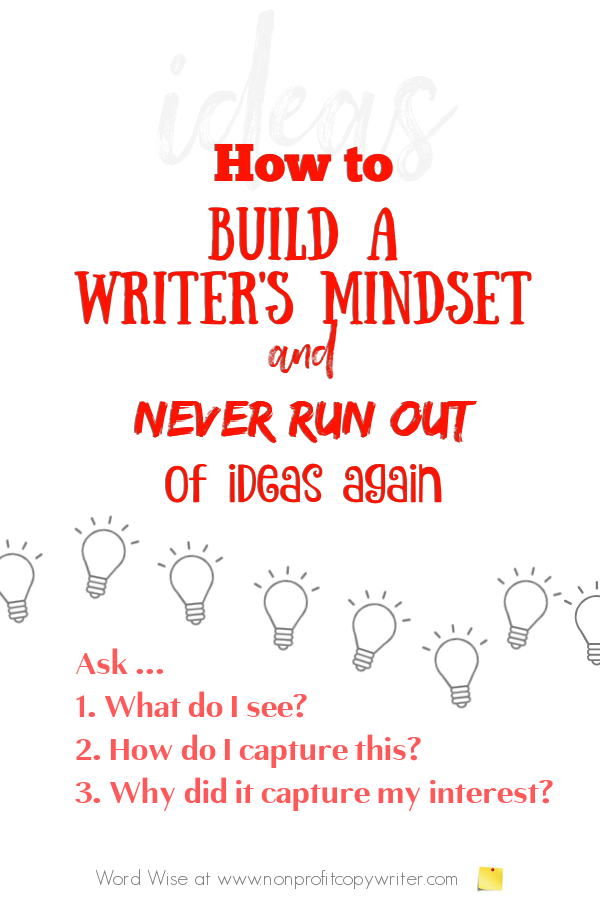
How to get ideas: build a writer’s mindset
1. Pay attention
Ask, “What do I see?”
The first step to develop an idea-gathering mindset? Notice the world around you.
Ask, “What do I see?” View everything in your daily life as a potential idea. Nothing is off-limits: family, friends, neighbors, pets, experiences, school, errands, work, hobbies, chores, and news.
Pay attention, and you’ll find that soon, your mind gets snagged on a simple thought. Maybe it’s a phrase, comment, observation, experience, quote, mistake, opinion, conflict, question, conversation, mix up …
For instance, let’s say you are at the playground. A young father is playing with his son. For whatever reason, the scene captures your attention. You watch them for a minute or two, noting what they wear and how they talk with each other. You jot down “family — dad and child — playground” in your phone app.
You’ve just recorded an idea — a kernel of a thought. It has captured your attention because you were intentionally paying attention.
Your idea doesn’t need to be a full-blown novel, a 500-word article, or even a quick social media post. In fact, it shouldn’t be. Developing your idea comes later. What you are looking for are sparks that are interesting to you or rouse your curiosity, leading you to want to know more.
When you develop a writer’s mindset ...
- You look at life through a different set of glasses.
- You practice, and you realize that getting ideas doesn’t happen by chance.
- You learn how to get ideas by working your attention muscle.
2. Record your idea
Ask, “How do I capture this idea?”
Ideas don’t disappear because you lack them. They disappear because you don’t catch them.
Find a way to collect your ideas in an app, voice memo, computer file, journal, notepad, sticky notes, or on index cards. Experiment. Your system doesn’t need to be fancy. It simply needs to be right for you.
If a method works, stay with it. If it’s too inconvenient or you don’t use it, try another. Keep at it until you find one.
In doing so, you create a parking lot (call it a swipe file or inspiration bank) where you can safely leave your ideas. Record enough from your seed thought so you can process it later.
3. Unpack your idea
Ask, “Why did that idea capture my attention?”
Once you have a seed thought and you’re ready to examine it, allow your curiosity to take over. You can take this step at your computer … or not. I often process my ideas while sitting in the car.
Ask, “Why did that idea capture my attention?” The answer to that question is uniquely yours. I will come up with a different answer than you when I think about the same phrase, comment, observation, experience, quote, mistake, opinion, conflict, question, conversation, mix up …
Let’s go back to our example of “family.” Remember the dad and child on the swing set? Ask yourself, “Why did that idea capture my attention?”
That question generates all kinds of ideas, depending on your background … your life experiences … what concerns you at the moment. You may answer that question in one or more ways, such as …
- My dad didn’t have time to play with me because he worked 2 jobs. Why does this dad have the time? How many parents must work extra these days, just to pay their bills?
- My brother is a single dad. Perhaps this dad has custody of his child. How many single fathers nationwide are custodial parents, and how does that impact the father? The child? The mother? The extended family?
- I see students in my classroom who don’t have a father in their lives. How can others “fill in the gaps” for those children?
- My husband plays with our children at the playground. What can I do to encourage and support him in that? What are the benefits of father-child interaction in child development?
- I know a dozen single mothers. How do they find healthy male adult role models for their children?
You’re not looking for a complete project outline. You’re examining what triggered you to capture that one idea and then investigate it further. Research, your main idea, the project structure — all that comes later.

Find your content's main idea before you write with this worksheet.
Your ideas are unique to you
It may be easy to toss off an idea by thinking, “Everybody gets that idea. It’s not special.” Wrong. You have a set of life circumstances, relationships, experiences, and viewpoints that are unique to you.
Back to the idea of “family" ...
- Some see “family” as a mom and a child.
- Others have experienced a clan of dozens.
- Still others shudder at the word, given their conflicts in the home.
- To a different group, “family” evokes warm fuzzies around the kitchen table. The image of a father playing with a child at the playground is not original. But the way you see it offers an innovative slant.
Getting good ideas is a numbers game
What if you generate a crummy idea?
Do the math. When your mind seizes on just one idea per day, by the end of one year, you will have 365 ideas. Even if you use only 10% of them, you’ll have 36 content seeds that are one-of-a-kind to you.
How one writer gets ideas
Author and speaker Beth Moore buys into the “it-grabbed-my-attention” principle for generating ideas. When her mind gets stuck on one phrase or principle, she investigates. Often, it’s a simple idea that leads to a book or presentation.
Once, she became fixated on the phrase “the slimy pit.” She soaked herself in that set of words and let it marinate. That one idea led to Get Out Of That Pit (2007), an entire book devoted to getting out of life’s “pits” of despair, trouble, and hopelessness.
How to never run out of ideas again
“There is nothing new under the sun.” So wrote King Solomon, the 10th-century BC monarch reputed to be the wisest man who ever lived.
But while ideas are not new, the way you view them is.
Pay attention. You’ll notice certain images or words stick in your mind. Jot them down. Let each one simmer and grow, generating dozens more through your one-of-a-kind filter.
And you’ll never run out of ideas again.
More on How To Get Ideas
Capturing Ideas for Writing Projects ...
12 Places to Look for Story Writing Ideas ...
Where to Look for Ideas for Devotionals ...
How to find the main idea of your piece before you write ...
21 Ways To Beat Writer's Block and Jumpstart Your Project
Pre-Writing: 4 Easy Steps to Make Your Writing Go Faster ...
Tips about the Writing Process on our Pinterest board ...
Return from How To Get Ideas and Never Run Out
to Nonprofit Copywriter home
As an Amazon Associate I earn from qualifying purchases.
Share This Page

Named to 2022 Writer's Digest list
BEST GENRE/NICHE WRITING WEBSITE



Stop Wasting Time!
Grab your exclusive FREE guide, "5 Simple Writing Tips You Can Put to Use in 10 Minutes or Less"
 Subscribe To This Site